

96 unifying physics of accelerators, lasers and plasma
FIGURE 5.31
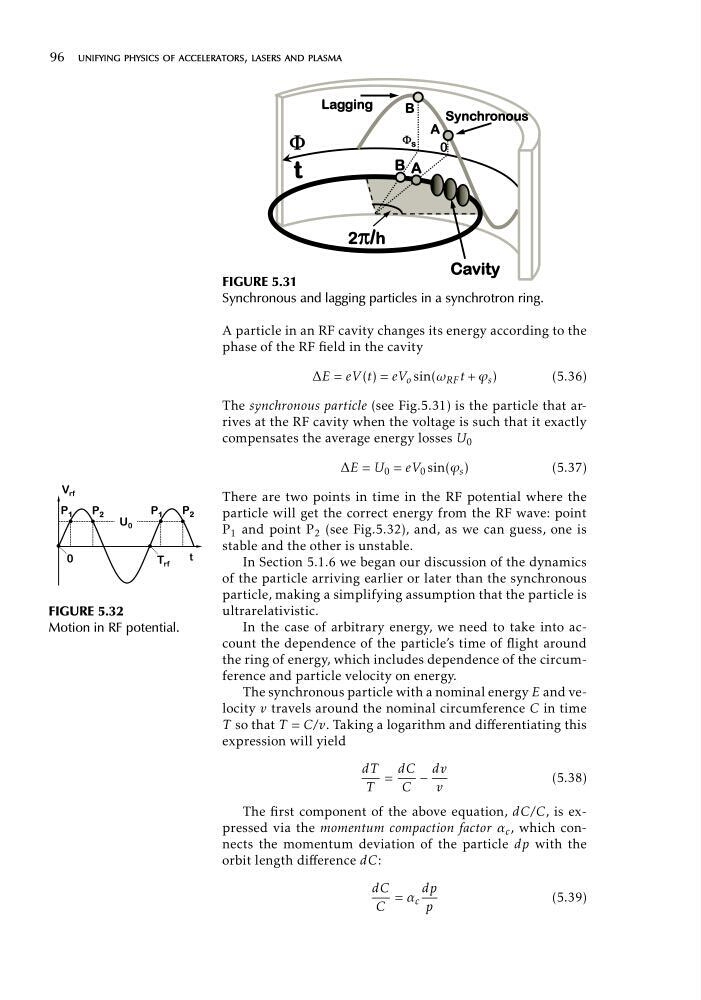
FIGURE 5.32
Motion in RF potential.
Synchronous and lagging particles in a synchrotron ring.
A particle in an RF cavity changes its energy according to the
phase of the RF field in the cavity
ΔE = eV (t) = eV o sin(ω RF t + ϕ s )
(5.36)
The synchronous particle (see Fig.5.31) is the particle that arrives at the RF cavity when the voltage is such that it exactly
compensates the average energy losses U 0
ΔE = U 0 = eV 0 sin(ϕ s )
(5.37)
There are two points in time in the RF potential where the
particle will get the correct energy from the RF wave: point
P 1 and point P 2 (see Fig.5.32), and, as we can guess, one is
stable and the other is unstable.
In Section 5.1.6 we began our discussion of the dynamics
of the particle arriving earlier or later than the synchronous
particle, making a simplifying assumption that the particle is
ultrarelativistic.
In the case of arbitrary energy, we need to take into account the dependence of the particle’s time of flight around
the ring of energy, which includes dependence of the circumference and particle velocity on energy.
The synchronous particle with a nominal energy E and velocity v travels around the nominal circumference C in time
T so that T = C/v. Taking a logarithm and differentiating this
expression will yield
dT dC dv
=
−
(5.38)
T
C
v
The first component of the above equation, dC/C, is expressed via the momentum compaction factor α c , which connects the momentum deviation of the particle dp with the
orbit length difference dC:
dC
dp
= α c
(5.39)
C
p
FIGURE 5.31
FIGURE 5.32
Motion in RF potential.
Synchronous and lagging particles in a synchrotron ring.
A particle in an RF cavity changes its energy according to the
phase of the RF field in the cavity
ΔE = eV (t) = eV o sin(ω RF t + ϕ s )
(5.36)
The synchronous particle (see Fig.5.31) is the particle that arrives at the RF cavity when the voltage is such that it exactly
compensates the average energy losses U 0
ΔE = U 0 = eV 0 sin(ϕ s )
(5.37)
There are two points in time in the RF potential where the
particle will get the correct energy from the RF wave: point
P 1 and point P 2 (see Fig.5.32), and, as we can guess, one is
stable and the other is unstable.
In Section 5.1.6 we began our discussion of the dynamics
of the particle arriving earlier or later than the synchronous
particle, making a simplifying assumption that the particle is
ultrarelativistic.
In the case of arbitrary energy, we need to take into account the dependence of the particle’s time of flight around
the ring of energy, which includes dependence of the circumference and particle velocity on energy.
The synchronous particle with a nominal energy E and velocity v travels around the nominal circumference C in time
T so that T = C/v. Taking a logarithm and differentiating this
expression will yield
dT dC dv
=
−
(5.38)
T
C
v
The first component of the above equation, dC/C, is expressed via the momentum compaction factor α c , which connects the momentum deviation of the particle dp with the
orbit length difference dC:
dC
dp
= α c
(5.39)
C
p