

conventional acceleration 85
G
K
D
E
FIGURE 5.19
Iris-loaded accelerating structure.
)
The dispersion relation in a waveguide ω = c k z
2 + (2π/λ c )
2
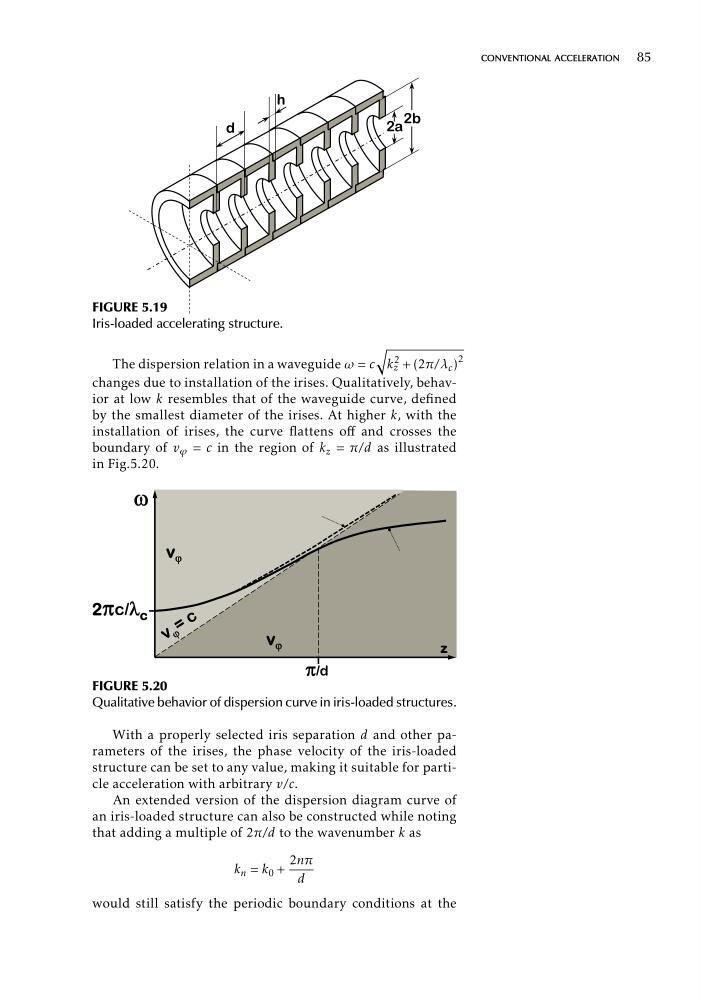
changes due to installation of the irises. Qualitatively, behavior at low k resembles that of the waveguide curve, defined
by the smallest diameter of the irises. At higher k, with the
installation of irises, the curve flattens off and crosses the
boundary of v ϕ = c in the region of k z = π/d as illustrated
in Fig.5.20.
8QGLVWXUEHG
VWUXFWXUH
!F
'LVFORDGHG
VWUXFWXUH
F
F
N
G
FIGURE 5.20
Qualitative behavior of dispersion curve in iris-loaded structures.
With a properly selected iris separation d and other parameters of the irises, the phase velocity of the iris-loaded
structure can be set to any value, making it suitable for particle acceleration with arbitrary v/c.
An extended version of the dispersion diagram curve of
an iris-loaded structure can also be constructed while noting
that adding a multiple of 2π/d to the wavenumber k as
2nπ
k n = k 0 + d
would still satisfy the periodic boundary conditions at the
G
K
D
E
FIGURE 5.19
Iris-loaded accelerating structure.
)
The dispersion relation in a waveguide ω = c k z
2 + (2π/λ c )
2
changes due to installation of the irises. Qualitatively, behavior at low k resembles that of the waveguide curve, defined
by the smallest diameter of the irises. At higher k, with the
installation of irises, the curve flattens off and crosses the
boundary of v ϕ = c in the region of k z = π/d as illustrated
in Fig.5.20.
8QGLVWXUEHG
VWUXFWXUH
!F
'LVFORDGHG
VWUXFWXUH
F
F
N
G
FIGURE 5.20
Qualitative behavior of dispersion curve in iris-loaded structures.
With a properly selected iris separation d and other parameters of the irises, the phase velocity of the iris-loaded
structure can be set to any value, making it suitable for particle acceleration with arbitrary v/c.
An extended version of the dispersion diagram curve of
an iris-loaded structure can also be constructed while noting
that adding a multiple of 2π/d to the wavenumber k as
2nπ
k n = k 0 + d
would still satisfy the periodic boundary conditions at the