

64
An Introduction to Beam Physics
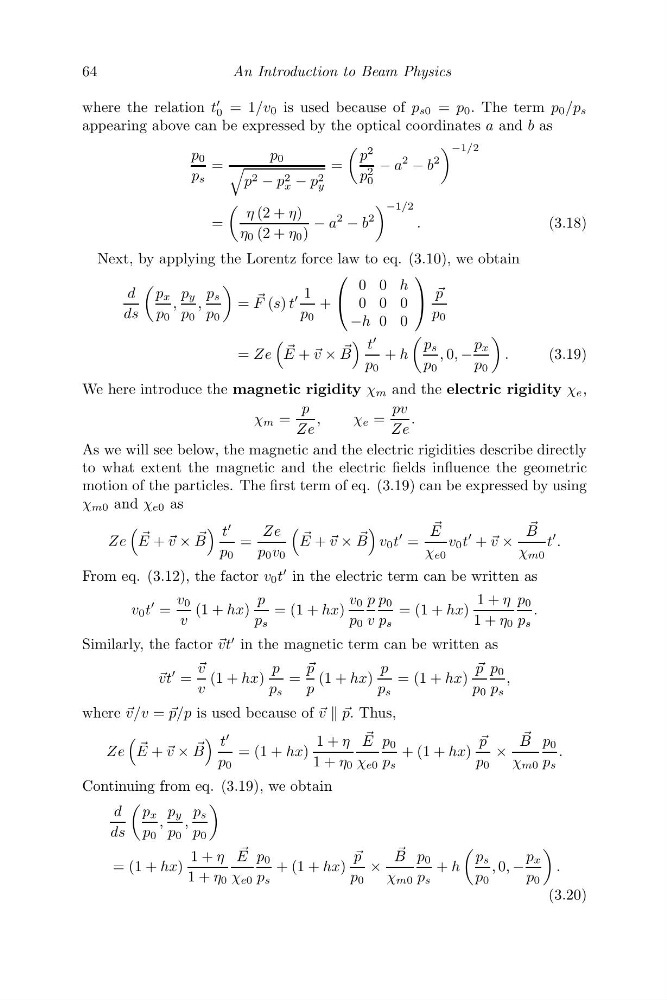
where the relation t
0 = 1/v 0 is used because of p s0 = p 0 . The term p 0 /p s
appearing above can be expressed by the optical coordinates a and b as
p 0
p s
=
p 0
p 2 − p 2
x − p 2
y
=
p
2
p 2
0
− a
2
− b
2
−1/2
=
η (2 + η)
η 0 (2 + η 0 )
− a
2
− b
2
−1/2
.
(3.18)
Next, by applying the Lorentz force law to eq. (3.10), we obtain
d
ds
p x
p 0
,
p y
p 0
,
p s
p 0
=
F (s) t
1
p 0
+
⎛
⎝
0 0 h
0 0 0
−h 0 0
⎞
⎠
p
p 0
= Ze
E + v ×
B
t
p 0
+ h
p s
p 0
, 0, −
p x
p 0
.
(3.19)
We here introduce the magnetic rigidity χ m and the electric rigidity χ e ,
χ m =
p
Ze
,
χ e =
pv
Ze
.
As we will see below, the magnetic and the electric rigidities describe directly
to what extent the magnetic and the electric fields influence the geometric
motion of the particles. The first term of eq. (3.19) can be expressed by using
χ m0 and χ e0 as
Ze
E + v ×
B
t
p 0
=
Ze
p 0 v 0
E + v ×
B
v 0 t
=
E
χ e0
v 0 t
+ v ×
B
χ m0
t
.
From eq. (3.12), the factor v 0 t
in the electric term can be written as
v 0 t
=
v 0
v
(1 + hx)
p
p s
= (1 + hx)
v 0
p 0
p
v
p 0
p s
= (1 + hx)
1 + η
1 + η 0
p 0
p s
.
Similarly, the factor vt
in the magnetic term can be written as
vt
=
v
v
(1 + hx)
p
p s
=
p
p
(1 + hx)
p
p s
= (1 + hx)
p
p 0
p 0
p s
,
where v/v =
p/p is used because of v
p. Thus,
Ze
E + v ×
B
t
p 0
= (1 + hx)
1 + η
1 + η 0
E
χ e0
p 0
p s
+ (1 + hx)
p
p 0
×
B
χ m0
p 0
p s
.
Continuing from eq. (3.19), we obtain
d
ds
p x
p 0
,
p y
p 0
,
p s
p 0
= (1 + hx)
1 + η
1 + η 0
E
χ e0
p 0
p s
+ (1 + hx)
p
p 0
×
B
χ m0
p 0
p s
+ h
p s
p 0
, 0, −
p x
p 0
.
(3.20)
An Introduction to Beam Physics
where the relation t
0 = 1/v 0 is used because of p s0 = p 0 . The term p 0 /p s
appearing above can be expressed by the optical coordinates a and b as
p 0
p s
=
p 0
p 2 − p 2
x − p 2
y
=
p
2
p 2
0
− a
2
− b
2
−1/2
=
η (2 + η)
η 0 (2 + η 0 )
− a
2
− b
2
−1/2
.
(3.18)
Next, by applying the Lorentz force law to eq. (3.10), we obtain
d
ds
p x
p 0
,
p y
p 0
,
p s
p 0
=
F (s) t
1
p 0
+
⎛
⎝
0 0 h
0 0 0
−h 0 0
⎞
⎠
p
p 0
= Ze
E + v ×
B
t
p 0
+ h
p s
p 0
, 0, −
p x
p 0
.
(3.19)
We here introduce the magnetic rigidity χ m and the electric rigidity χ e ,
χ m =
p
Ze
,
χ e =
pv
Ze
.
As we will see below, the magnetic and the electric rigidities describe directly
to what extent the magnetic and the electric fields influence the geometric
motion of the particles. The first term of eq. (3.19) can be expressed by using
χ m0 and χ e0 as
Ze
E + v ×
B
t
p 0
=
Ze
p 0 v 0
E + v ×
B
v 0 t
=
E
χ e0
v 0 t
+ v ×
B
χ m0
t
.
From eq. (3.12), the factor v 0 t
in the electric term can be written as
v 0 t
=
v 0
v
(1 + hx)
p
p s
= (1 + hx)
v 0
p 0
p
v
p 0
p s
= (1 + hx)
1 + η
1 + η 0
p 0
p s
.
Similarly, the factor vt
in the magnetic term can be written as
vt
=
v
v
(1 + hx)
p
p s
=
p
p
(1 + hx)
p
p s
= (1 + hx)
p
p 0
p 0
p s
,
where v/v =
p/p is used because of v
p. Thus,
Ze
E + v ×
B
t
p 0
= (1 + hx)
1 + η
1 + η 0
E
χ e0
p 0
p s
+ (1 + hx)
p
p 0
×
B
χ m0
p 0
p s
.
Continuing from eq. (3.19), we obtain
d
ds
p x
p 0
,
p y
p 0
,
p s
p 0
= (1 + hx)
1 + η
1 + η 0
E
χ e0
p 0
p s
+ (1 + hx)
p
p 0
×
B
χ m0
p 0
p s
+ h
p s
p 0
, 0, −
p x
p 0
.
(3.20)