

Fields, Potentials and Equations of Motion
65
Finally, we consider the change of the last variable in the particle optical
coordinates, δ. Since by definition it describes the deviation of initial kinetic
energy of the particle of interest, we have
δ
= 0.
(3.21)
Note, however, that since δ describes the deviation from the kinetic energy of
the reference particle before the system, in case there is net acceleration or
deceleration along the orbits, it may be desirable to periodically absorb the
accumulated amounts in the orbit dependent path integral for V in eq. (3.14)
into the variable δ. In the case the motion was merely through a static electric
field, this will entail that δ will depend on positional variables. In the case of
full time dependence as in the motion in RF cavities discussed in Chapter 10,
after the renormalization, δ will depend on all particle optical coordinates.
3.3.2 The Equations of Motion
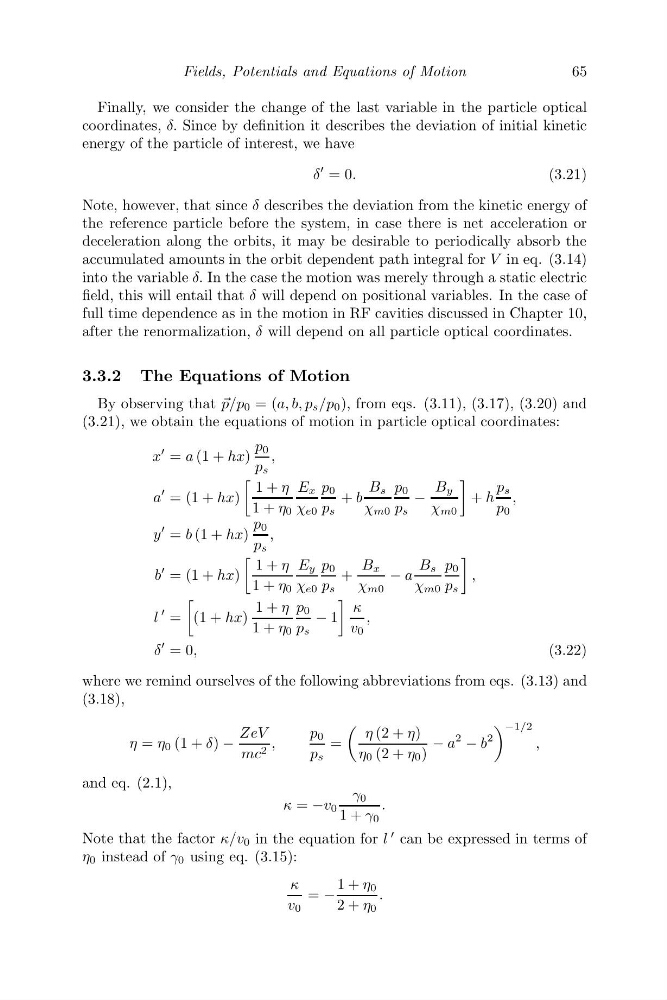
By observing that
p/p 0 = (a, b, p s /p 0 ), from eqs. (3.11), (3.17), (3.20) and
(3.21), we obtain the equations of motion in particle optical coordinates:
x
= a (1 + hx)
p 0
p s
,
a
= (1 + hx)
1 + η
1 + η 0
E x
χ e0
p 0
p s
+ b
B s
χ m0
p 0
p s
−
B y
χ m0
+ h
p s
p 0
,
y
= b (1 + hx)
p 0
p s
,
b
= (1 + hx)
1 + η
1 + η 0
E y
χ e0
p 0
p s
+
B x
χ m0
− a
B s
χ m0
p 0
p s
,
l
=
(1 + hx)
1 + η
1 + η 0
p 0
p s
− 1
κ
v 0
,
δ
= 0,
(3.22)
where we remind ourselves of the following abbreviations from eqs. (3.13) and
(3.18),
η = η 0 (1 + δ) −
ZeV
mc 2 ,
p 0
p s
=
η (2 + η)
η 0 (2 + η 0 )
− a
2
− b
2
−1/2
,
and eq. (2.1),
κ = −v 0
γ 0
1 + γ 0
.
Note that the factor κ/v 0 in the equation for l
can be expressed in terms of
η 0 instead of γ 0 using eq. (3.15):
κ
v 0
= −
1 + η 0
2 + η 0
.
65
Finally, we consider the change of the last variable in the particle optical
coordinates, δ. Since by definition it describes the deviation of initial kinetic
energy of the particle of interest, we have
δ
= 0.
(3.21)
Note, however, that since δ describes the deviation from the kinetic energy of
the reference particle before the system, in case there is net acceleration or
deceleration along the orbits, it may be desirable to periodically absorb the
accumulated amounts in the orbit dependent path integral for V in eq. (3.14)
into the variable δ. In the case the motion was merely through a static electric
field, this will entail that δ will depend on positional variables. In the case of
full time dependence as in the motion in RF cavities discussed in Chapter 10,
after the renormalization, δ will depend on all particle optical coordinates.
3.3.2 The Equations of Motion
By observing that
p/p 0 = (a, b, p s /p 0 ), from eqs. (3.11), (3.17), (3.20) and
(3.21), we obtain the equations of motion in particle optical coordinates:
x
= a (1 + hx)
p 0
p s
,
a
= (1 + hx)
1 + η
1 + η 0
E x
χ e0
p 0
p s
+ b
B s
χ m0
p 0
p s
−
B y
χ m0
+ h
p s
p 0
,
y
= b (1 + hx)
p 0
p s
,
b
= (1 + hx)
1 + η
1 + η 0
E y
χ e0
p 0
p s
+
B x
χ m0
− a
B s
χ m0
p 0
p s
,
l
=
(1 + hx)
1 + η
1 + η 0
p 0
p s
− 1
κ
v 0
,
δ
= 0,
(3.22)
where we remind ourselves of the following abbreviations from eqs. (3.13) and
(3.18),
η = η 0 (1 + δ) −
ZeV
mc 2 ,
p 0
p s
=
η (2 + η)
η 0 (2 + η 0 )
− a
2
− b
2
−1/2
,
and eq. (2.1),
κ = −v 0
γ 0
1 + γ 0
.
Note that the factor κ/v 0 in the equation for l
can be expressed in terms of
η 0 instead of γ 0 using eq. (3.15):
κ
v 0
= −
1 + η 0
2 + η 0
.