

Fields, Potentials and Equations of Motion
63
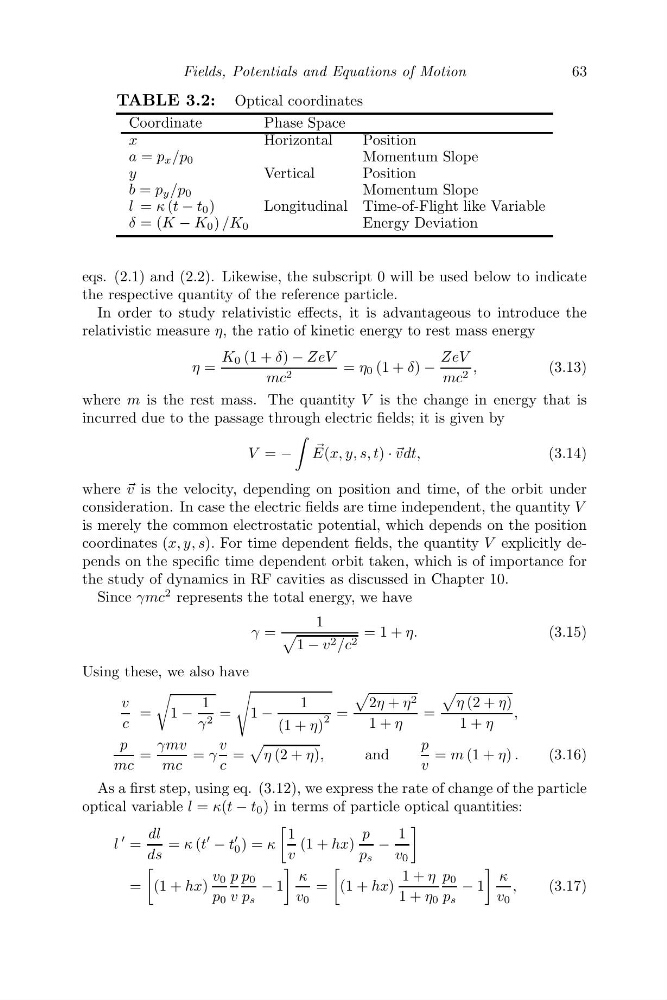
TABLE 3.2: Optical coordinates
Coordinate
Phase Space
x
Horizontal
Position
a = p x /p 0
Momentum Slope
y
Vertical
Position
b = p y /p 0
Momentum Slope
l = κ (t − t 0 )
Longitudinal Time-of-Flight like Variable
δ = (K − K 0 ) /K 0
Energy Deviation
eqs. (2.1) and (2.2). Likewise, the subscript 0 will be used below to indicate
the respective quantity of the reference particle.
In order to study relativistic effects, it is advantageous to introduce the
relativistic measure η, the ratio of kinetic energy to rest mass energy
η =
K 0 (1 + δ) − ZeV
mc 2
= η 0 (1 + δ) −
ZeV
mc 2 ,
(3.13)
where m is the rest mass. The quantity V is the change in energy that is
incurred due to the passage through electric fields; it is given by
V = −
E(x, y, s, t) · vdt,
(3.14)
where v is the velocity, depending on position and time, of the orbit under
consideration. In case the electric fields are time independent, the quantity V
is merely the common electrostatic potential, which depends on the position
coordinates (x, y, s). For time dependent fields, the quantity V explicitly depends on the specific time dependent orbit taken, which is of importance for
the study of dynamics in RF cavities as discussed in Chapter 10.
Since γmc
2 represents the total energy, we have
γ =
1
1 − v 2 /c 2
= 1 + η.
(3.15)
Using these, we also have
v
c
=
1 −
1
γ 2 =
1 −
1
(1 + η)
2 =
2η + η 2
1 + η
=
η (2 + η)
1 + η
,
p
mc
=
γmv
mc
= γ
v
c
=
η (2 + η),
and
p
v
= m (1 + η) .
(3.16)
As a first step, using eq. (3.12), we express the rate of change of the particle
optical variable l = κ(t − t 0 ) in terms of particle optical quantities:
l
=
dl
ds
= κ (t
− t
0 ) = κ
1
v
(1 + hx)
p
p s
−
1
v 0
=
(1 + hx)
v 0
p 0
p
v
p 0
p s
− 1
κ
v 0
=
(1 + hx)
1 + η
1 + η 0
p 0
p s
− 1
κ
v 0
,
(3.17)
63
TABLE 3.2: Optical coordinates
Coordinate
Phase Space
x
Horizontal
Position
a = p x /p 0
Momentum Slope
y
Vertical
Position
b = p y /p 0
Momentum Slope
l = κ (t − t 0 )
Longitudinal Time-of-Flight like Variable
δ = (K − K 0 ) /K 0
Energy Deviation
eqs. (2.1) and (2.2). Likewise, the subscript 0 will be used below to indicate
the respective quantity of the reference particle.
In order to study relativistic effects, it is advantageous to introduce the
relativistic measure η, the ratio of kinetic energy to rest mass energy
η =
K 0 (1 + δ) − ZeV
mc 2
= η 0 (1 + δ) −
ZeV
mc 2 ,
(3.13)
where m is the rest mass. The quantity V is the change in energy that is
incurred due to the passage through electric fields; it is given by
V = −
E(x, y, s, t) · vdt,
(3.14)
where v is the velocity, depending on position and time, of the orbit under
consideration. In case the electric fields are time independent, the quantity V
is merely the common electrostatic potential, which depends on the position
coordinates (x, y, s). For time dependent fields, the quantity V explicitly depends on the specific time dependent orbit taken, which is of importance for
the study of dynamics in RF cavities as discussed in Chapter 10.
Since γmc
2 represents the total energy, we have
γ =
1
1 − v 2 /c 2
= 1 + η.
(3.15)
Using these, we also have
v
c
=
1 −
1
γ 2 =
1 −
1
(1 + η)
2 =
2η + η 2
1 + η
=
η (2 + η)
1 + η
,
p
mc
=
γmv
mc
= γ
v
c
=
η (2 + η),
and
p
v
= m (1 + η) .
(3.16)
As a first step, using eq. (3.12), we express the rate of change of the particle
optical variable l = κ(t − t 0 ) in terms of particle optical quantities:
l
=
dl
ds
= κ (t
− t
0 ) = κ
1
v
(1 + hx)
p
p s
−
1
v 0
=
(1 + hx)
v 0
p 0
p
v
p 0
p s
− 1
κ
v 0
=
(1 + hx)
1 + η
1 + η 0
p 0
p s
− 1
κ
v 0
,
(3.17)