

Fields, Potentials and Equations of Motion
57
',
5V
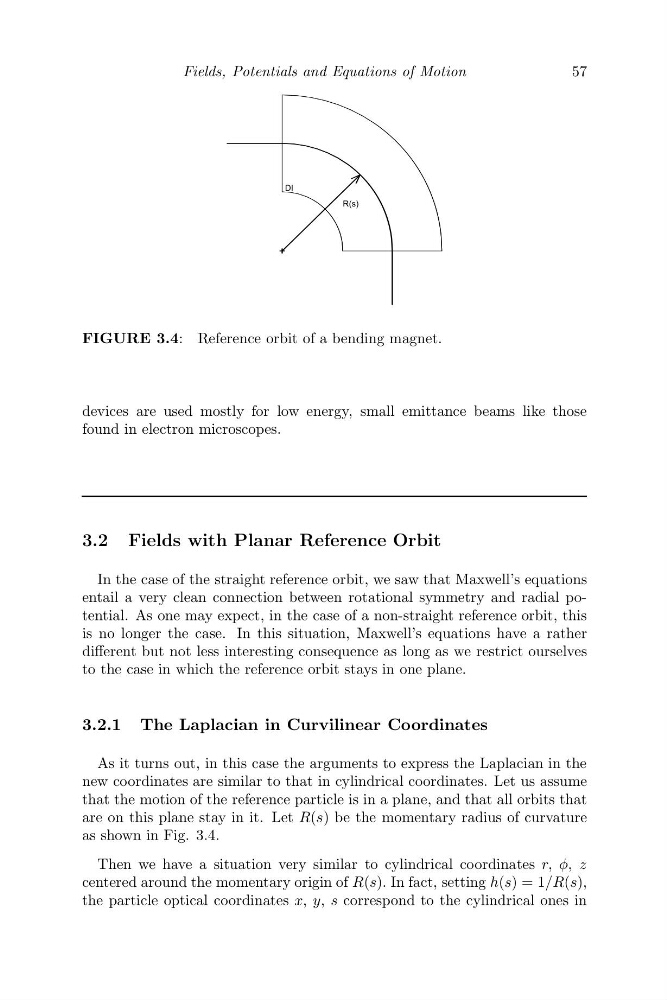
FIGURE 3.4: Reference orbit of a bending magnet.
devices are used mostly for low energy, small emittance beams like those
found in electron microscopes.
3.2 Fields with Planar Reference Orbit
In the case of the straight reference orbit, we saw that Maxwell’s equations
entail a very clean connection between rotational symmetry and radial potential. As one may expect, in the case of a non-straight reference orbit, this
is no longer the case. In this situation, Maxwell’s equations have a rather
different but not less interesting consequence as long as we restrict ourselves
to the case in which the reference orbit stays in one plane.
3.2.1 The Laplacian in Curvilinear Coordinates
As it turns out, in this case the arguments to express the Laplacian in the
new coordinates are similar to that in cylindrical coordinates. Let us assume
that the motion of the reference particle is in a plane, and that all orbits that
are on this plane stay in it. Let R(s) be the momentary radius of curvature
as shown in Fig. 3.4.
Then we have a situation very similar to cylindrical coordinates r, φ, z
centered around the momentary origin of R(s). In fact, setting h(s) = 1/R(s),
the particle optical coordinates x, y, s correspond to the cylindrical ones in
57
',
5V
FIGURE 3.4: Reference orbit of a bending magnet.
devices are used mostly for low energy, small emittance beams like those
found in electron microscopes.
3.2 Fields with Planar Reference Orbit
In the case of the straight reference orbit, we saw that Maxwell’s equations
entail a very clean connection between rotational symmetry and radial potential. As one may expect, in the case of a non-straight reference orbit, this
is no longer the case. In this situation, Maxwell’s equations have a rather
different but not less interesting consequence as long as we restrict ourselves
to the case in which the reference orbit stays in one plane.
3.2.1 The Laplacian in Curvilinear Coordinates
As it turns out, in this case the arguments to express the Laplacian in the
new coordinates are similar to that in cylindrical coordinates. Let us assume
that the motion of the reference particle is in a plane, and that all orbits that
are on this plane stay in it. Let R(s) be the momentary radius of curvature
as shown in Fig. 3.4.
Then we have a situation very similar to cylindrical coordinates r, φ, z
centered around the momentary origin of R(s). In fact, setting h(s) = 1/R(s),
the particle optical coordinates x, y, s correspond to the cylindrical ones in