

Fields, Potentials and Equations of Motion
55
s
M k,k
fringe field
fringe field
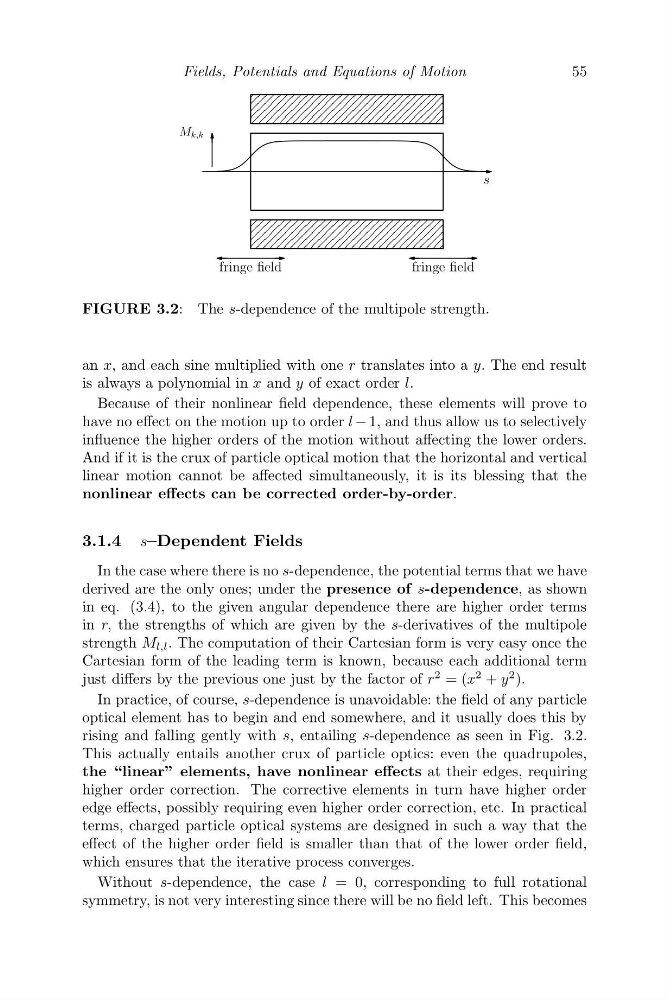
FIGURE 3.2: The s-dependence of the multipole strength.
an x, and each sine multiplied with one r translates into a y. The end result
is always a polynomial in x and y of exact order l.
Because of their nonlinear field dependence, these elements will prove to
have no effect on the motion up to order l − 1, and thus allow us to selectively
influence the higher orders of the motion without affecting the lower orders.
And if it is the crux of particle optical motion that the horizontal and vertical
linear motion cannot be affected simultaneously, it is its blessing that the
nonlinear effects can be corrected order-by-order.
3.1.4 s–Dependent Fields
In the case where there is no s-dependence, the potential terms that we have
derived are the only ones; under the presence of s-dependence, as shown
in eq. (3.4), to the given angular dependence there are higher order terms
in r, the strengths of which are given by the s-derivatives of the multipole
strength M l,l . The computation of their Cartesian form is very easy once the
Cartesian form of the leading term is known, because each additional term
just differs by the previous one just by the factor of r
2 = (x
2 + y
2 ).
In practice, of course, s-dependence is unavoidable: the field of any particle
optical element has to begin and end somewhere, and it usually does this by
rising and falling gently with s, entailing s-dependence as seen in Fig. 3.2.
This actually entails another crux of particle optics: even the quadrupoles,
the “linear” elements, have nonlinear effects at their edges, requiring
higher order correction. The corrective elements in turn have higher order
edge effects, possibly requiring even higher order correction, etc. In practical
terms, charged particle optical systems are designed in such a way that the
effect of the higher order field is smaller than that of the lower order field,
which ensures that the iterative process converges.
Without s-dependence, the case l = 0, corresponding to full rotational
symmetry, is not very interesting since there will be no field left. This becomes
55
s
M k,k
fringe field
fringe field
FIGURE 3.2: The s-dependence of the multipole strength.
an x, and each sine multiplied with one r translates into a y. The end result
is always a polynomial in x and y of exact order l.
Because of their nonlinear field dependence, these elements will prove to
have no effect on the motion up to order l − 1, and thus allow us to selectively
influence the higher orders of the motion without affecting the lower orders.
And if it is the crux of particle optical motion that the horizontal and vertical
linear motion cannot be affected simultaneously, it is its blessing that the
nonlinear effects can be corrected order-by-order.
3.1.4 s–Dependent Fields
In the case where there is no s-dependence, the potential terms that we have
derived are the only ones; under the presence of s-dependence, as shown
in eq. (3.4), to the given angular dependence there are higher order terms
in r, the strengths of which are given by the s-derivatives of the multipole
strength M l,l . The computation of their Cartesian form is very easy once the
Cartesian form of the leading term is known, because each additional term
just differs by the previous one just by the factor of r
2 = (x
2 + y
2 ).
In practice, of course, s-dependence is unavoidable: the field of any particle
optical element has to begin and end somewhere, and it usually does this by
rising and falling gently with s, entailing s-dependence as seen in Fig. 3.2.
This actually entails another crux of particle optics: even the quadrupoles,
the “linear” elements, have nonlinear effects at their edges, requiring
higher order correction. The corrective elements in turn have higher order
edge effects, possibly requiring even higher order correction, etc. In practical
terms, charged particle optical systems are designed in such a way that the
effect of the higher order field is smaller than that of the lower order field,
which ensures that the iterative process converges.
Without s-dependence, the case l = 0, corresponding to full rotational
symmetry, is not very interesting since there will be no field left. This becomes