

280
An Introduction to Beam Physics
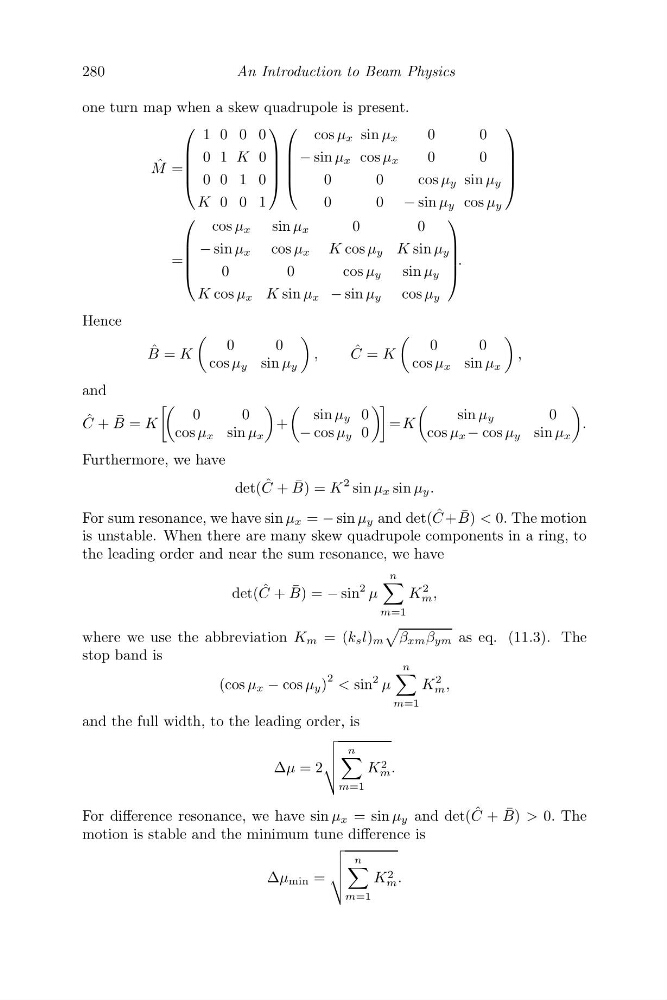
one turn map when a skew quadrupole is present.
ˆ
M =
⎛
⎜
⎜
⎜
⎝
1 0 0 0
0 1 K 0
0 0 1 0
K 0 0 1
⎞
⎟
⎟
⎟
⎠
⎛
⎜
⎜
⎜
⎝
cos μ x sin μ x
0
0
− sin μ x cos μ x
0
0
0
0
cosμ y sin μ y
0
0 − sin μ y cos μ y
⎞
⎟
⎟
⎟
⎠
=
⎛
⎜
⎜
⎜
⎝
cos μ x sin μ x
0
0
− sin μ x cos μ x K cos μ y K sin μ y
0
0
c o sμ y sin μ y
K cos μ x K sin μ x − sin μ y cos μ y
⎞
⎟
⎟
⎟
⎠
.
Hence
ˆ
B = K
0
0
cos μ y sin μ y
,
ˆ
C = K
0
0
cos μ x sin μ x
,
and
ˆ
C + ¯
B = K
0
0
cos μ x sin μ x
+
sin μ y 0
− cos μ y 0
= K
sin μ y
0
cos μ x − cos μ y sin μ x
.
Furthermore, we have
det( ˆ
C + ¯
B) = K
2 sin μ x sin μ y .
For sum resonance, we have sin μ x = − sin μ y and det( ˆ
C + ¯
B) < 0. The motion
is unstable. When there are many skew quadrupole components in a ring, to
the leading order and near the sum resonance, we have
det( ˆ
C + ¯
B) = − sin
2 μ
n
m=1
K
2
m ,
where we use the abbreviation K m = (k s l) m
β xm β ym as eq. (11.3). The
stop band is
(cos μ x − cos μ y )
2 < sin
2 μ
n
m=1
K
2
m ,
and the full width, to the leading order, is
Δμ = 2
n
m=1
K 2
m .
For difference resonance, we have sin μ x = sin μ y and det( ˆ
C + ¯
B) > 0. The
motion is stable and the minimum tune difference is
Δμ min =
n
m=1
K 2
m .
An Introduction to Beam Physics
one turn map when a skew quadrupole is present.
ˆ
M =
⎛
⎜
⎜
⎜
⎝
1 0 0 0
0 1 K 0
0 0 1 0
K 0 0 1
⎞
⎟
⎟
⎟
⎠
⎛
⎜
⎜
⎜
⎝
cos μ x sin μ x
0
0
− sin μ x cos μ x
0
0
0
0
cosμ y sin μ y
0
0 − sin μ y cos μ y
⎞
⎟
⎟
⎟
⎠
=
⎛
⎜
⎜
⎜
⎝
cos μ x sin μ x
0
0
− sin μ x cos μ x K cos μ y K sin μ y
0
0
c o sμ y sin μ y
K cos μ x K sin μ x − sin μ y cos μ y
⎞
⎟
⎟
⎟
⎠
.
Hence
ˆ
B = K
0
0
cos μ y sin μ y
,
ˆ
C = K
0
0
cos μ x sin μ x
,
and
ˆ
C + ¯
B = K
0
0
cos μ x sin μ x
+
sin μ y 0
− cos μ y 0
= K
sin μ y
0
cos μ x − cos μ y sin μ x
.
Furthermore, we have
det( ˆ
C + ¯
B) = K
2 sin μ x sin μ y .
For sum resonance, we have sin μ x = − sin μ y and det( ˆ
C + ¯
B) < 0. The motion
is unstable. When there are many skew quadrupole components in a ring, to
the leading order and near the sum resonance, we have
det( ˆ
C + ¯
B) = − sin
2 μ
n
m=1
K
2
m ,
where we use the abbreviation K m = (k s l) m
β xm β ym as eq. (11.3). The
stop band is
(cos μ x − cos μ y )
2 < sin
2 μ
n
m=1
K
2
m ,
and the full width, to the leading order, is
Δμ = 2
n
m=1
K 2
m .
For difference resonance, we have sin μ x = sin μ y and det( ˆ
C + ¯
B) > 0. The
motion is stable and the minimum tune difference is
Δμ min =
n
m=1
K 2
m .