

Resonances in Repetitive Systems
279
μ x
μ y
μ x
μ y
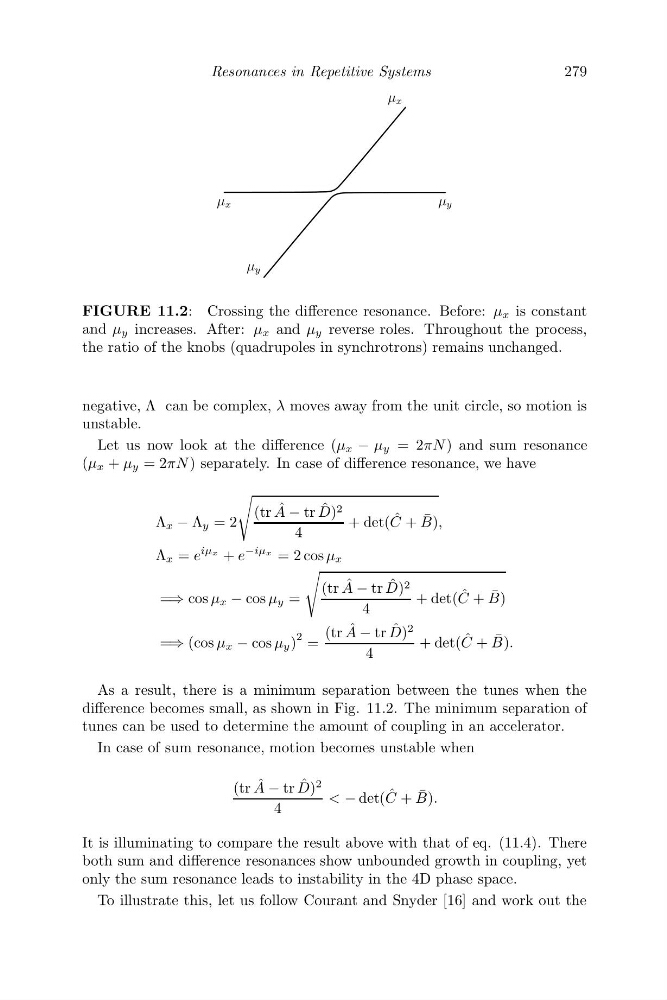
FIGURE 11.2: Crossing the difference resonance. Before: μ x is constant
and μ y increases. After: μ x and μ y reverse roles. Throughout the process,
the ratio of the knobs (quadrupoles in synchrotrons) remains unchanged.
negative, Λ can be complex, λ moves away from the unit circle, so motion is
unstable.
Let us now look at the difference (μ x − μ y = 2πN ) and sum resonance
(μ x + μ y = 2πN ) separately. In case of difference resonance, we have
Λ x − Λ y = 2
(tr ˆ
A − tr ˆ
D) 2
4
+ det( ˆ
C + ¯
B),
Λ x = e
iμx + e
−iμx = 2 cos μ x
=⇒ cos μ x − cos μ y =
(tr ˆ
A − tr ˆ
D) 2
4
+ det( ˆ
C + ¯
B)
=⇒ (cos μ x − cos μ y )
2 =
(tr ˆ
A − tr ˆ
D)
2
4
+ det( ˆ
C + ¯
B).
As a result, there is a minimum separation between the tunes when the
difference becomes small, as shown in Fig. 11.2. The minimum separation of
tunes can be used to determine the amount of coupling in an accelerator.
In case of sum resonance, motion becomes unstable when
(tr ˆ
A − tr ˆ
D)
2
4
< − det( ˆ
C + ¯
B).
It is illuminating to compare the result above with that of eq. (11.4). There
both sum and difference resonances show unbounded growth in coupling, yet
only the sum resonance leads to instability in the 4D phase space.
To illustrate this, let us follow Courant and Snyder [16] and work out the
279
μ x
μ y
μ x
μ y
FIGURE 11.2: Crossing the difference resonance. Before: μ x is constant
and μ y increases. After: μ x and μ y reverse roles. Throughout the process,
the ratio of the knobs (quadrupoles in synchrotrons) remains unchanged.
negative, Λ can be complex, λ moves away from the unit circle, so motion is
unstable.
Let us now look at the difference (μ x − μ y = 2πN ) and sum resonance
(μ x + μ y = 2πN ) separately. In case of difference resonance, we have
Λ x − Λ y = 2
(tr ˆ
A − tr ˆ
D) 2
4
+ det( ˆ
C + ¯
B),
Λ x = e
iμx + e
−iμx = 2 cos μ x
=⇒ cos μ x − cos μ y =
(tr ˆ
A − tr ˆ
D) 2
4
+ det( ˆ
C + ¯
B)
=⇒ (cos μ x − cos μ y )
2 =
(tr ˆ
A − tr ˆ
D)
2
4
+ det( ˆ
C + ¯
B).
As a result, there is a minimum separation between the tunes when the
difference becomes small, as shown in Fig. 11.2. The minimum separation of
tunes can be used to determine the amount of coupling in an accelerator.
In case of sum resonance, motion becomes unstable when
(tr ˆ
A − tr ˆ
D)
2
4
< − det( ˆ
C + ¯
B).
It is illuminating to compare the result above with that of eq. (11.4). There
both sum and difference resonances show unbounded growth in coupling, yet
only the sum resonance leads to instability in the 4D phase space.
To illustrate this, let us follow Courant and Snyder [16] and work out the