

278
An Introduction to Beam Physics
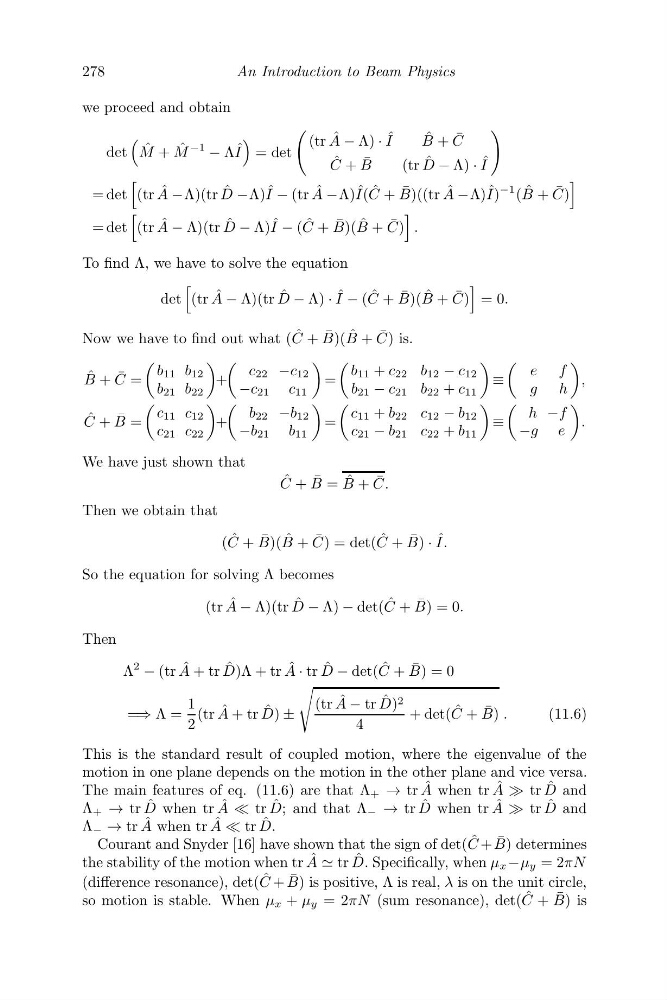
we proceed and obtain
det
ˆ
M + ˆ
M
−1
− Λ ˆ
I
= det
(tr ˆ
A − Λ) · ˆ
I
ˆ
B + ¯
C
ˆ
C + ¯
B
(tr ˆ
D − Λ) · ˆ
I
= det
(tr ˆ
A −Λ)(tr ˆ
D −Λ) ˆ
I − (tr ˆ
A −Λ) ˆ
I( ˆ
C + ¯
B)((tr ˆ
A −Λ) ˆ
I)
−1 ( ˆ
B + ¯
C)
= det
(tr ˆ
A − Λ)(tr ˆ
D − Λ) ˆ
I − ( ˆ
C + ¯
B)( ˆ
B + ¯
C)
.
To find Λ, we have to solve the equation
det
(tr ˆ
A − Λ)(tr ˆ
D − Λ) · ˆ
I − ( ˆ
C + ¯
B)( ˆ
B + ¯
C)
= 0.
Now we have to find out what ( ˆ
C + ¯
B)( ˆ
B + ¯
C) is.
ˆ
B + ¯
C =
b 11 b 12
b 21 b 22
+
c 22 −c 12
−c 21 c 11
=
b 11 + c 22 b 12 − c 12
b 21 − c 21 b 22 + c 11
≡
e f
g h
,
ˆ
C + ¯
B =
c 11 c 12
c 21 c 22
+
b 22 −b 12
−b 21 b 11
=
c 11 + b 22 c 12 − b 12
c 21 − b 21 c 22 + b 11
≡
h −f
−g e
.
We have just shown that
ˆ
C + ¯
B = ˆ
B + ¯
C.
Then we obtain that
( ˆ
C + ¯
B)( ˆ
B + ¯
C) = det( ˆ
C + ¯
B) · ˆ
I.
So the equation for solving Λ becomes
(tr ˆ
A − Λ)(tr ˆ
D − Λ) − det( ˆ
C + ¯
B) = 0.
Then
Λ
2
− (tr ˆ
A + tr ˆ
D)Λ + tr ˆ
A · tr ˆ
D − det( ˆ
C + ¯
B) = 0
=⇒ Λ =
1
2
(tr ˆ
A + tr ˆ
D) ±
(tr ˆ
A − tr ˆ
D) 2
4
+ det( ˆ
C + ¯
B) .
(11.6)
This is the standard result of coupled motion, where the eigenvalue of the
motion in one plane depends on the motion in the other plane and vice versa.
The main features of eq. (11.6) are that Λ + → tr ˆ
A when tr ˆ
A tr ˆ
D and
Λ + → tr ˆ
D when tr ˆ
A tr ˆ
D; and that Λ − → tr ˆ
D when tr ˆ
A tr ˆ
D and
Λ − → tr ˆ
A when tr ˆ
A tr ˆ
D.
Courant and Snyder [16] have shown that the sign of det( ˆ
C + ¯
B) determines
the stability of the motion when tr ˆ
A tr ˆ
D. Specifically, when μ x −μ y = 2πN
(difference resonance), det( ˆ
C + ¯
B) is positive, Λ is real, λ is on the unit circle,
so motion is stable. When μ x + μ y = 2πN (sum resonance), det( ˆ
C + ¯
B) is
An Introduction to Beam Physics
we proceed and obtain
det
ˆ
M + ˆ
M
−1
− Λ ˆ
I
= det
(tr ˆ
A − Λ) · ˆ
I
ˆ
B + ¯
C
ˆ
C + ¯
B
(tr ˆ
D − Λ) · ˆ
I
= det
(tr ˆ
A −Λ)(tr ˆ
D −Λ) ˆ
I − (tr ˆ
A −Λ) ˆ
I( ˆ
C + ¯
B)((tr ˆ
A −Λ) ˆ
I)
−1 ( ˆ
B + ¯
C)
= det
(tr ˆ
A − Λ)(tr ˆ
D − Λ) ˆ
I − ( ˆ
C + ¯
B)( ˆ
B + ¯
C)
.
To find Λ, we have to solve the equation
det
(tr ˆ
A − Λ)(tr ˆ
D − Λ) · ˆ
I − ( ˆ
C + ¯
B)( ˆ
B + ¯
C)
= 0.
Now we have to find out what ( ˆ
C + ¯
B)( ˆ
B + ¯
C) is.
ˆ
B + ¯
C =
b 11 b 12
b 21 b 22
+
c 22 −c 12
−c 21 c 11
=
b 11 + c 22 b 12 − c 12
b 21 − c 21 b 22 + c 11
≡
e f
g h
,
ˆ
C + ¯
B =
c 11 c 12
c 21 c 22
+
b 22 −b 12
−b 21 b 11
=
c 11 + b 22 c 12 − b 12
c 21 − b 21 c 22 + b 11
≡
h −f
−g e
.
We have just shown that
ˆ
C + ¯
B = ˆ
B + ¯
C.
Then we obtain that
( ˆ
C + ¯
B)( ˆ
B + ¯
C) = det( ˆ
C + ¯
B) · ˆ
I.
So the equation for solving Λ becomes
(tr ˆ
A − Λ)(tr ˆ
D − Λ) − det( ˆ
C + ¯
B) = 0.
Then
Λ
2
− (tr ˆ
A + tr ˆ
D)Λ + tr ˆ
A · tr ˆ
D − det( ˆ
C + ¯
B) = 0
=⇒ Λ =
1
2
(tr ˆ
A + tr ˆ
D) ±
(tr ˆ
A − tr ˆ
D) 2
4
+ det( ˆ
C + ¯
B) .
(11.6)
This is the standard result of coupled motion, where the eigenvalue of the
motion in one plane depends on the motion in the other plane and vice versa.
The main features of eq. (11.6) are that Λ + → tr ˆ
A when tr ˆ
A tr ˆ
D and
Λ + → tr ˆ
D when tr ˆ
A tr ˆ
D; and that Λ − → tr ˆ
D when tr ˆ
A tr ˆ
D and
Λ − → tr ˆ
A when tr ˆ
A tr ˆ
D.
Courant and Snyder [16] have shown that the sign of det( ˆ
C + ¯
B) determines
the stability of the motion when tr ˆ
A tr ˆ
D. Specifically, when μ x −μ y = 2πN
(difference resonance), det( ˆ
C + ¯
B) is positive, Λ is real, λ is on the unit circle,
so motion is stable. When μ x + μ y = 2πN (sum resonance), det( ˆ
C + ¯
B) is