

Resonances in Repetitive Systems
267
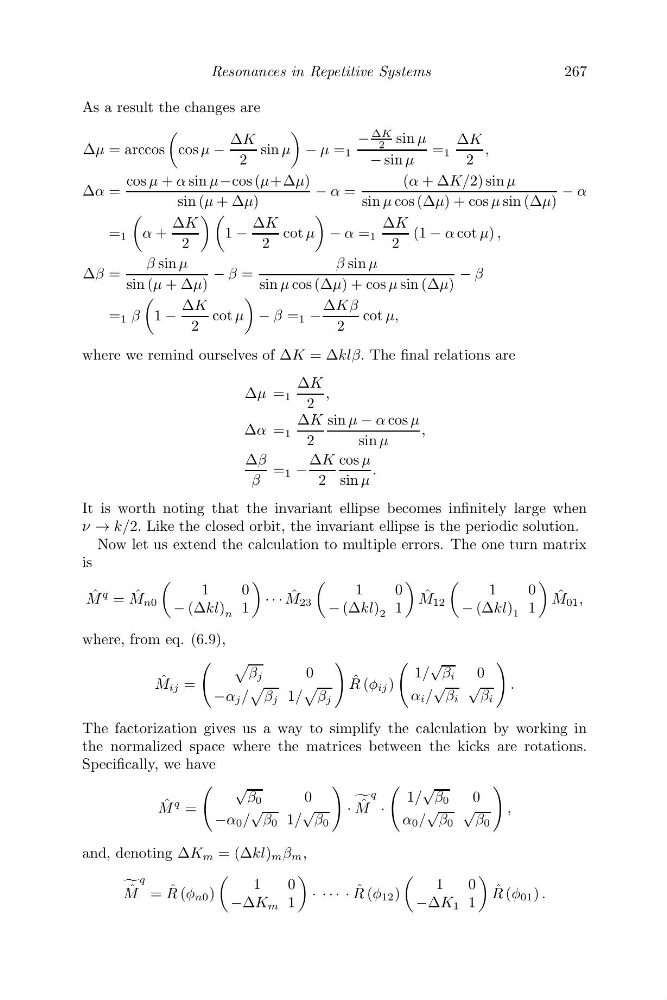
As a result the changes are
Δμ = arccos
cos μ −
ΔK
2
sin μ
− μ = 1
−
ΔK
2 sin μ
− sin μ
= 1
ΔK
2
,
Δα =
cos μ + α sin μ−cos (μ+Δμ)
sin (μ + Δμ)
− α =
(α + ΔK/2) sin μ
sin μ cos (Δμ) + cos μ sin (Δμ)
− α
= 1
α +
ΔK
2
1 −
ΔK
2
cot μ
− α = 1
ΔK
2
(1 − α cot μ) ,
Δβ =
β sin μ
sin (μ + Δμ)
− β =
β sin μ
sin μ cos (Δμ) + cos μ sin (Δμ)
− β
= 1 β
1 −
ΔK
2
cot μ
− β = 1 −
ΔKβ
2
cot μ,
where we remind ourselves of ΔK = Δklβ. The final relations are
Δμ = 1
ΔK
2
,
Δα = 1
ΔK
2
sin μ − α cos μ
sin μ
,
Δβ
β
= 1 −
ΔK
2
cos μ
sin μ
.
It is worth noting that the invariant ellipse becomes infinitely large when
ν → k/2. Like the closed orbit, the invariant ellipse is the periodic solution.
Now let us extend the calculation to multiple errors. The one turn matrix
is
ˆ
M
q = ˆ
M n0
1
0
− (Δkl) n 1
· · · ˆ
M 23
1
0
− (Δkl) 2 1
ˆ
M 12
1
0
− (Δkl) 1 1
ˆ
M 01 ,
where, from eq. (6.9),
ˆ
M ij =
β j
0
−α j /
β j 1/
β j
ˆ
R (φ ij )
1/
√
β i 0
α i /
√
β i
√
β i
.
The factorization gives us a way to simplify the calculation by working in
the normalized space where the matrices between the kicks are rotations.
Specifically, we have
ˆ
M
q =
√
β 0
0
−α 0 /
√
β 0 1/
√
β 0
·
ˆ
M
q
·
1/
√
β 0
0
α 0 /
√
β 0
√
β 0
,
and, denoting ΔK m = (Δkl) m β m ,
ˆ
M
q
= ˆ
R (φ n0 )
1
0
−ΔK m 1
· · · · · ˆ
R (φ 12 )
1
0
−ΔK 1 1
ˆ
R (φ 01 ) .
267
As a result the changes are
Δμ = arccos
cos μ −
ΔK
2
sin μ
− μ = 1
−
ΔK
2 sin μ
− sin μ
= 1
ΔK
2
,
Δα =
cos μ + α sin μ−cos (μ+Δμ)
sin (μ + Δμ)
− α =
(α + ΔK/2) sin μ
sin μ cos (Δμ) + cos μ sin (Δμ)
− α
= 1
α +
ΔK
2
1 −
ΔK
2
cot μ
− α = 1
ΔK
2
(1 − α cot μ) ,
Δβ =
β sin μ
sin (μ + Δμ)
− β =
β sin μ
sin μ cos (Δμ) + cos μ sin (Δμ)
− β
= 1 β
1 −
ΔK
2
cot μ
− β = 1 −
ΔKβ
2
cot μ,
where we remind ourselves of ΔK = Δklβ. The final relations are
Δμ = 1
ΔK
2
,
Δα = 1
ΔK
2
sin μ − α cos μ
sin μ
,
Δβ
β
= 1 −
ΔK
2
cos μ
sin μ
.
It is worth noting that the invariant ellipse becomes infinitely large when
ν → k/2. Like the closed orbit, the invariant ellipse is the periodic solution.
Now let us extend the calculation to multiple errors. The one turn matrix
is
ˆ
M
q = ˆ
M n0
1
0
− (Δkl) n 1
· · · ˆ
M 23
1
0
− (Δkl) 2 1
ˆ
M 12
1
0
− (Δkl) 1 1
ˆ
M 01 ,
where, from eq. (6.9),
ˆ
M ij =
β j
0
−α j /
β j 1/
β j
ˆ
R (φ ij )
1/
√
β i 0
α i /
√
β i
√
β i
.
The factorization gives us a way to simplify the calculation by working in
the normalized space where the matrices between the kicks are rotations.
Specifically, we have
ˆ
M
q =
√
β 0
0
−α 0 /
√
β 0 1/
√
β 0
·
ˆ
M
q
·
1/
√
β 0
0
α 0 /
√
β 0
√
β 0
,
and, denoting ΔK m = (Δkl) m β m ,
ˆ
M
q
= ˆ
R (φ n0 )
1
0
−ΔK m 1
· · · · · ˆ
R (φ 12 )
1
0
−ΔK 1 1
ˆ
R (φ 01 ) .