

266
An Introduction to Beam Physics
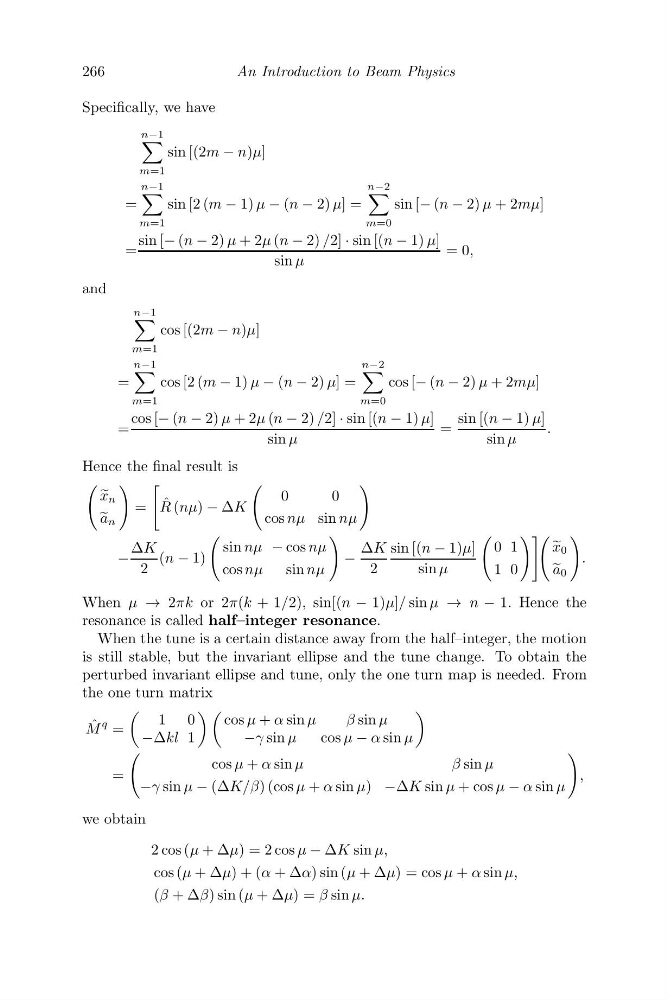
Specifically, we have
n−1
m=1
sin [(2m − n)μ]
=
n−1
m=1
sin [2 (m − 1) μ − (n − 2) μ] =
n−2
m=0
sin [− (n − 2) μ + 2mμ]
=
sin [− (n − 2) μ + 2μ (n − 2) /2] · sin [(n − 1) μ]
sin μ
= 0,
and
n−1
m=1
cos [(2m − n)μ]
=
n−1
m=1
cos [2 (m − 1) μ − (n − 2) μ] =
n−2
m=0
cos [− (n − 2) μ + 2mμ]
=
cos [− (n − 2) μ + 2μ (n − 2) /2] · sin [(n − 1) μ]
sin μ
=
sin [(n − 1) μ]
sin μ
.
Hence the final result is
x n
a n
=
ˆ
R (nμ) − ΔK
0
0
cos nμ sin nμ
−
ΔK
2
(n − 1)
sin nμ − cos nμ
cos nμ
sin nμ
−
ΔK
2
sin [(n − 1)μ]
sin μ
0 1
1 0
x 0
a 0
.
When μ → 2πk or 2π(k + 1/2), sin[(n − 1)μ]/ sin μ → n − 1. Hence the
resonance is called half–integer resonance.
When the tune is a certain distance away from the half–integer, the motion
is still stable, but the invariant ellipse and the tune change. To obtain the
perturbed invariant ellipse and tune, only the one turn map is needed. From
the one turn matrix
ˆ
M
q =
1 0
−Δkl 1
cos μ + α sin μ
βsin μ
−γ sin μ
cos μ − α sin μ
=
cos μ + α sin μ
β sin μ
−γ sin μ − (ΔK/β) (cos μ + α sin μ) −ΔK sin μ + cos μ − α sin μ
,
we obtain
2 cos (μ + Δμ) = 2 cos μ − ΔK sin μ,
cos (μ + Δμ) + (α + Δα) sin (μ + Δμ) = cos μ + α sin μ,
(β + Δβ) sin (μ + Δμ) = β sin μ.
An Introduction to Beam Physics
Specifically, we have
n−1
m=1
sin [(2m − n)μ]
=
n−1
m=1
sin [2 (m − 1) μ − (n − 2) μ] =
n−2
m=0
sin [− (n − 2) μ + 2mμ]
=
sin [− (n − 2) μ + 2μ (n − 2) /2] · sin [(n − 1) μ]
sin μ
= 0,
and
n−1
m=1
cos [(2m − n)μ]
=
n−1
m=1
cos [2 (m − 1) μ − (n − 2) μ] =
n−2
m=0
cos [− (n − 2) μ + 2mμ]
=
cos [− (n − 2) μ + 2μ (n − 2) /2] · sin [(n − 1) μ]
sin μ
=
sin [(n − 1) μ]
sin μ
.
Hence the final result is
x n
a n
=
ˆ
R (nμ) − ΔK
0
0
cos nμ sin nμ
−
ΔK
2
(n − 1)
sin nμ − cos nμ
cos nμ
sin nμ
−
ΔK
2
sin [(n − 1)μ]
sin μ
0 1
1 0
x 0
a 0
.
When μ → 2πk or 2π(k + 1/2), sin[(n − 1)μ]/ sin μ → n − 1. Hence the
resonance is called half–integer resonance.
When the tune is a certain distance away from the half–integer, the motion
is still stable, but the invariant ellipse and the tune change. To obtain the
perturbed invariant ellipse and tune, only the one turn map is needed. From
the one turn matrix
ˆ
M
q =
1 0
−Δkl 1
cos μ + α sin μ
βsin μ
−γ sin μ
cos μ − α sin μ
=
cos μ + α sin μ
β sin μ
−γ sin μ − (ΔK/β) (cos μ + α sin μ) −ΔK sin μ + cos μ − α sin μ
,
we obtain
2 cos (μ + Δμ) = 2 cos μ − ΔK sin μ,
cos (μ + Δμ) + (α + Δα) sin (μ + Δμ) = cos μ + α sin μ,
(β + Δβ) sin (μ + Δμ) = β sin μ.