

Resonances in Repetitive Systems
265
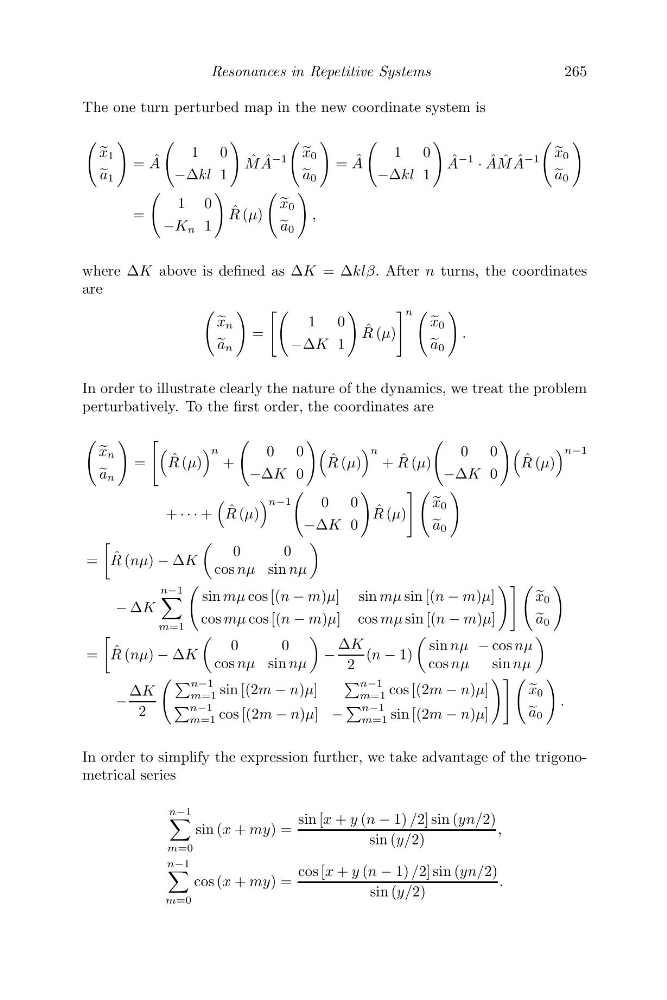
The one turn perturbed map in the new coordinate system is
x 1
a 1
= ˆ
A
1 0
−Δkl 1
ˆ
M ˆ
A
−1
x 0
a 0
= ˆ
A
1 0
−Δkl 1
ˆ
A
−1
· ˆ
A ˆ
M ˆ
A
−1
x 0
a 0
=
1 0
−K n 1
ˆ
R (μ)
x 0
a 0
,
where ΔK above is defined as ΔK = Δklβ. After n turns, the coordinates
are
x n
a n
=
1 0
−ΔK 1
ˆ
R (μ)
n
x 0
a 0
.
In order to illustrate clearly the nature of the dynamics, we treat the problem
perturbatively. To the first order, the coordinates are
x n
a n
=
ˆ
R (μ)
n
+
0 0
−ΔK 0
ˆ
R (μ)
n
+ ˆ
R (μ)
0 0
−ΔK 0
ˆ
R (μ)
n−1
+ · · · +
ˆ
R (μ)
n−1
0 0
−ΔK 0
ˆ
R (μ)
x 0
a 0
=
ˆ
R (nμ) − ΔK
0
0
cos nμ sin nμ
− ΔK
n−1
m=1
sin mμ cos [(n − m)μ] sinmμ sin [(n − m)μ]
cos mμ cos [(n − m)μ] cosmμ sin [(n − m)μ]
x 0
a 0
=
ˆ
R (nμ) − ΔK
0
0
cos nμ sin nμ
−
ΔK
2
(n − 1)
sin nμ − cos nμ
cos nμ
sin nμ
−
ΔK
2
n−1
m=1 sin [(2m − n)μ]
n−1
m=1 cos [(2m − n)μ]
n−1
m=1 cos [(2m − n)μ] −
n−1
m=1 sin [(2m − n)μ]
x 0
a 0
.
In order to simplify the expression further, we take advantage of the trigonometrical series
n−1
m=0
sin (x + my) =
sin [x + y (n − 1) /2] sin (yn/2)
sin (y/2)
,
n−1
m=0
cos (x + my) =
cos [x + y (n − 1) /2] sin (yn/2)
sin (y/2)
.
265
The one turn perturbed map in the new coordinate system is
x 1
a 1
= ˆ
A
1 0
−Δkl 1
ˆ
M ˆ
A
−1
x 0
a 0
= ˆ
A
1 0
−Δkl 1
ˆ
A
−1
· ˆ
A ˆ
M ˆ
A
−1
x 0
a 0
=
1 0
−K n 1
ˆ
R (μ)
x 0
a 0
,
where ΔK above is defined as ΔK = Δklβ. After n turns, the coordinates
are
x n
a n
=
1 0
−ΔK 1
ˆ
R (μ)
n
x 0
a 0
.
In order to illustrate clearly the nature of the dynamics, we treat the problem
perturbatively. To the first order, the coordinates are
x n
a n
=
ˆ
R (μ)
n
+
0 0
−ΔK 0
ˆ
R (μ)
n
+ ˆ
R (μ)
0 0
−ΔK 0
ˆ
R (μ)
n−1
+ · · · +
ˆ
R (μ)
n−1
0 0
−ΔK 0
ˆ
R (μ)
x 0
a 0
=
ˆ
R (nμ) − ΔK
0
0
cos nμ sin nμ
− ΔK
n−1
m=1
sin mμ cos [(n − m)μ] sinmμ sin [(n − m)μ]
cos mμ cos [(n − m)μ] cosmμ sin [(n − m)μ]
x 0
a 0
=
ˆ
R (nμ) − ΔK
0
0
cos nμ sin nμ
−
ΔK
2
(n − 1)
sin nμ − cos nμ
cos nμ
sin nμ
−
ΔK
2
n−1
m=1 sin [(2m − n)μ]
n−1
m=1 cos [(2m − n)μ]
n−1
m=1 cos [(2m − n)μ] −
n−1
m=1 sin [(2m − n)μ]
x 0
a 0
.
In order to simplify the expression further, we take advantage of the trigonometrical series
n−1
m=0
sin (x + my) =
sin [x + y (n − 1) /2] sin (yn/2)
sin (y/2)
,
n−1
m=0
cos (x + my) =
cos [x + y (n − 1) /2] sin (yn/2)
sin (y/2)
.