

268
An Introduction to Beam Physics
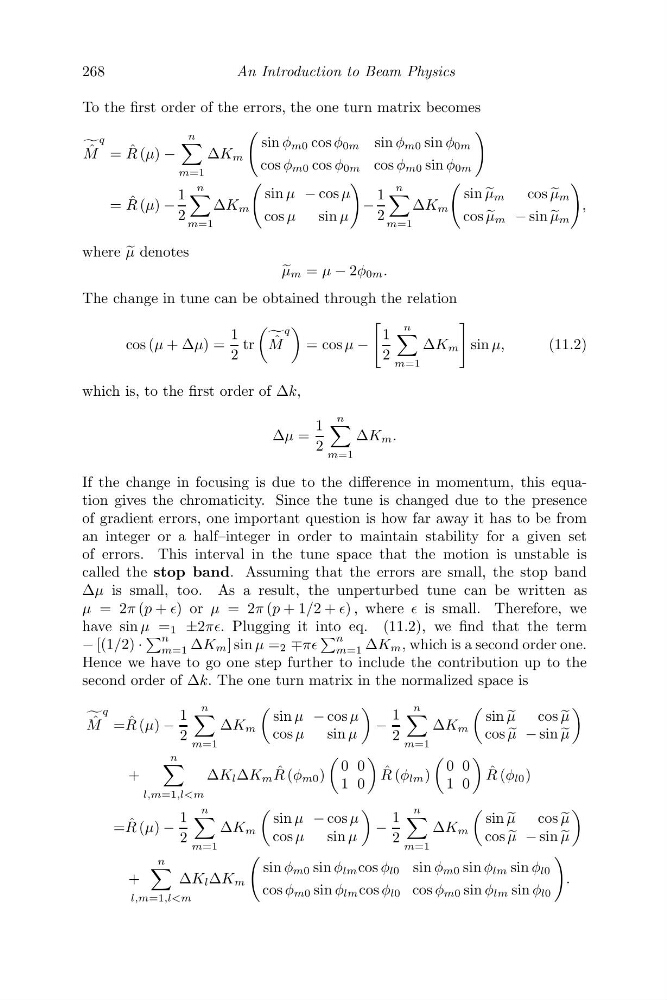
To the first order of the errors, the one turn matrix becomes
ˆ
M
q
= ˆ
R (μ) −
n
m=1
ΔK m
sin φ m0 cos φ 0m sin φ m0 sin φ 0m
cos φ m0 cos φ 0m cos φ m0 sin φ 0m
= ˆ
R (μ) −
1
2
n
m=1
ΔK m
sin μ − cos μ
cos μ
sin μ
−
1
2
n
m=1
ΔK m
sin
μ m
cos
μ m
cos
μ m − sin
μ m
,
where
μ denotes
μ m = μ − 2φ 0m .
The change in tune can be obtained through the relation
cos (μ + Δμ) =
1
2
tr
ˆ
M
q
= cos μ −
1
2
n
m=1
ΔK m
sin μ,
(11.2)
which is, to the first order of Δk,
Δμ =
1
2
n
m=1
ΔK m .
If the change in focusing is due to the difference in momentum, this equation gives the chromaticity. Since the tune is changed due to the presence
of gradient errors, one important question is how far away it has to be from
an integer or a half–integer in order to maintain stability for a given set
of errors. This interval in the tune space that the motion is unstable is
called the stop band. Assuming that the errors are small, the stop band
Δμ is small, too. As a result, the unperturbed tune can be written as
μ = 2π (p + ) or μ = 2π (p + 1/2 + ) , where is small. Therefore, we
have sin μ = 1 ±2ππ. Plugging it into eq. (11.2), we find that the term
− [(1/2) ·
n
m=1 ΔK m ] sin μ = 2 ∓ππ
n
m=1 ΔK m , which is a second order one.
Hence we have to go one step further to include the contribution up to the
second order of Δk. The one turn matrix in the normalized space is
ˆ
M
q
= ˆ
R (μ) −
1
2
n
m=1
ΔK m
sin μ − cos μ
cos μ
sin μ
−
1
2
n
m=1
ΔK m
sin
μ cos
μ
cos
μ − sin
μ
+
n
l,m=1,l
R (φ m0 )
0 0
1 0
ˆ
R (φ lm )
0 0
1 0
ˆ
R (φ l0 )
= ˆ
R (μ) −
1
2
n
m=1
ΔK m
sin μ − cos μ
cos μ
sin μ
−
1
2
n
m=1
ΔK m
sin
μ cos
μ
cos
μ − sin
μ
+
n
l,m=1,l
sin φ m0 sin φ lm cos φ l0 sin φ m0 sin φ lm sin φ l0
cos φ m0 sin φ lm cos φ l0 cos φ m0 sin φ lm sin φ l0
.
An Introduction to Beam Physics
To the first order of the errors, the one turn matrix becomes
ˆ
M
q
= ˆ
R (μ) −
n
m=1
ΔK m
sin φ m0 cos φ 0m sin φ m0 sin φ 0m
cos φ m0 cos φ 0m cos φ m0 sin φ 0m
= ˆ
R (μ) −
1
2
n
m=1
ΔK m
sin μ − cos μ
cos μ
sin μ
−
1
2
n
m=1
ΔK m
sin
μ m
cos
μ m
cos
μ m − sin
μ m
,
where
μ denotes
μ m = μ − 2φ 0m .
The change in tune can be obtained through the relation
cos (μ + Δμ) =
1
2
tr
ˆ
M
q
= cos μ −
1
2
n
m=1
ΔK m
sin μ,
(11.2)
which is, to the first order of Δk,
Δμ =
1
2
n
m=1
ΔK m .
If the change in focusing is due to the difference in momentum, this equation gives the chromaticity. Since the tune is changed due to the presence
of gradient errors, one important question is how far away it has to be from
an integer or a half–integer in order to maintain stability for a given set
of errors. This interval in the tune space that the motion is unstable is
called the stop band. Assuming that the errors are small, the stop band
Δμ is small, too. As a result, the unperturbed tune can be written as
μ = 2π (p + ) or μ = 2π (p + 1/2 + ) , where is small. Therefore, we
have sin μ = 1 ±2ππ. Plugging it into eq. (11.2), we find that the term
− [(1/2) ·
n
m=1 ΔK m ] sin μ = 2 ∓ππ
n
m=1 ΔK m , which is a second order one.
Hence we have to go one step further to include the contribution up to the
second order of Δk. The one turn matrix in the normalized space is
ˆ
M
q
= ˆ
R (μ) −
1
2
n
m=1
ΔK m
sin μ − cos μ
cos μ
sin μ
−
1
2
n
m=1
ΔK m
sin
μ cos
μ
cos
μ − sin
μ
+
n
l,m=1,l
R (φ m0 )
0 0
1 0
ˆ
R (φ lm )
0 0
1 0
ˆ
R (φ l0 )
= ˆ
R (μ) −
1
2
n
m=1
ΔK m
sin μ − cos μ
cos μ
sin μ
−
1
2
n
m=1
ΔK m
sin
μ cos
μ
cos
μ − sin
μ
+
n
l,m=1,l
sin φ m0 sin φ lm cos φ l0 sin φ m0 sin φ lm sin φ l0
cos φ m0 sin φ lm cos φ l0 cos φ m0 sin φ lm sin φ l0
.