

258
An Introduction to Beam Physics
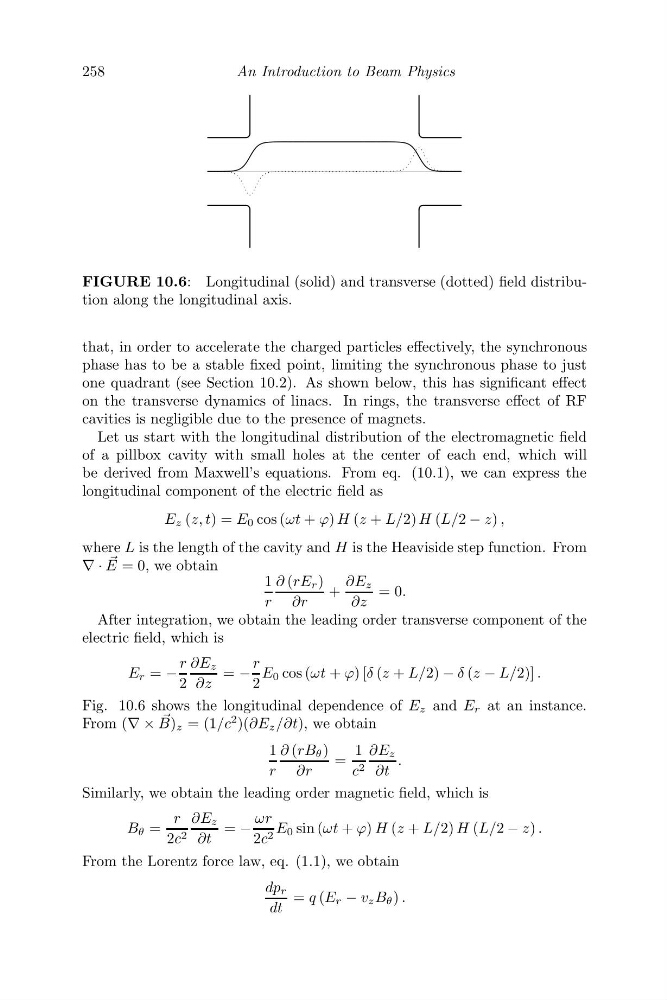
FIGURE 10.6: Longitudinal (solid) and transverse (dotted) field distribution along the longitudinal axis.
that, in order to accelerate the charged particles effectively, the synchronous
phase has to be a stable fixed point, limiting the synchronous phase to just
one quadrant (see Section 10.2). As shown below, this has significant effect
on the transverse dynamics of linacs. In rings, the transverse effect of RF
cavities is negligible due to the presence of magnets.
Let us start with the longitudinal distribution of the electromagnetic field
of a pillbox cavity with small holes at the center of each end, which will
be derived from Maxwell’s equations. From eq. (10.1), we can express the
longitudinal component of the electric field as
E z (z, t) = E 0 cos (ωt + ϕ) H (z + L/2) H (L/2 − z) ,
where L is the length of the cavity and H is the Heaviside step function. From
∇ ·
E = 0, we obtain
1
r
∂ (rE r )
∂r
+
∂E z
∂z
= 0.
After integration, we obtain the leading order transverse component of the
electric field, which is
E r = −
r
2
∂E z
∂z
= −
r
2
E 0 cos (ωt + ϕ) [δ (z + L/2) − δ (z − L/2)] .
Fig. 10.6 shows the longitudinal dependence of E z and E r at an instance.
From (∇ ×
B) z = (1/c
2 )(∂E z /∂t), we obtain
1
r
∂ (rB θ )
∂r
=
1
c 2
∂E z
∂t
.
Similarly, we obtain the leading order magnetic field, which is
B θ =
r
2c 2
∂E z
∂t
= −
ωr
2c 2 E 0 sin (ωt + ϕ) H (z + L/2) H (L/2 − z) .
From the Lorentz force law, eq. (1.1), we obtain
dp r
dt
= q (E r − v z B θ ) .
An Introduction to Beam Physics
FIGURE 10.6: Longitudinal (solid) and transverse (dotted) field distribution along the longitudinal axis.
that, in order to accelerate the charged particles effectively, the synchronous
phase has to be a stable fixed point, limiting the synchronous phase to just
one quadrant (see Section 10.2). As shown below, this has significant effect
on the transverse dynamics of linacs. In rings, the transverse effect of RF
cavities is negligible due to the presence of magnets.
Let us start with the longitudinal distribution of the electromagnetic field
of a pillbox cavity with small holes at the center of each end, which will
be derived from Maxwell’s equations. From eq. (10.1), we can express the
longitudinal component of the electric field as
E z (z, t) = E 0 cos (ωt + ϕ) H (z + L/2) H (L/2 − z) ,
where L is the length of the cavity and H is the Heaviside step function. From
∇ ·
E = 0, we obtain
1
r
∂ (rE r )
∂r
+
∂E z
∂z
= 0.
After integration, we obtain the leading order transverse component of the
electric field, which is
E r = −
r
2
∂E z
∂z
= −
r
2
E 0 cos (ωt + ϕ) [δ (z + L/2) − δ (z − L/2)] .
Fig. 10.6 shows the longitudinal dependence of E z and E r at an instance.
From (∇ ×
B) z = (1/c
2 )(∂E z /∂t), we obtain
1
r
∂ (rB θ )
∂r
=
1
c 2
∂E z
∂t
.
Similarly, we obtain the leading order magnetic field, which is
B θ =
r
2c 2
∂E z
∂t
= −
ωr
2c 2 E 0 sin (ωt + ϕ) H (z + L/2) H (L/2 − z) .
From the Lorentz force law, eq. (1.1), we obtain
dp r
dt
= q (E r − v z B θ ) .