

Synchrotron Motion
259
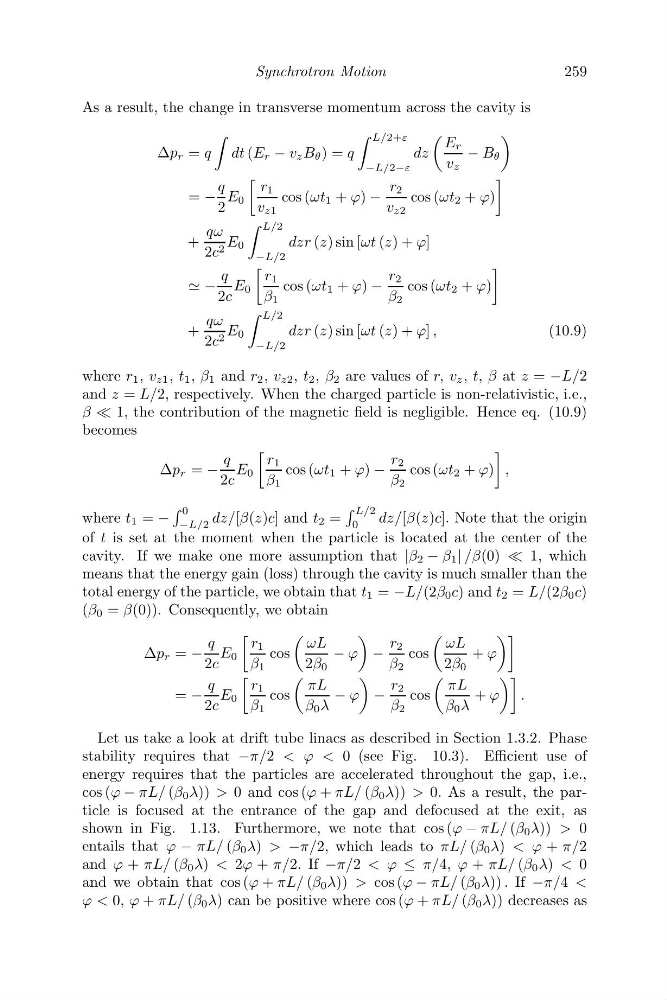
As a result, the change in transverse momentum across the cavity is
Δp r = q
dt (E r − v z B θ ) = q
L/2+ε
−L/2−ε
dz
E r
v z
− B θ
= −
q
2
E 0
r 1
v z1
cos (ωt 1 + ϕ) −
r 2
v z2
cos (ωt 2 + ϕ)
+
qω
2c 2 E 0
L/2
−L/2
dzr (z) sin [ωt (z) + ϕ]
−
q
2c
E 0
r 1
β 1
cos (ωt 1 + ϕ) −
r 2
β 2
cos (ωt 2 + ϕ)
+
qω
2c 2 E 0
L/2
−L/2
dzr (z) sin [ωt (z) + ϕ] ,
(10.9)
where r 1 , v z1 , t 1 , β 1 and r 2 , v z2 , t 2 , β 2 are values of r, v z , t, β at z = −L/2
and z = L/2, respectively. When the charged particle is non-relativistic, i.e.,
β 1, the contribution of the magnetic field is negligible. Hence eq. (10.9)
becomes
Δp r = −
q
2c
E 0
r 1
β 1
cos (ωt 1 + ϕ) −
r 2
β 2
cos (ωt 2 + ϕ)
,
where t 1 = −
0
−L/2
dz/[β(z)c] and t 2 =
L/2
0
dz/[β(z)c]. Note that the origin
of t is set at the moment when the particle is located at the center of the
cavity. If we make one more assumption that |β 2 − β 1 | /β(0) 1, which
means that the energy gain (loss) through the cavity is much smaller than the
total energy of the particle, we obtain that t 1 = −L/(2β 0 c) and t 2 = L/(2β 0 c)
(β 0 = β(0)). Consequently, we obtain
Δp r = −
q
2c
E 0
r 1
β 1
cos
ωL
2β 0
− ϕ
−
r 2
β 2
cos
ωL
2β 0
+ ϕ
= −
q
2c
E 0
r 1
β 1
cos
πL
β 0 λ
− ϕ
−
r 2
β 2
cos
πL
β 0 λ
+ ϕ
.
Let us take a look at drift tube linacs as described in Section 1.3.2. Phase
stability requires that −π/2 < ϕ < 0 (see Fig. 10.3). Efficient use of
energy requires that the particles are accelerated throughout the gap, i.e.,
cos (ϕ − πL/ (β 0 λ)) > 0 and cos (ϕ + πL/ (β 0 λ)) > 0. As a result, the particle is focused at the entrance of the gap and defocused at the exit, as
shown in Fig. 1.13. Furthermore, we note that cos (ϕ − πL/ (β 0 λ)) > 0
entails that ϕ − πL/ (β 0 λ) > −π/2, which leads to πL/ (β 0 λ) < ϕ + π/2
and ϕ + πL/ (β 0 λ) < 2ϕ + π/2. If −π/2 < ϕ ≤ π/4, ϕ + πL/ (β 0 λ) < 0
and we obtain that cos (ϕ + πL/ (β 0 λ)) > cos (ϕ − πL/ (β 0 λ)) . If −π/4 <
ϕ < 0, ϕ + πL/ (β 0 λ) can be positive where cos (ϕ + πL/ (β 0 λ)) decreases as
259
As a result, the change in transverse momentum across the cavity is
Δp r = q
dt (E r − v z B θ ) = q
L/2+ε
−L/2−ε
dz
E r
v z
− B θ
= −
q
2
E 0
r 1
v z1
cos (ωt 1 + ϕ) −
r 2
v z2
cos (ωt 2 + ϕ)
+
qω
2c 2 E 0
L/2
−L/2
dzr (z) sin [ωt (z) + ϕ]
−
q
2c
E 0
r 1
β 1
cos (ωt 1 + ϕ) −
r 2
β 2
cos (ωt 2 + ϕ)
+
qω
2c 2 E 0
L/2
−L/2
dzr (z) sin [ωt (z) + ϕ] ,
(10.9)
where r 1 , v z1 , t 1 , β 1 and r 2 , v z2 , t 2 , β 2 are values of r, v z , t, β at z = −L/2
and z = L/2, respectively. When the charged particle is non-relativistic, i.e.,
β 1, the contribution of the magnetic field is negligible. Hence eq. (10.9)
becomes
Δp r = −
q
2c
E 0
r 1
β 1
cos (ωt 1 + ϕ) −
r 2
β 2
cos (ωt 2 + ϕ)
,
where t 1 = −
0
−L/2
dz/[β(z)c] and t 2 =
L/2
0
dz/[β(z)c]. Note that the origin
of t is set at the moment when the particle is located at the center of the
cavity. If we make one more assumption that |β 2 − β 1 | /β(0) 1, which
means that the energy gain (loss) through the cavity is much smaller than the
total energy of the particle, we obtain that t 1 = −L/(2β 0 c) and t 2 = L/(2β 0 c)
(β 0 = β(0)). Consequently, we obtain
Δp r = −
q
2c
E 0
r 1
β 1
cos
ωL
2β 0
− ϕ
−
r 2
β 2
cos
ωL
2β 0
+ ϕ
= −
q
2c
E 0
r 1
β 1
cos
πL
β 0 λ
− ϕ
−
r 2
β 2
cos
πL
β 0 λ
+ ϕ
.
Let us take a look at drift tube linacs as described in Section 1.3.2. Phase
stability requires that −π/2 < ϕ < 0 (see Fig. 10.3). Efficient use of
energy requires that the particles are accelerated throughout the gap, i.e.,
cos (ϕ − πL/ (β 0 λ)) > 0 and cos (ϕ + πL/ (β 0 λ)) > 0. As a result, the particle is focused at the entrance of the gap and defocused at the exit, as
shown in Fig. 1.13. Furthermore, we note that cos (ϕ − πL/ (β 0 λ)) > 0
entails that ϕ − πL/ (β 0 λ) > −π/2, which leads to πL/ (β 0 λ) < ϕ + π/2
and ϕ + πL/ (β 0 λ) < 2ϕ + π/2. If −π/2 < ϕ ≤ π/4, ϕ + πL/ (β 0 λ) < 0
and we obtain that cos (ϕ + πL/ (β 0 λ)) > cos (ϕ − πL/ (β 0 λ)) . If −π/4 <
ϕ < 0, ϕ + πL/ (β 0 λ) can be positive where cos (ϕ + πL/ (β 0 λ)) decreases as