

Lattice Modules
231
VP
&$0'V\PPHWULF]HURGLVSHUVLRQ/DWWLFH
β P
'[ P
β [
β\
'[
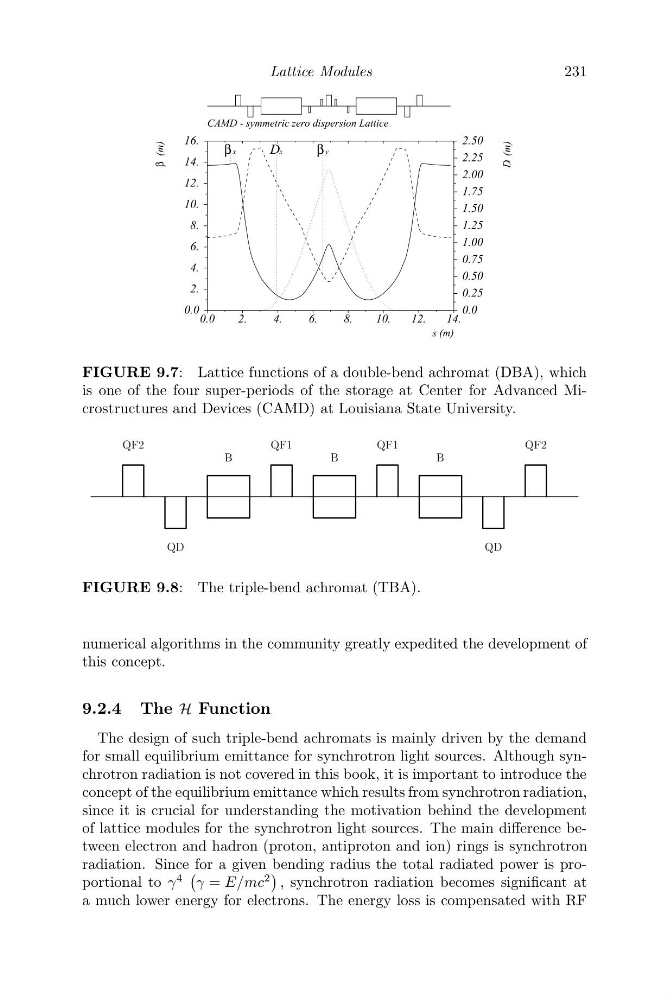
FIGURE 9.7: Lattice functions of a double-bend achromat (DBA), which
is one of the four super-periods of the storage at Center for Advanced Microstructures and Devices (CAMD) at Louisiana State University.
B
B
B
QF1
QF1
QD
QD
QF2
QF2
FIGURE 9.8: The triple-bend achromat (TBA).
numerical algorithms in the community greatly expedited the development of
this concept.
9.2.4 The H Function
The design of such triple-bend achromats is mainly driven by the demand
for small equilibrium emittance for synchrotron light sources. Although synchrotron radiation is not covered in this book, it is important to introduce the
concept of the equilibrium emittance which results from synchrotron radiation,
since it is crucial for understanding the motivation behind the development
of lattice modules for the synchrotron light sources. The main difference between electron and hadron (proton, antiproton and ion) rings is synchrotron
radiation. Since for a given bending radius the total radiated power is proportional to γ
4
γ = E/mc
2
, synchrotron radiation becomes significant at
a much lower energy for electrons. The energy loss is compensated with RF
231
VP
&$0'V\PPHWULF]HURGLVSHUVLRQ/DWWLFH
β P
'[ P
β [
β\
'[
FIGURE 9.7: Lattice functions of a double-bend achromat (DBA), which
is one of the four super-periods of the storage at Center for Advanced Microstructures and Devices (CAMD) at Louisiana State University.
B
B
B
QF1
QF1
QD
QD
QF2
QF2
FIGURE 9.8: The triple-bend achromat (TBA).
numerical algorithms in the community greatly expedited the development of
this concept.
9.2.4 The H Function
The design of such triple-bend achromats is mainly driven by the demand
for small equilibrium emittance for synchrotron light sources. Although synchrotron radiation is not covered in this book, it is important to introduce the
concept of the equilibrium emittance which results from synchrotron radiation,
since it is crucial for understanding the motivation behind the development
of lattice modules for the synchrotron light sources. The main difference between electron and hadron (proton, antiproton and ion) rings is synchrotron
radiation. Since for a given bending radius the total radiated power is proportional to γ
4
γ = E/mc
2
, synchrotron radiation becomes significant at
a much lower energy for electrons. The energy loss is compensated with RF