

232
An Introduction to Beam Physics
VP
635
β P
'[ P
β [
β \
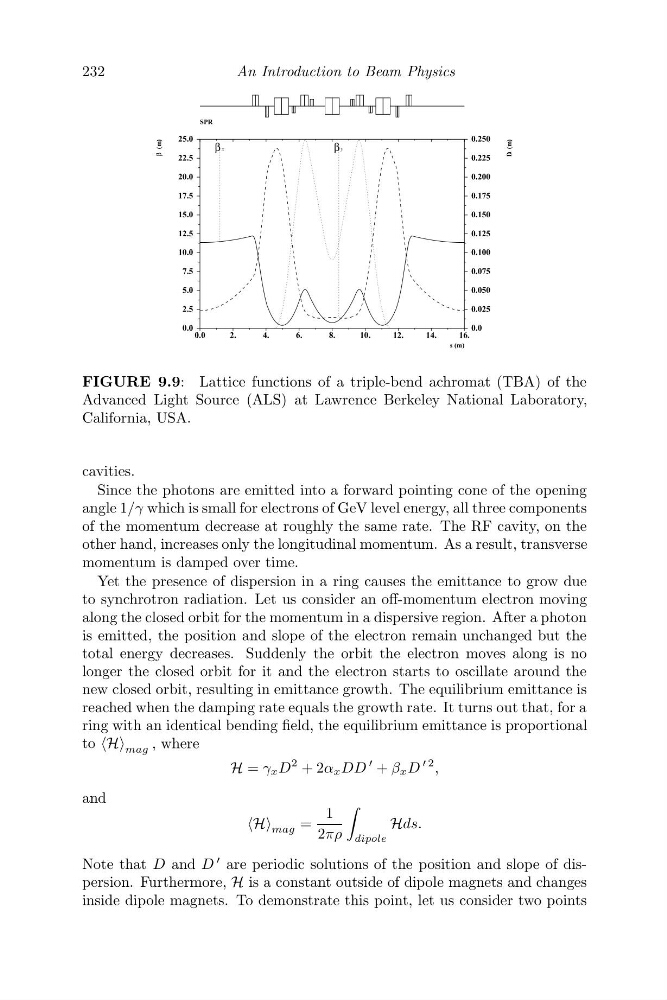
FIGURE 9.9: Lattice functions of a triple-bend achromat (TBA) of the
Advanced Light Source (ALS) at Lawrence Berkeley National Laboratory,
California, USA.
cavities.
Since the photons are emitted into a forward pointing cone of the opening
angle 1/γ which is small for electrons of GeV level energy, all three components
of the momentum decrease at roughly the same rate. The RF cavity, on the
other hand, increases only the longitudinal momentum. As a result, transverse
momentum is damped over time.
Yet the presence of dispersion in a ring causes the emittance to grow due
to synchrotron radiation. Let us consider an off-momentum electron moving
along the closed orbit for the momentum in a dispersive region. After a photon
is emitted, the position and slope of the electron remain unchanged but the
total energy decreases. Suddenly the orbit the electron moves along is no
longer the closed orbit for it and the electron starts to oscillate around the
new closed orbit, resulting in emittance growth. The equilibrium emittance is
reached when the damping rate equals the growth rate. It turns out that, for a
ring with an identical bending field, the equilibrium emittance is proportional
to mag , where
H = γ x D
2 + 2α x DD
+ β x D
2 ,
and
HH mag =
1
2πρ
dipole
Hds.
Note that D and D
are periodic solutions of the position and slope of dispersion. Furthermore, H is a constant outside of dipole magnets and changes
inside dipole magnets. To demonstrate this point, let us consider two points
An Introduction to Beam Physics
VP
635
β P
'[ P
β [
β \
FIGURE 9.9: Lattice functions of a triple-bend achromat (TBA) of the
Advanced Light Source (ALS) at Lawrence Berkeley National Laboratory,
California, USA.
cavities.
Since the photons are emitted into a forward pointing cone of the opening
angle 1/γ which is small for electrons of GeV level energy, all three components
of the momentum decrease at roughly the same rate. The RF cavity, on the
other hand, increases only the longitudinal momentum. As a result, transverse
momentum is damped over time.
Yet the presence of dispersion in a ring causes the emittance to grow due
to synchrotron radiation. Let us consider an off-momentum electron moving
along the closed orbit for the momentum in a dispersive region. After a photon
is emitted, the position and slope of the electron remain unchanged but the
total energy decreases. Suddenly the orbit the electron moves along is no
longer the closed orbit for it and the electron starts to oscillate around the
new closed orbit, resulting in emittance growth. The equilibrium emittance is
reached when the damping rate equals the growth rate. It turns out that, for a
ring with an identical bending field, the equilibrium emittance is proportional
to mag , where
H = γ x D
2 + 2α x DD
+ β x D
2 ,
and
HH mag =
1
2πρ
dipole
Hds.
Note that D and D
are periodic solutions of the position and slope of dispersion. Furthermore, H is a constant outside of dipole magnets and changes
inside dipole magnets. To demonstrate this point, let us consider two points