

230
An Introduction to Beam Physics
B
B
QF
QD
QD
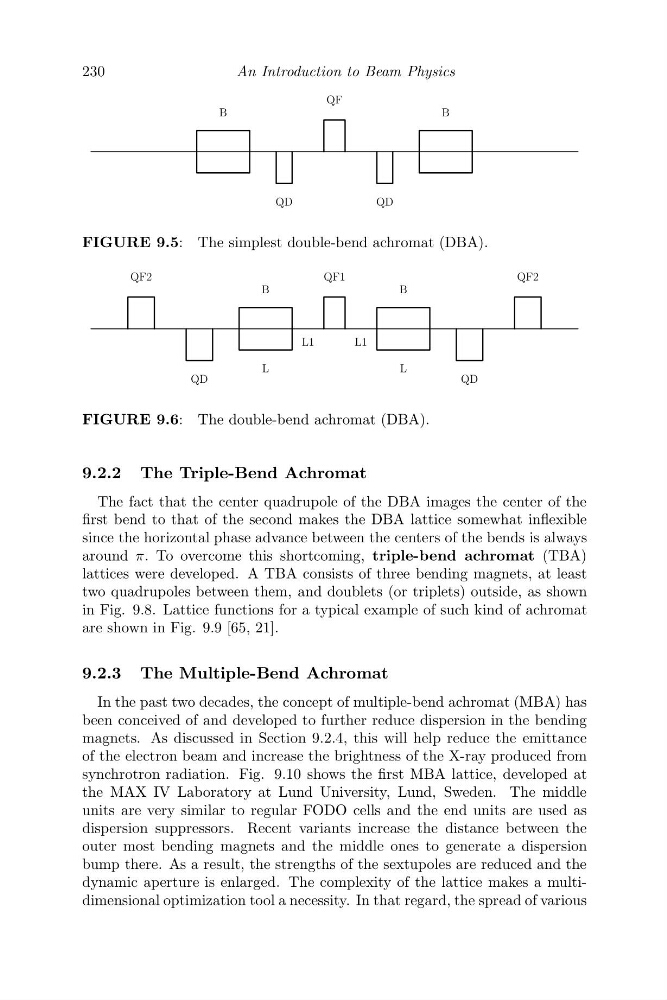
FIGURE 9.5: The simplest double-bend achromat (DBA).
B
B
QF1
QD
QD
QF2
QF2
L
L
L1
L1
FIGURE 9.6: The double-bend achromat (DBA).
9.2.2 The Triple-Bend Achromat
The fact that the center quadrupole of the DBA images the center of the
first bend to that of the second makes the DBA lattice somewhat inflexible
since the horizontal phase advance between the centers of the bends is always
around π. To overcome this shortcoming, triple-bend achromat (TBA)
lattices were developed. A TBA consists of three bending magnets, at least
two quadrupoles between them, and doublets (or triplets) outside, as shown
in Fig. 9.8. Lattice functions for a typical example of such kind of achromat
are shown in Fig. 9.9 [65, 21].
9.2.3 The Multiple-Bend Achromat
In the past two decades, the concept of multiple-bend achromat (MBA) has
been conceived of and developed to further reduce dispersion in the bending
magnets. As discussed in Section 9.2.4, this will help reduce the emittance
of the electron beam and increase the brightness of the X-ray produced from
synchrotron radiation. Fig. 9.10 shows the first MBA lattice, developed at
the MAX IV Laboratory at Lund University, Lund, Sweden. The middle
units are very similar to regular FODO cells and the end units are used as
dispersion suppressors. Recent variants increase the distance between the
outer most bending magnets and the middle ones to generate a dispersion
bump there. As a result, the strengths of the sextupoles are reduced and the
dynamic aperture is enlarged. The complexity of the lattice makes a multidimensional optimization tool a necessity. In that regard, the spread of various
An Introduction to Beam Physics
B
B
QF
QD
QD
FIGURE 9.5: The simplest double-bend achromat (DBA).
B
B
QF1
QD
QD
QF2
QF2
L
L
L1
L1
FIGURE 9.6: The double-bend achromat (DBA).
9.2.2 The Triple-Bend Achromat
The fact that the center quadrupole of the DBA images the center of the
first bend to that of the second makes the DBA lattice somewhat inflexible
since the horizontal phase advance between the centers of the bends is always
around π. To overcome this shortcoming, triple-bend achromat (TBA)
lattices were developed. A TBA consists of three bending magnets, at least
two quadrupoles between them, and doublets (or triplets) outside, as shown
in Fig. 9.8. Lattice functions for a typical example of such kind of achromat
are shown in Fig. 9.9 [65, 21].
9.2.3 The Multiple-Bend Achromat
In the past two decades, the concept of multiple-bend achromat (MBA) has
been conceived of and developed to further reduce dispersion in the bending
magnets. As discussed in Section 9.2.4, this will help reduce the emittance
of the electron beam and increase the brightness of the X-ray produced from
synchrotron radiation. Fig. 9.10 shows the first MBA lattice, developed at
the MAX IV Laboratory at Lund University, Lund, Sweden. The middle
units are very similar to regular FODO cells and the end units are used as
dispersion suppressors. Recent variants increase the distance between the
outer most bending magnets and the middle ones to generate a dispersion
bump there. As a result, the strengths of the sextupoles are reduced and the
dynamic aperture is enlarged. The complexity of the lattice makes a multidimensional optimization tool a necessity. In that regard, the spread of various