

Lattice Modules
211
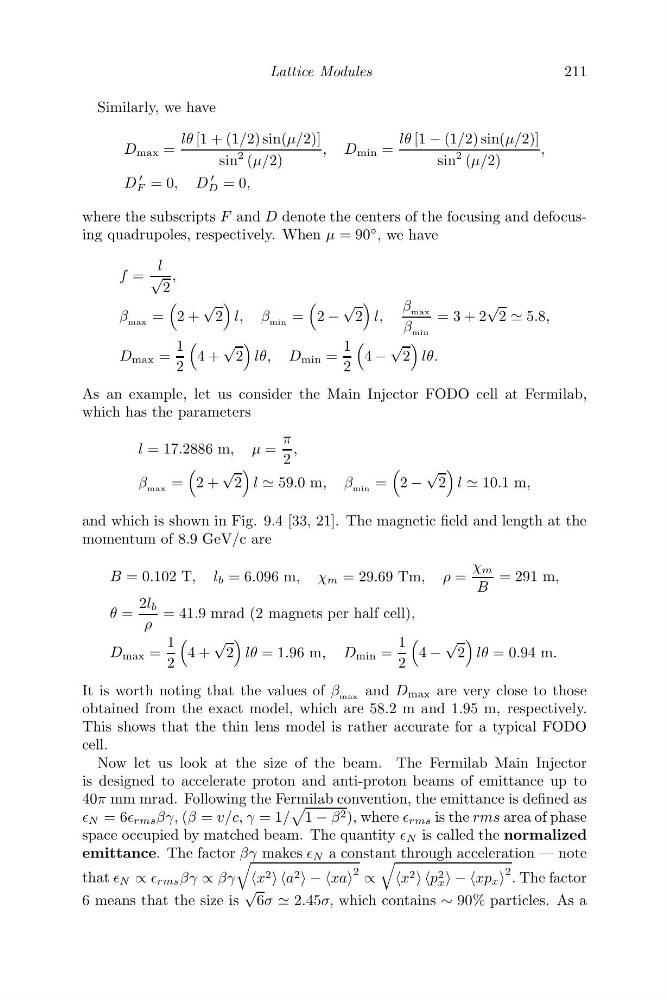
Similarly, we have
D max =
lθ [1 + (1/2) sin(μ/2)]
sin
2 (μ/2)
, D min =
lθ [1 − (1/2) sin(μ/2)]
sin
2 (μ/2)
,
D
F = 0, D
D = 0,
where the subscripts F and D denote the centers of the focusing and defocusing quadrupoles, respectively. When μ = 90
◦ , we have
f =
l
√
2
,
β max =
2 +
√
2
l, β min =
2 −
√
2
l,
β max
β min
= 3 + 2
√
2 5.8,
D max =
1
2
4 +
√
2
lθ, D min =
1
2
4 −
√
2
lθ.
As an example, let us consider the Main Injector FODO cell at Fermilab,
which has the parameters
l = 17.2886 m, μ =
π
2
,
β max =
2 +
√
2
l 59.0 m, β min =
2 −
√
2
l 10.1 m,
and which is shown in Fig. 9.4 [33, 21]. The magnetic field and length at the
momentum of 8.9 GeV/c are
B = 0.102 T, l b = 6.096 m, χ m = 29.69 Tm, ρ =
χ m
B
= 291 m,
θ =
2l b
ρ
= 41.9 mrad (2 magnets per half cell),
D max =
1
2
4 +
√
2
lθ = 1.96 m, D min =
1
2
4 −
√
2
lθ = 0.94 m.
It is worth noting that the values of β max and D max are very close to those
obtained from the exact model, which are 58.2 m and 1.95 m, respectively.
This shows that the thin lens model is rather accurate for a typical FODO
cell.
Now let us look at the size of the beam. The Fermilab Main Injector
is designed to accelerate proton and anti-proton beams of emittance up to
40π mm mrad. Following the Fermilab convention, the emittance is defined as
N = 6 rms βγ, (β = v/c, γ = 1/
1 − β 2 ), where rms is the rms area of phase
space occupied by matched beam. The quantity N is called the normalized
emittance. The factor βγ makes N a constant through acceleration — note
that N ∝ rms βγ ∝ βγ
x 2 a 2 − −xa
2 ∝
x 2 p 2
x − −xp x
2 . The factor
6 means that the size is
√
6σ 2.45σ, which contains ∼ 90% particles. As a
211
Similarly, we have
D max =
lθ [1 + (1/2) sin(μ/2)]
sin
2 (μ/2)
, D min =
lθ [1 − (1/2) sin(μ/2)]
sin
2 (μ/2)
,
D
F = 0, D
D = 0,
where the subscripts F and D denote the centers of the focusing and defocusing quadrupoles, respectively. When μ = 90
◦ , we have
f =
l
√
2
,
β max =
2 +
√
2
l, β min =
2 −
√
2
l,
β max
β min
= 3 + 2
√
2 5.8,
D max =
1
2
4 +
√
2
lθ, D min =
1
2
4 −
√
2
lθ.
As an example, let us consider the Main Injector FODO cell at Fermilab,
which has the parameters
l = 17.2886 m, μ =
π
2
,
β max =
2 +
√
2
l 59.0 m, β min =
2 −
√
2
l 10.1 m,
and which is shown in Fig. 9.4 [33, 21]. The magnetic field and length at the
momentum of 8.9 GeV/c are
B = 0.102 T, l b = 6.096 m, χ m = 29.69 Tm, ρ =
χ m
B
= 291 m,
θ =
2l b
ρ
= 41.9 mrad (2 magnets per half cell),
D max =
1
2
4 +
√
2
lθ = 1.96 m, D min =
1
2
4 −
√
2
lθ = 0.94 m.
It is worth noting that the values of β max and D max are very close to those
obtained from the exact model, which are 58.2 m and 1.95 m, respectively.
This shows that the thin lens model is rather accurate for a typical FODO
cell.
Now let us look at the size of the beam. The Fermilab Main Injector
is designed to accelerate proton and anti-proton beams of emittance up to
40π mm mrad. Following the Fermilab convention, the emittance is defined as
N = 6 rms βγ, (β = v/c, γ = 1/
1 − β 2 ), where rms is the rms area of phase
space occupied by matched beam. The quantity N is called the normalized
emittance. The factor βγ makes N a constant through acceleration — note
that N ∝ rms βγ ∝ βγ
x 2 a 2 − −xa
2 ∝
x 2 p 2
x − −xp x
2 . The factor
6 means that the size is
√
6σ 2.45σ, which contains ∼ 90% particles. As a