

212
An Introduction to Beam Physics
VP
&(//
β P
'[ P
β [
β \
'[
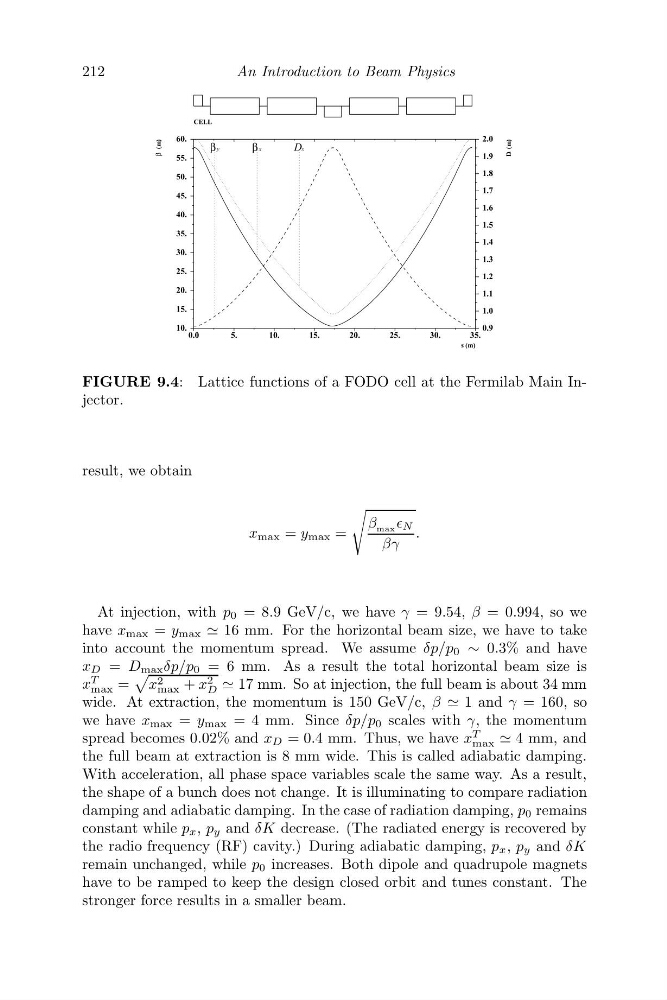
FIGURE 9.4: Lattice functions of a FODO cell at the Fermilab Main Injector.
result, we obtain
x max = y max =
β max N
βγ
.
At injection, with p 0 = 8.9 GeV/c, we have γ = 9.54, β = 0.994, so we
have x max = y max 16 mm. For the horizontal beam size, we have to take
into account the momentum spread. We assume δp/p 0 ∼ 0.3% and have
x D = D max δp/p 0 = 6 mm. As a result the total horizontal beam size is
x
T
max =
x 2
max + x 2
D 17 mm. So at injection, the full beam is about 34 mm
wide. At extraction, the momentum is 150 GeV/c, β 1 and γ = 160, so
we have x max = y max = 4 mm. Since δp/p 0 scales with γ, the momentum
spread becomes 0.02% and x D = 0.4 mm. Thus, we have x
T
max 4 mm, and
the full beam at extraction is 8 mm wide. This is called adiabatic damping.
With acceleration, all phase space variables scale the same way. As a result,
the shape of a bunch does not change. It is illuminating to compare radiation
damping and adiabatic damping. In the case of radiation damping, p 0 remains
constant while p x , p y and δK decrease. (The radiated energy is recovered by
the radio frequency (RF) cavity.) During adiabatic damping, p x , p y and δK
remain unchanged, while p 0 increases. Both dipole and quadrupole magnets
have to be ramped to keep the design closed orbit and tunes constant. The
stronger force results in a smaller beam.
An Introduction to Beam Physics
VP
&(//
β P
'[ P
β [
β \
'[
FIGURE 9.4: Lattice functions of a FODO cell at the Fermilab Main Injector.
result, we obtain
x max = y max =
β max N
βγ
.
At injection, with p 0 = 8.9 GeV/c, we have γ = 9.54, β = 0.994, so we
have x max = y max 16 mm. For the horizontal beam size, we have to take
into account the momentum spread. We assume δp/p 0 ∼ 0.3% and have
x D = D max δp/p 0 = 6 mm. As a result the total horizontal beam size is
x
T
max =
x 2
max + x 2
D 17 mm. So at injection, the full beam is about 34 mm
wide. At extraction, the momentum is 150 GeV/c, β 1 and γ = 160, so
we have x max = y max = 4 mm. Since δp/p 0 scales with γ, the momentum
spread becomes 0.02% and x D = 0.4 mm. Thus, we have x
T
max 4 mm, and
the full beam at extraction is 8 mm wide. This is called adiabatic damping.
With acceleration, all phase space variables scale the same way. As a result,
the shape of a bunch does not change. It is illuminating to compare radiation
damping and adiabatic damping. In the case of radiation damping, p 0 remains
constant while p x , p y and δK decrease. (The radiated energy is recovered by
the radio frequency (RF) cavity.) During adiabatic damping, p x , p y and δK
remain unchanged, while p 0 increases. Both dipole and quadrupole magnets
have to be ramped to keep the design closed orbit and tunes constant. The
stronger force results in a smaller beam.