

210
An Introduction to Beam Physics
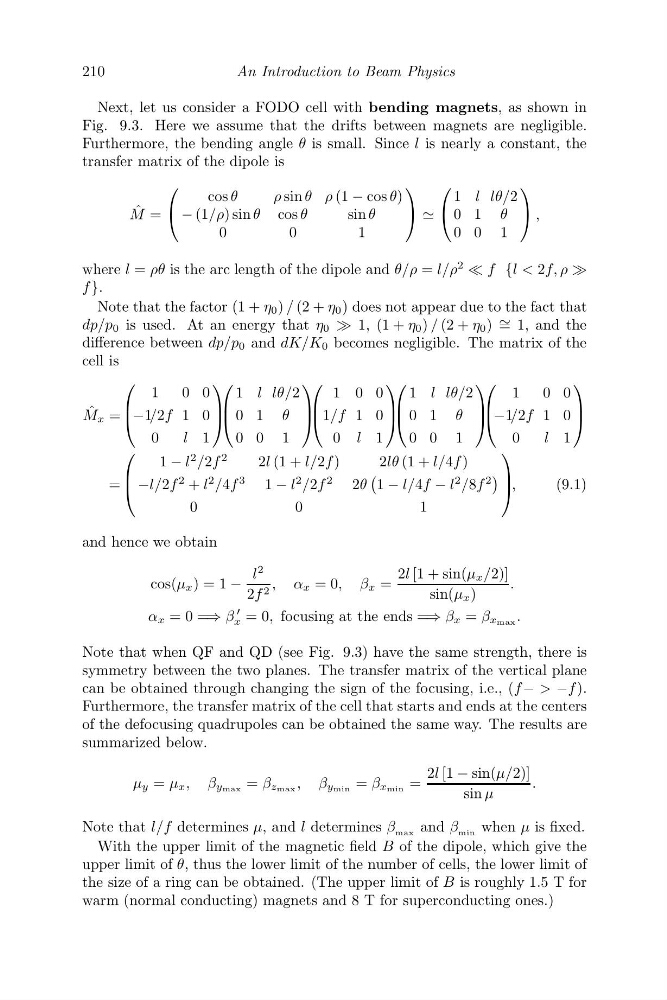
Next, let us consider a FODO cell with bending magnets, as shown in
Fig. 9.3. Here we assume that the drifts between magnets are negligible.
Furthermore, the bending angle θ is small. Since l is nearly a constant, the
transfer matrix of the dipole is
ˆ
M =
⎛
⎝
cos θ
ρsin θ ρ(1 − cos θ)
− (1/ρ) sin θ cos θ
sin θ
0
0
1
⎞
⎠
⎛
⎝
1 l lθ/2
0 1 θ
0 0 1
⎞
⎠ ,
where l = ρθ is the arc length of the dipole and θ/ρ = l/ρ
2
f {l < 2f, ρ
f }.
Note that the factor (1 + η 0 ) / (2 + η 0 ) does not appear due to the fact that
dp/p 0 is used. At an energy that η 0 1, (1 + η 0 ) / (2 + η 0 ) ∼ = 1, and the
difference between dp/p 0 and dK/K 0 becomes negligible. The matrix of the
cell is
ˆ
M x =
⎛
⎜
⎝
1
0 0
−1/2f 1 0
0
l 1
⎞
⎟
⎠
⎛
⎜
⎝
1 l lθ/2
0 1 θ
0 0 1
⎞
⎟
⎠
⎛
⎜
⎝
1 0 0
1/f 1 0
0 l 1
⎞
⎟
⎠
⎛
⎜
⎝
1 l lθ/2
0 1 θ
0 0 1
⎞
⎟
⎠
⎛
⎜
⎝
1
0 0
−1/2f 1 0
0
l 1
⎞
⎟
⎠
=
⎛
⎜
⎝
1 − l
2 /2f
2
2l (1 + l/2f )
2lθ (1 + l/4f )
−l/2f
2 + l
2 /4f
3
1 − l
2 /2f
2
2θ
1 − l/4f − l
2 /8f
2
0
0
1
⎞
⎟
⎠,
(9.1)
and hence we obtain
cos(μ x ) = 1 −
l
2
2f 2 , α x = 0, β x =
2l [1 + sin(μ x /2)]
sin(μ x )
.
α x = 0 =⇒ β
x = 0, focusing at the ends =⇒ β x = β xmax .
Note that when QF and QD (see Fig. 9.3) have the same strength, there is
symmetry between the two planes. The transfer matrix of the vertical plane
can be obtained through changing the sign of the focusing, i.e., (f − > −f ).
Furthermore, the transfer matrix of the cell that starts and ends at the centers
of the defocusing quadrupoles can be obtained the same way. The results are
summarized below.
μ y = μ x , β ymax = β zmax , β ymin = β xmin =
2l [1 − sin(μ/2)]
sin μ
.
Note that l/f determines μ, and l determines β max and β min when μ is fixed.
With the upper limit of the magnetic field B of the dipole, which give the
upper limit of θ, thus the lower limit of the number of cells, the lower limit of
the size of a ring can be obtained. (The upper limit of B is roughly 1.5 T for
warm (normal conducting) magnets and 8 T for superconducting ones.)
An Introduction to Beam Physics
Next, let us consider a FODO cell with bending magnets, as shown in
Fig. 9.3. Here we assume that the drifts between magnets are negligible.
Furthermore, the bending angle θ is small. Since l is nearly a constant, the
transfer matrix of the dipole is
ˆ
M =
⎛
⎝
cos θ
ρsin θ ρ(1 − cos θ)
− (1/ρ) sin θ cos θ
sin θ
0
0
1
⎞
⎠
⎛
⎝
1 l lθ/2
0 1 θ
0 0 1
⎞
⎠ ,
where l = ρθ is the arc length of the dipole and θ/ρ = l/ρ
2
f {l < 2f, ρ
f }.
Note that the factor (1 + η 0 ) / (2 + η 0 ) does not appear due to the fact that
dp/p 0 is used. At an energy that η 0 1, (1 + η 0 ) / (2 + η 0 ) ∼ = 1, and the
difference between dp/p 0 and dK/K 0 becomes negligible. The matrix of the
cell is
ˆ
M x =
⎛
⎜
⎝
1
0 0
−1/2f 1 0
0
l 1
⎞
⎟
⎠
⎛
⎜
⎝
1 l lθ/2
0 1 θ
0 0 1
⎞
⎟
⎠
⎛
⎜
⎝
1 0 0
1/f 1 0
0 l 1
⎞
⎟
⎠
⎛
⎜
⎝
1 l lθ/2
0 1 θ
0 0 1
⎞
⎟
⎠
⎛
⎜
⎝
1
0 0
−1/2f 1 0
0
l 1
⎞
⎟
⎠
=
⎛
⎜
⎝
1 − l
2 /2f
2
2l (1 + l/2f )
2lθ (1 + l/4f )
−l/2f
2 + l
2 /4f
3
1 − l
2 /2f
2
2θ
1 − l/4f − l
2 /8f
2
0
0
1
⎞
⎟
⎠,
(9.1)
and hence we obtain
cos(μ x ) = 1 −
l
2
2f 2 , α x = 0, β x =
2l [1 + sin(μ x /2)]
sin(μ x )
.
α x = 0 =⇒ β
x = 0, focusing at the ends =⇒ β x = β xmax .
Note that when QF and QD (see Fig. 9.3) have the same strength, there is
symmetry between the two planes. The transfer matrix of the vertical plane
can be obtained through changing the sign of the focusing, i.e., (f − > −f ).
Furthermore, the transfer matrix of the cell that starts and ends at the centers
of the defocusing quadrupoles can be obtained the same way. The results are
summarized below.
μ y = μ x , β ymax = β zmax , β ymin = β xmin =
2l [1 − sin(μ/2)]
sin μ
.
Note that l/f determines μ, and l determines β max and β min when μ is fixed.
With the upper limit of the magnetic field B of the dipole, which give the
upper limit of θ, thus the lower limit of the number of cells, the lower limit of
the size of a ring can be obtained. (The upper limit of B is roughly 1.5 T for
warm (normal conducting) magnets and 8 T for superconducting ones.)