

208
An Introduction to Beam Physics
d
2
d
2
d
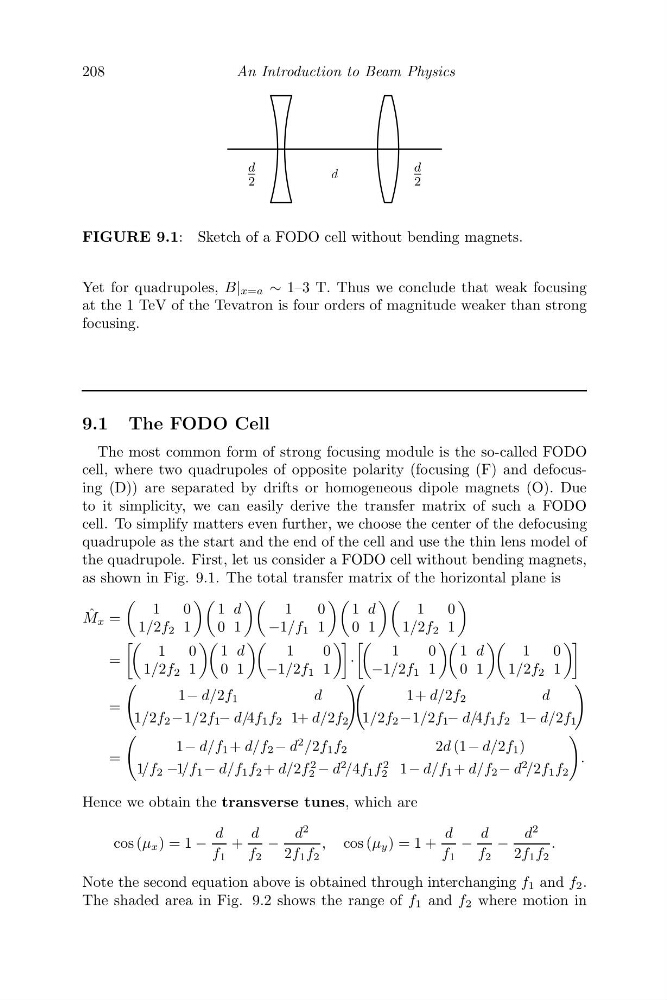
FIGURE 9.1: Sketch of a FODO cell without bending magnets.
Yet for quadrupoles, B| x=a ∼ 1–3 T. Thus we conclude that weak focusing
at the 1 TeV of the Tevatron is four orders of magnitude weaker than strong
focusing.
9.1 The FODO Cell
The most common form of strong focusing module is the so-called FODO
cell, where two quadrupoles of opposite polarity (focusing (F) and defocusing (D)) are separated by drifts or homogeneous dipole magnets (O). Due
to it simplicity, we can easily derive the transfer matrix of such a FODO
cell. To simplify matters even further, we choose the center of the defocusing
quadrupole as the start and the end of the cell and use the thin lens model of
the quadrupole. First, let us consider a FODO cell without bending magnets,
as shown in Fig. 9.1. The total transfer matrix of the horizontal plane is
ˆ
M x =
1
0
1/2f 2 1
1 d
0 1
1
0
−1/f 1 1
1 d
0 1
1
0
1/2f 2 1
=
1
0
1/2f 2 1
1 d
0 1
1
0
−1/2f 1 1
·
1
0
−1/2f 1 1
1 d
0 1
1
0
1/2f 2 1
=
1− d/2f 1
d
1/2f 2 −1/2f 1 − d/4f 1 f 2 1+ d/2f 2
1+ d/2f 2
d
1/2f 2 −1/2f 1 − d/4f 1 f 2 1− d/2f 1
=
1− d/f 1 + d/f 2 − d
2 /2f 1 f 2
2d (1− d/2f 1 )
1/f 2 −1/f 1 − d/f 1 f 2 + d/2f
2
2 − d
2
/4f 1 f
2
2 1− d/f 1 + d/f 2 − d
2
/2f 1 f 2
.
Hence we obtain the transverse tunes, which are
cos (μ x ) = 1 −
d
f 1
+
d
f 2
−
d
2
2f 1 f 2
, cos (μ y ) = 1 +
d
f 1
−
d
f 2
−
d
2
2f 1 f 2
.
Note the second equation above is obtained through interchanging f 1 and f 2 .
The shaded area in Fig. 9.2 shows the range of f 1 and f 2 where motion in
An Introduction to Beam Physics
d
2
d
2
d
FIGURE 9.1: Sketch of a FODO cell without bending magnets.
Yet for quadrupoles, B| x=a ∼ 1–3 T. Thus we conclude that weak focusing
at the 1 TeV of the Tevatron is four orders of magnitude weaker than strong
focusing.
9.1 The FODO Cell
The most common form of strong focusing module is the so-called FODO
cell, where two quadrupoles of opposite polarity (focusing (F) and defocusing (D)) are separated by drifts or homogeneous dipole magnets (O). Due
to it simplicity, we can easily derive the transfer matrix of such a FODO
cell. To simplify matters even further, we choose the center of the defocusing
quadrupole as the start and the end of the cell and use the thin lens model of
the quadrupole. First, let us consider a FODO cell without bending magnets,
as shown in Fig. 9.1. The total transfer matrix of the horizontal plane is
ˆ
M x =
1
0
1/2f 2 1
1 d
0 1
1
0
−1/f 1 1
1 d
0 1
1
0
1/2f 2 1
=
1
0
1/2f 2 1
1 d
0 1
1
0
−1/2f 1 1
·
1
0
−1/2f 1 1
1 d
0 1
1
0
1/2f 2 1
=
1− d/2f 1
d
1/2f 2 −1/2f 1 − d/4f 1 f 2 1+ d/2f 2
1+ d/2f 2
d
1/2f 2 −1/2f 1 − d/4f 1 f 2 1− d/2f 1
=
1− d/f 1 + d/f 2 − d
2 /2f 1 f 2
2d (1− d/2f 1 )
1/f 2 −1/f 1 − d/f 1 f 2 + d/2f
2
2 − d
2
/4f 1 f
2
2 1− d/f 1 + d/f 2 − d
2
/2f 1 f 2
.
Hence we obtain the transverse tunes, which are
cos (μ x ) = 1 −
d
f 1
+
d
f 2
−
d
2
2f 1 f 2
, cos (μ y ) = 1 +
d
f 1
−
d
f 2
−
d
2
2f 1 f 2
.
Note the second equation above is obtained through interchanging f 1 and f 2 .
The shaded area in Fig. 9.2 shows the range of f 1 and f 2 where motion in