

Chapter 9
Lattice Modules
In the design of actual devices for the manipulation of beams, it is important to employ field arrangements that achieve the basic features of steering
the beam as a whole to its desired location, as well as keeping the beam
close together over possibly extended distances, which is achieved through
various focusing mechanisms. Thus in both single pass lines and rings, there
exist different sections that perform different functions which require different types of lattice modules. Modern accelerators and beam transport lines
focus the beam transversely using alternate-gradient focusing, also called
strong focusing, which evolves from the so-called weak focusing used in
betatrons and early weak focusing synchrotrons. In the weak focusing machines, inhomogeneous dipoles were used to bend and transversely confine the
beam simultaneously. This is possible due to the fact that an inhomogeneous
dipole with 0 < n < 1 focuses the beam in both x and y planes.
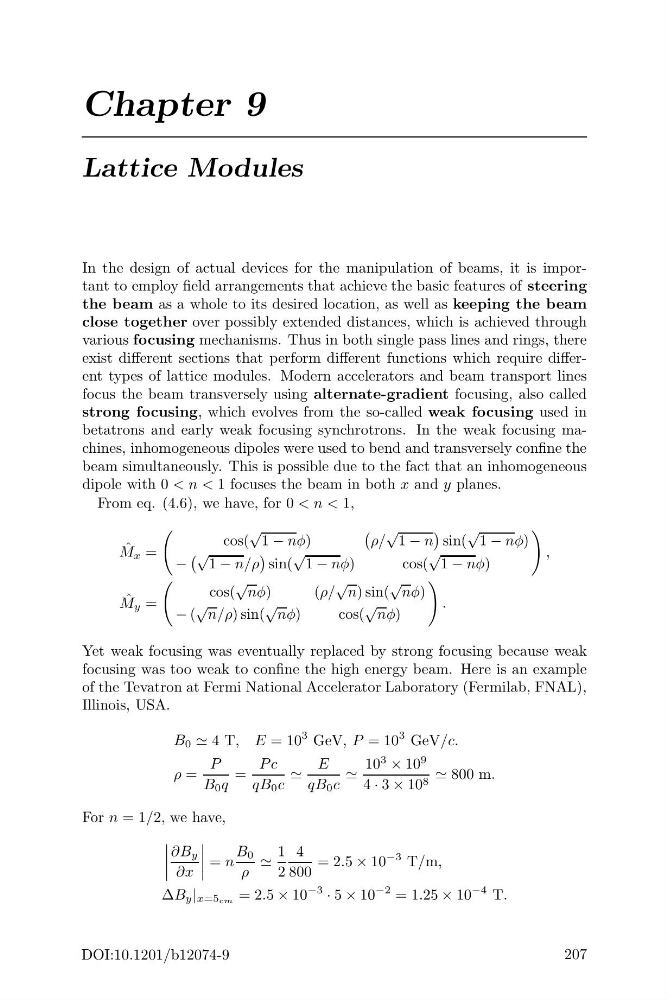
From eq. (4.6), we have, for 0 < n < 1,
ˆ
M x =
cos(
√
1 − nφ)
ρ/
√
1 − n
sin(
√
1 − nφ)
−
√
1 − n/ρ
sin(
√
1 − nφ)
c o s (
√
1 − nφ)
,
ˆ
M y =
cos(
√
nφ)
(ρ/
√
n) sin(
√
nφ)
− (
√
n/ρ) sin(
√
nφ)
cos(
√ nφ)
.
Yet weak focusing was eventually replaced by strong focusing because weak
focusing was too weak to confine the high energy beam. Here is an example
of the Tevatron at Fermi National Accelerator Laboratory (Fermilab, FNAL),
Illinois, USA.
B 0 4 T, E = 10
3 GeV, P = 10
3 GeV/c.
ρ =
P
B 0 q
=
P c
qB 0 c
E
qB 0 c
10
3
× 10
9
4 · 3 × 10 8 800 m.
For n = 1/2, we have,
∂B y
∂x
= n
B 0
ρ
1
2
4
800
= 2.5 × 10
−3 T/m,
ΔB y | x=5cm = 2.5 × 10
−3
· 5 × 10
−2 = 1.25 × 10
−4 T.
207
DOI:10.1201/b12074-9
Lattice Modules
In the design of actual devices for the manipulation of beams, it is important to employ field arrangements that achieve the basic features of steering
the beam as a whole to its desired location, as well as keeping the beam
close together over possibly extended distances, which is achieved through
various focusing mechanisms. Thus in both single pass lines and rings, there
exist different sections that perform different functions which require different types of lattice modules. Modern accelerators and beam transport lines
focus the beam transversely using alternate-gradient focusing, also called
strong focusing, which evolves from the so-called weak focusing used in
betatrons and early weak focusing synchrotrons. In the weak focusing machines, inhomogeneous dipoles were used to bend and transversely confine the
beam simultaneously. This is possible due to the fact that an inhomogeneous
dipole with 0 < n < 1 focuses the beam in both x and y planes.
From eq. (4.6), we have, for 0 < n < 1,
ˆ
M x =
cos(
√
1 − nφ)
ρ/
√
1 − n
sin(
√
1 − nφ)
−
√
1 − n/ρ
sin(
√
1 − nφ)
c o s (
√
1 − nφ)
,
ˆ
M y =
cos(
√
nφ)
(ρ/
√
n) sin(
√
nφ)
− (
√
n/ρ) sin(
√
nφ)
cos(
√ nφ)
.
Yet weak focusing was eventually replaced by strong focusing because weak
focusing was too weak to confine the high energy beam. Here is an example
of the Tevatron at Fermi National Accelerator Laboratory (Fermilab, FNAL),
Illinois, USA.
B 0 4 T, E = 10
3 GeV, P = 10
3 GeV/c.
ρ =
P
B 0 q
=
P c
qB 0 c
E
qB 0 c
10
3
× 10
9
4 · 3 × 10 8 800 m.
For n = 1/2, we have,
∂B y
∂x
= n
B 0
ρ
1
2
4
800
= 2.5 × 10
−3 T/m,
ΔB y | x=5cm = 2.5 × 10
−3
· 5 × 10
−2 = 1.25 × 10
−4 T.
207
DOI:10.1201/b12074-9