

196
An Introduction to Beam Physics
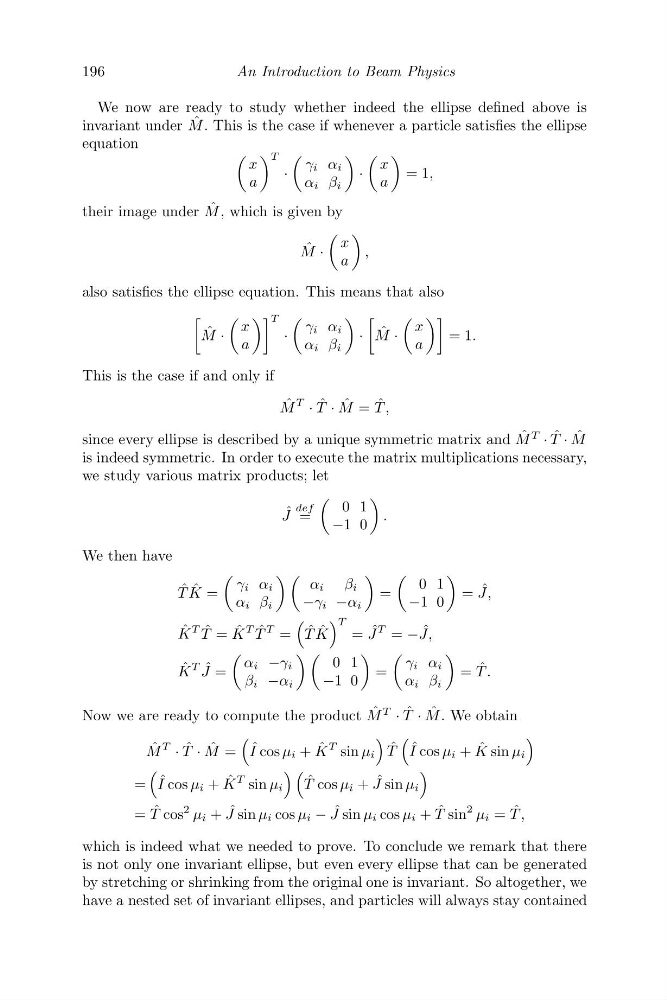
We now are ready to study whether indeed the ellipse defined above is
invariant under ˆ
M . This is the case if whenever a particle satisfies the ellipse
equation
x
a
T
·
γ i α i
α i β i
·
x
a
= 1,
their image under ˆ
M , which is given by
ˆ
M ·
x
a
,
also satisfies the ellipse equation. This means that also
ˆ
M ·
x
a
T
·
γ i α i
α i β i
·
ˆ
M ·
x
a
= 1.
This is the case if and only if
ˆ
M
T
· ˆ
T · ˆ
M = ˆ
T ,
since every ellipse is described by a unique symmetric matrix and ˆ
M
T
· ˆ
T · ˆ
M
is indeed symmetric. In order to execute the matrix multiplications necessary,
we study various matrix products; let
ˆ
J
def
=
0 1
−1 0
.
We then have
ˆ
T ˆ
K =
γ i α i
α i β i
α i β i
−γ i −α i
=
0 1
−1 0
= ˆ
J,
ˆ
K
T ˆ
T = ˆ
K
T ˆ
T
T =
ˆ
T ˆ
K
T
= ˆ
J
T = − ˆ
J,
ˆ
K
T ˆ
J =
α i −γ i
β i −α i
0 1
−1 0
=
γ i α i
α i β i
= ˆ
T .
Now we are ready to compute the product ˆ
M
T
· ˆ
T · ˆ
M . We obtain
ˆ
M
T
· ˆ
T · ˆ
M =
ˆ
I cos μ i + ˆ
K
T sin μ i
ˆ
T
ˆ
I cos μ i + ˆ
K sin μ i
=
ˆ
I cos μ i + ˆ
K
T sin μ i
ˆ
T cos μ i + ˆ
J sin μ i
= ˆ
T cos
2 μ i + ˆ
J sin μ i cos μ i − ˆ
J sin μ i cos μ i + ˆ
T sin
2 μ i = ˆ
T ,
which is indeed what we needed to prove. To conclude we remark that there
is not only one invariant ellipse, but even every ellipse that can be generated
by stretching or shrinking from the original one is invariant. So altogether, we
have a nested set of invariant ellipses, and particles will always stay contained
An Introduction to Beam Physics
We now are ready to study whether indeed the ellipse defined above is
invariant under ˆ
M . This is the case if whenever a particle satisfies the ellipse
equation
x
a
T
·
γ i α i
α i β i
·
x
a
= 1,
their image under ˆ
M , which is given by
ˆ
M ·
x
a
,
also satisfies the ellipse equation. This means that also
ˆ
M ·
x
a
T
·
γ i α i
α i β i
·
ˆ
M ·
x
a
= 1.
This is the case if and only if
ˆ
M
T
· ˆ
T · ˆ
M = ˆ
T ,
since every ellipse is described by a unique symmetric matrix and ˆ
M
T
· ˆ
T · ˆ
M
is indeed symmetric. In order to execute the matrix multiplications necessary,
we study various matrix products; let
ˆ
J
def
=
0 1
−1 0
.
We then have
ˆ
T ˆ
K =
γ i α i
α i β i
α i β i
−γ i −α i
=
0 1
−1 0
= ˆ
J,
ˆ
K
T ˆ
T = ˆ
K
T ˆ
T
T =
ˆ
T ˆ
K
T
= ˆ
J
T = − ˆ
J,
ˆ
K
T ˆ
J =
α i −γ i
β i −α i
0 1
−1 0
=
γ i α i
α i β i
= ˆ
T .
Now we are ready to compute the product ˆ
M
T
· ˆ
T · ˆ
M . We obtain
ˆ
M
T
· ˆ
T · ˆ
M =
ˆ
I cos μ i + ˆ
K
T sin μ i
ˆ
T
ˆ
I cos μ i + ˆ
K sin μ i
=
ˆ
I cos μ i + ˆ
K
T sin μ i
ˆ
T cos μ i + ˆ
J sin μ i
= ˆ
T cos
2 μ i + ˆ
J sin μ i cos μ i − ˆ
J sin μ i cos μ i + ˆ
T sin
2 μ i = ˆ
T ,
which is indeed what we needed to prove. To conclude we remark that there
is not only one invariant ellipse, but even every ellipse that can be generated
by stretching or shrinking from the original one is invariant. So altogether, we
have a nested set of invariant ellipses, and particles will always stay contained