

194
An Introduction to Beam Physics
v 1
v 2
λ 1
λ 2
OK
OK
λ 1 λ 2 = 1
bad
bad
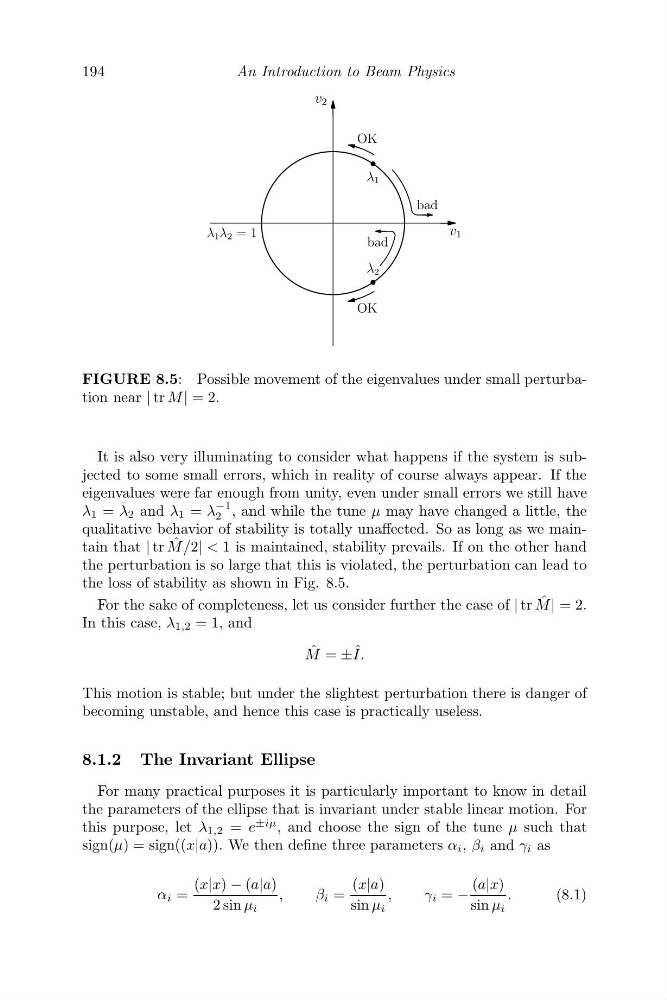
FIGURE 8.5: Possible movement of the eigenvalues under small perturbation near | tr M | = 2.
It is also very illuminating to consider what happens if the system is subjected to some small errors, which in reality of course always appear. If the
eigenvalues were far enough from unity, even under small errors we still have
λ 1 = ¯
λ 2 and λ 1 = λ
−1
2 , and while the tune μ may have changed a little, the
qualitative behavior of stability is totally unaffected. So as long as we maintain that | tr ˆ
M /2| < 1 is maintained, stability prevails. If on the other hand
the perturbation is so large that this is violated, the perturbation can lead to
the loss of stability as shown in Fig. 8.5.
For the sake of completeness, let us consider further the case of | tr ˆ
M | = 2.
In this case, λ 1,2 = 1, and
ˆ
M = ± ˆ
I.
This motion is stable; but under the slightest perturbation there is danger of
becoming unstable, and hence this case is practically useless.
8.1.2 The Invariant Ellipse
For many practical purposes it is particularly important to know in detail
the parameters of the ellipse that is invariant under stable linear motion. For
this purpose, let λ 1,2 = e
±iμ , and choose the sign of the tune μ such that
sign(μ) = sign((x|a)). We then define three parameters α i , β i and γ i as
α i =
(x|x) − (a|a)
2 sin μ i
,
β i =
(x|a)
sin μ i
,
γ i = −
(a|x)
sin μ i
.
(8.1)
An Introduction to Beam Physics
v 1
v 2
λ 1
λ 2
OK
OK
λ 1 λ 2 = 1
bad
bad
FIGURE 8.5: Possible movement of the eigenvalues under small perturbation near | tr M | = 2.
It is also very illuminating to consider what happens if the system is subjected to some small errors, which in reality of course always appear. If the
eigenvalues were far enough from unity, even under small errors we still have
λ 1 = ¯
λ 2 and λ 1 = λ
−1
2 , and while the tune μ may have changed a little, the
qualitative behavior of stability is totally unaffected. So as long as we maintain that | tr ˆ
M /2| < 1 is maintained, stability prevails. If on the other hand
the perturbation is so large that this is violated, the perturbation can lead to
the loss of stability as shown in Fig. 8.5.
For the sake of completeness, let us consider further the case of | tr ˆ
M | = 2.
In this case, λ 1,2 = 1, and
ˆ
M = ± ˆ
I.
This motion is stable; but under the slightest perturbation there is danger of
becoming unstable, and hence this case is practically useless.
8.1.2 The Invariant Ellipse
For many practical purposes it is particularly important to know in detail
the parameters of the ellipse that is invariant under stable linear motion. For
this purpose, let λ 1,2 = e
±iμ , and choose the sign of the tune μ such that
sign(μ) = sign((x|a)). We then define three parameters α i , β i and γ i as
α i =
(x|x) − (a|a)
2 sin μ i
,
β i =
(x|a)
sin μ i
,
γ i = −
(a|x)
sin μ i
.
(8.1)