

The Periodic Transport
193
x
a v −
v +
v +
v −
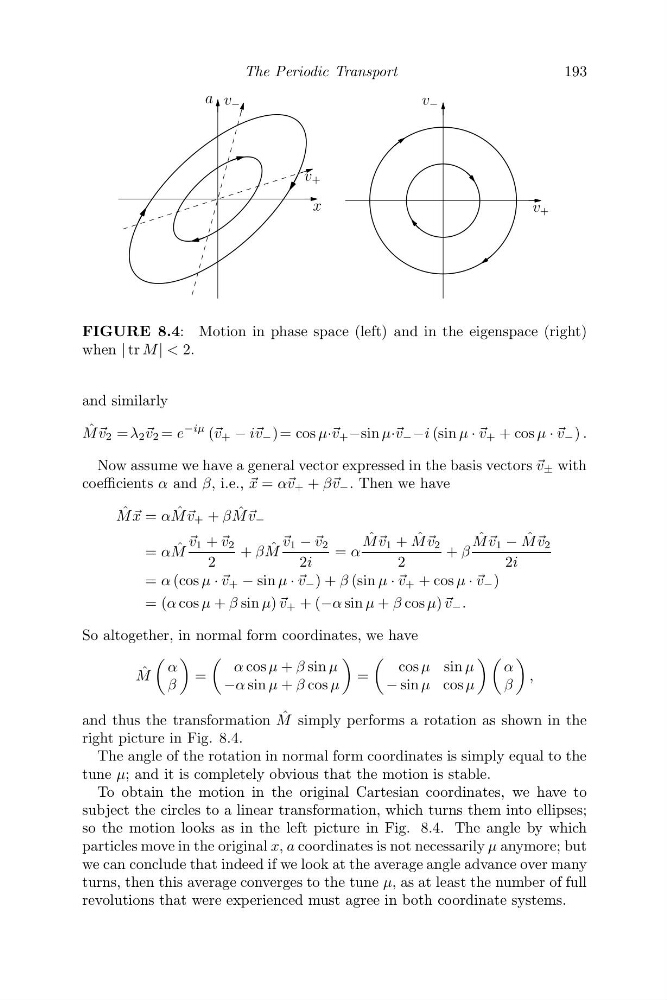
FIGURE 8.4: Motion in phase space (left) and in the eigenspace (right)
when | tr M | < 2.
and similarly
ˆ
MM v 2 = λ 2 v 2 = e
−iμ ( v + − ii v − )= cos μ· v + −sin μ· v − −i (sin μ · v + + cos μ · v − ) .
Now assume we have a general vector expressed in the basis vectors v ± with
coefficients α and β, i.e., x = αα v + + ββ v − . Then we have
ˆ
MM x = α ˆ
MM v + + β ˆ
MM v −
= α ˆ
M
v 1 + v 2
2
+ β ˆ
M
v 1 − v 2
2i
= α
ˆ
MM v 1 + ˆ
MM v 2
2
+ β
ˆ
MM v 1 − ˆ
MM v 2
2i
= α (cos μ · v + − sin μ · v − ) + β (sin μ · v + + cos μ · v − )
= (α cos μ + β sin μ) v + + (−α sin μ + β cos μ) v − .
So altogether, in normal form coordinates, we have
ˆ
M
α
β
=
α cos μ + β sin μ
−α sin μ + β cos μ
=
cos μ sin μ
− sin μ cos μ
α
β
,
and thus the transformation ˆ
M simply performs a rotation as shown in the
right picture in Fig. 8.4.
The angle of the rotation in normal form coordinates is simply equal to the
tune μ; and it is completely obvious that the motion is stable.
To obtain the motion in the original Cartesian coordinates, we have to
subject the circles to a linear transformation, which turns them into ellipses;
so the motion looks as in the left picture in Fig. 8.4. The angle by which
particles move in the original x, a coordinates is not necessarily μ anymore; but
we can conclude that indeed if we look at the average angle advance over many
turns, then this average converges to the tune μ, as at least the number of full
revolutions that were experienced must agree in both coordinate systems.
193
x
a v −
v +
v +
v −
FIGURE 8.4: Motion in phase space (left) and in the eigenspace (right)
when | tr M | < 2.
and similarly
ˆ
MM v 2 = λ 2 v 2 = e
−iμ ( v + − ii v − )= cos μ· v + −sin μ· v − −i (sin μ · v + + cos μ · v − ) .
Now assume we have a general vector expressed in the basis vectors v ± with
coefficients α and β, i.e., x = αα v + + ββ v − . Then we have
ˆ
MM x = α ˆ
MM v + + β ˆ
MM v −
= α ˆ
M
v 1 + v 2
2
+ β ˆ
M
v 1 − v 2
2i
= α
ˆ
MM v 1 + ˆ
MM v 2
2
+ β
ˆ
MM v 1 − ˆ
MM v 2
2i
= α (cos μ · v + − sin μ · v − ) + β (sin μ · v + + cos μ · v − )
= (α cos μ + β sin μ) v + + (−α sin μ + β cos μ) v − .
So altogether, in normal form coordinates, we have
ˆ
M
α
β
=
α cos μ + β sin μ
−α sin μ + β cos μ
=
cos μ sin μ
− sin μ cos μ
α
β
,
and thus the transformation ˆ
M simply performs a rotation as shown in the
right picture in Fig. 8.4.
The angle of the rotation in normal form coordinates is simply equal to the
tune μ; and it is completely obvious that the motion is stable.
To obtain the motion in the original Cartesian coordinates, we have to
subject the circles to a linear transformation, which turns them into ellipses;
so the motion looks as in the left picture in Fig. 8.4. The angle by which
particles move in the original x, a coordinates is not necessarily μ anymore; but
we can conclude that indeed if we look at the average angle advance over many
turns, then this average converges to the tune μ, as at least the number of full
revolutions that were experienced must agree in both coordinate systems.