

Imaging Devices
181
f
2f
f
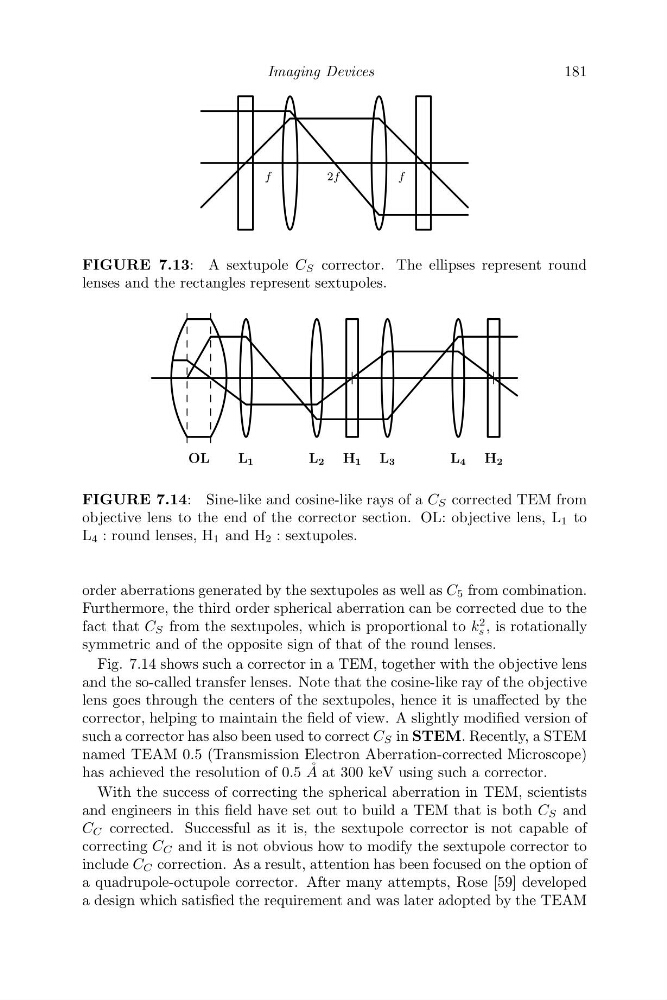
FIGURE 7.13: A sextupole C S corrector. The ellipses represent round
lenses and the rectangles represent sextupoles.
OL
H 1
H 2
L 1
L 2
L 3
L 4
FIGURE 7.14: Sine-like and cosine-like rays of a C S corrected TEM from
objective lens to the end of the corrector section. OL: objective lens, L 1 to
L 4 : round lenses, H 1 and H 2 : sextupoles.
order aberrations generated by the sextupoles as well as C 5 from combination.
Furthermore, the third order spherical aberration can be corrected due to the
fact that C S from the sextupoles, which is proportional to k
2
s , is rotationally
symmetric and of the opposite sign of that of the round lenses.
Fig. 7.14 shows such a corrector in a TEM, together with the objective lens
and the so-called transfer lenses. Note that the cosine-like ray of the objective
lens goes through the centers of the sextupoles, hence it is unaffected by the
corrector, helping to maintain the field of view. A slightly modified version of
such a corrector has also been used to correct C S in STEM. Recently, a STEM
named TEAM 0.5 (Transmission Electron Aberration-corrected Microscope)
has achieved the resolution of 0.5 ˚
A at 300 keV using such a corrector.
With the success of correcting the spherical aberration in TEM, scientists
and engineers in this field have set out to build a TEM that is both C S and
C C corrected. Successful as it is, the sextupole corrector is not capable of
correcting C C and it is not obvious how to modify the sextupole corrector to
include C C correction. As a result, attention has been focused on the option of
a quadrupole-octupole corrector. After many attempts, Rose [59] developed
a design which satisfied the requirement and was later adopted by the TEAM
181
f
2f
f
FIGURE 7.13: A sextupole C S corrector. The ellipses represent round
lenses and the rectangles represent sextupoles.
OL
H 1
H 2
L 1
L 2
L 3
L 4
FIGURE 7.14: Sine-like and cosine-like rays of a C S corrected TEM from
objective lens to the end of the corrector section. OL: objective lens, L 1 to
L 4 : round lenses, H 1 and H 2 : sextupoles.
order aberrations generated by the sextupoles as well as C 5 from combination.
Furthermore, the third order spherical aberration can be corrected due to the
fact that C S from the sextupoles, which is proportional to k
2
s , is rotationally
symmetric and of the opposite sign of that of the round lenses.
Fig. 7.14 shows such a corrector in a TEM, together with the objective lens
and the so-called transfer lenses. Note that the cosine-like ray of the objective
lens goes through the centers of the sextupoles, hence it is unaffected by the
corrector, helping to maintain the field of view. A slightly modified version of
such a corrector has also been used to correct C S in STEM. Recently, a STEM
named TEAM 0.5 (Transmission Electron Aberration-corrected Microscope)
has achieved the resolution of 0.5 ˚
A at 300 keV using such a corrector.
With the success of correcting the spherical aberration in TEM, scientists
and engineers in this field have set out to build a TEM that is both C S and
C C corrected. Successful as it is, the sextupole corrector is not capable of
correcting C C and it is not obvious how to modify the sextupole corrector to
include C C correction. As a result, attention has been focused on the option of
a quadrupole-octupole corrector. After many attempts, Rose [59] developed
a design which satisfied the requirement and was later adopted by the TEAM