

Imaging Devices
173
TABLE 7.3: Aberrations of the Browne-Buechner
spectrograph at the tilted focal plane that are 10 μm or
larger (Parameters: x max = 0.23 mm, a max = 40 mrad,
y max = 1 mm, b max = 10 mrad, δ max = 20%. Exponents:
in the initial variables x, a, y, b, l, δ)
#
Coefficient
Order
Exponents
1 -0.2300000000000000e-3 1
1 0 0 0 0 0
2
0.1038881145421565
1
0 0 0 0 0 1
3 -0.9320954298691634e-4 2
1 0 0 0 0 1
4 -0.5127000000000000e-4 2
0 0 0 2 0 0
5
0.1079501821087351e-1 2
0 0 0 0 0 2
6 -0.6562560000000000e-4 3
0 3 0 0 0 0
7
0.3324419665349009e-3 3
0 2 0 0 0 1
8 -0.2105079060488440e-3 3
0 1 0 0 0 2
9 -0.1038881145421566e-4 3
0 0 0 2 0 1
10
0.1654199766297046e-2 3
0 0 0 0 0 3
11 -0.1329767866139604e-4 4
0 3 0 0 0 1
12
0.5138469075870278e-4 4
0 2 0 0 0 2
13 -0.2242022047923136e-4 4
0 1 0 0 0 3
14
0.1745846601755523e-3 4
0 0 0 0 0 4
15
0.1305877080464639e-4 5
0 2 0 0 0 3
16
0.2771149616039620e-4 5
0 0 0 0 0 5
1/ cos ψ while Δx d remains unchanged, the resolution is
R ab =
(x|δ)
Δx d cos ψ
,
which is greater than the linear resolution. Rigorous computation of the actual
resolution requires that the aberrations on the tilted focal plane be calculated.
For the Browne-Buechner spectrograph, eighth order maps of both straight
and tilted focal planes are computed. Table 7.2 shows the aberrations on the
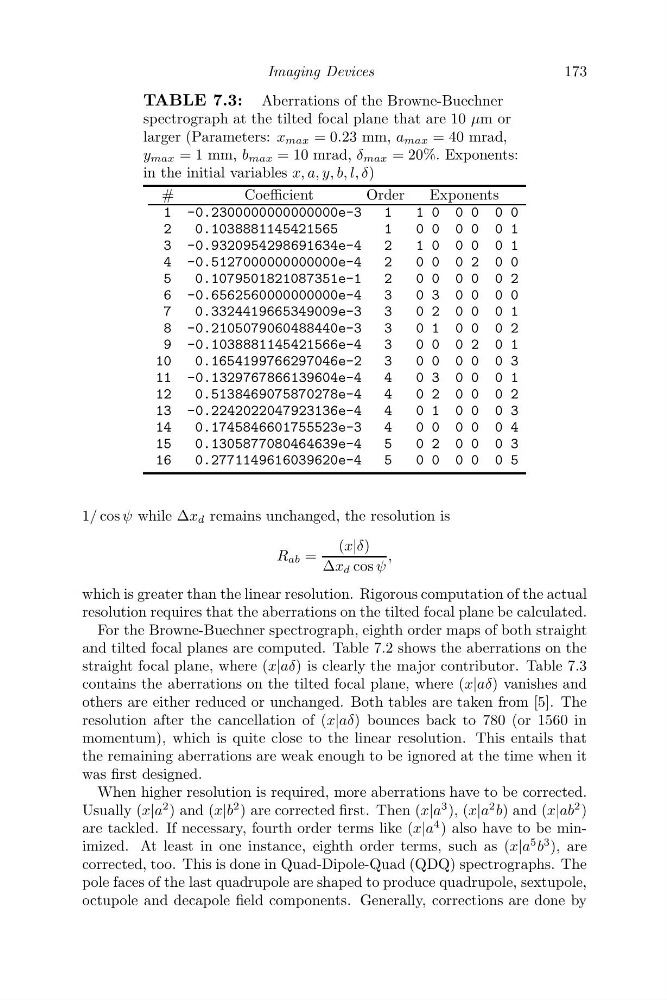
straight focal plane, where (x|aδ) is clearly the major contributor. Table 7.3
contains the aberrations on the tilted focal plane, where (x|aδ) vanishes and
others are either reduced or unchanged. Both tables are taken from [5]. The
resolution after the cancellation of (x|aδ) bounces back to 780 (or 1560 in
momentum), which is quite close to the linear resolution. This entails that
the remaining aberrations are weak enough to be ignored at the time when it
was first designed.
When higher resolution is required, more aberrations have to be corrected.
Usually (x|a
2 ) and (x|b
2 ) are corrected first. Then (x|a
3 ), (x|a
2 b) and (x|ab
2 )
are tackled. If necessary, fourth order terms like (x|a
4 ) also have to be minimized. At least in one instance, eighth order terms, such as (x|a
5 b
3 ), are
corrected, too. This is done in Quad-Dipole-Quad (QDQ) spectrographs. The
pole faces of the last quadrupole are shaped to produce quadrupole, sextupole,
octupole and decapole field components. Generally, corrections are done by
173
TABLE 7.3: Aberrations of the Browne-Buechner
spectrograph at the tilted focal plane that are 10 μm or
larger (Parameters: x max = 0.23 mm, a max = 40 mrad,
y max = 1 mm, b max = 10 mrad, δ max = 20%. Exponents:
in the initial variables x, a, y, b, l, δ)
#
Coefficient
Order
Exponents
1 -0.2300000000000000e-3 1
1 0 0 0 0 0
2
0.1038881145421565
1
0 0 0 0 0 1
3 -0.9320954298691634e-4 2
1 0 0 0 0 1
4 -0.5127000000000000e-4 2
0 0 0 2 0 0
5
0.1079501821087351e-1 2
0 0 0 0 0 2
6 -0.6562560000000000e-4 3
0 3 0 0 0 0
7
0.3324419665349009e-3 3
0 2 0 0 0 1
8 -0.2105079060488440e-3 3
0 1 0 0 0 2
9 -0.1038881145421566e-4 3
0 0 0 2 0 1
10
0.1654199766297046e-2 3
0 0 0 0 0 3
11 -0.1329767866139604e-4 4
0 3 0 0 0 1
12
0.5138469075870278e-4 4
0 2 0 0 0 2
13 -0.2242022047923136e-4 4
0 1 0 0 0 3
14
0.1745846601755523e-3 4
0 0 0 0 0 4
15
0.1305877080464639e-4 5
0 2 0 0 0 3
16
0.2771149616039620e-4 5
0 0 0 0 0 5
1/ cos ψ while Δx d remains unchanged, the resolution is
R ab =
(x|δ)
Δx d cos ψ
,
which is greater than the linear resolution. Rigorous computation of the actual
resolution requires that the aberrations on the tilted focal plane be calculated.
For the Browne-Buechner spectrograph, eighth order maps of both straight
and tilted focal planes are computed. Table 7.2 shows the aberrations on the
straight focal plane, where (x|aδ) is clearly the major contributor. Table 7.3
contains the aberrations on the tilted focal plane, where (x|aδ) vanishes and
others are either reduced or unchanged. Both tables are taken from [5]. The
resolution after the cancellation of (x|aδ) bounces back to 780 (or 1560 in
momentum), which is quite close to the linear resolution. This entails that
the remaining aberrations are weak enough to be ignored at the time when it
was first designed.
When higher resolution is required, more aberrations have to be corrected.
Usually (x|a
2 ) and (x|b
2 ) are corrected first. Then (x|a
3 ), (x|a
2 b) and (x|ab
2 )
are tackled. If necessary, fourth order terms like (x|a
4 ) also have to be minimized. At least in one instance, eighth order terms, such as (x|a
5 b
3 ), are
corrected, too. This is done in Quad-Dipole-Quad (QDQ) spectrographs. The
pole faces of the last quadrupole are shaped to produce quadrupole, sextupole,
octupole and decapole field components. Generally, corrections are done by