

Imaging Devices
171
Δa 1
ψ
Δx 1
(Δz, x 1 )
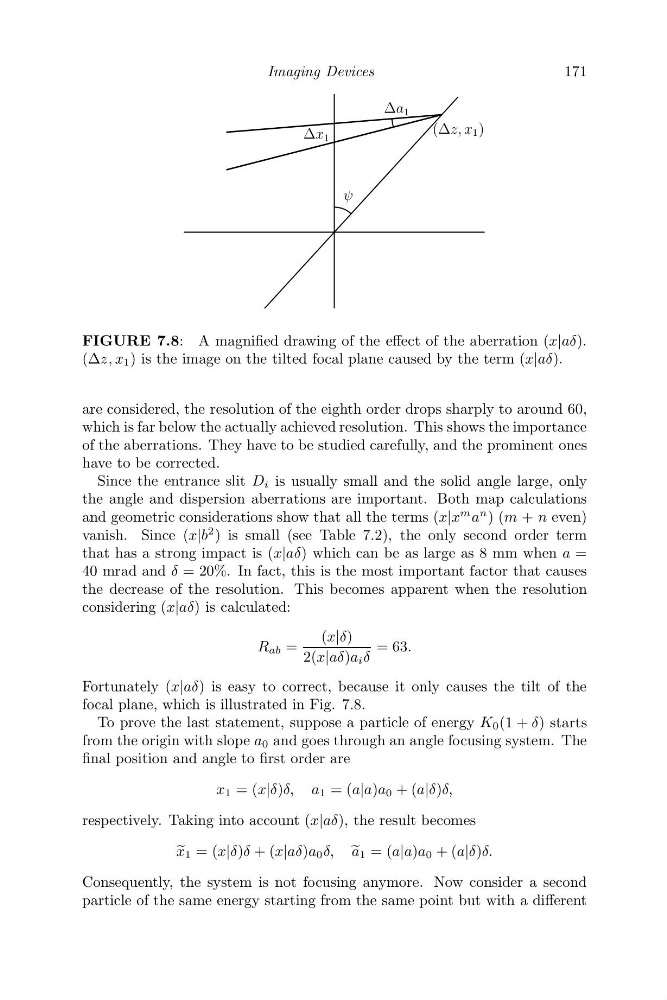
FIGURE 7.8: A magnified drawing of the effect of the aberration (x|aδ).
(Δz, x 1 ) is the image on the tilted focal plane caused by the term (x|aδ).
are considered, the resolution of the eighth order drops sharply to around 60,
which is far below the actually achieved resolution. This shows the importance
of the aberrations. They have to be studied carefully, and the prominent ones
have to be corrected.
Since the entrance slit D i is usually small and the solid angle large, only
the angle and dispersion aberrations are important. Both map calculations
and geometric considerations show that all the terms (x|x
m a
n ) (m + n even)
vanish. Since (x|b
2 ) is small (see Table 7.2), the only second order term
that has a strong impact is (x|aδ) which can be as large as 8 mm when a =
40 mrad and δ = 20%. In fact, this is the most important factor that causes
the decrease of the resolution. This becomes apparent when the resolution
considering (x|aδ) is calculated:
R ab =
(x|δ)
2(x|aδ)a i δ
= 63.
Fortunately (x|aδ) is easy to correct, because it only causes the tilt of the
focal plane, which is illustrated in Fig. 7.8.
To prove the last statement, suppose a particle of energy K 0 (1 + δ) starts
from the origin with slope a 0 and goes through an angle focusing system. The
final position and angle to first order are
x 1 = (x|δ)δ, a 1 = (a|a)a 0 + (a|δ)δ,
respectively. Taking into account (x|aδ), the result becomes
x 1 = (x|δ)δ + (x|aδ)a 0 δ, a 1 = (a|a)a 0 + (a|δ)δ.
Consequently, the system is not focusing anymore. Now consider a second
particle of the same energy starting from the same point but with a different
171
Δa 1
ψ
Δx 1
(Δz, x 1 )
FIGURE 7.8: A magnified drawing of the effect of the aberration (x|aδ).
(Δz, x 1 ) is the image on the tilted focal plane caused by the term (x|aδ).
are considered, the resolution of the eighth order drops sharply to around 60,
which is far below the actually achieved resolution. This shows the importance
of the aberrations. They have to be studied carefully, and the prominent ones
have to be corrected.
Since the entrance slit D i is usually small and the solid angle large, only
the angle and dispersion aberrations are important. Both map calculations
and geometric considerations show that all the terms (x|x
m a
n ) (m + n even)
vanish. Since (x|b
2 ) is small (see Table 7.2), the only second order term
that has a strong impact is (x|aδ) which can be as large as 8 mm when a =
40 mrad and δ = 20%. In fact, this is the most important factor that causes
the decrease of the resolution. This becomes apparent when the resolution
considering (x|aδ) is calculated:
R ab =
(x|δ)
2(x|aδ)a i δ
= 63.
Fortunately (x|aδ) is easy to correct, because it only causes the tilt of the
focal plane, which is illustrated in Fig. 7.8.
To prove the last statement, suppose a particle of energy K 0 (1 + δ) starts
from the origin with slope a 0 and goes through an angle focusing system. The
final position and angle to first order are
x 1 = (x|δ)δ, a 1 = (a|a)a 0 + (a|δ)δ,
respectively. Taking into account (x|aδ), the result becomes
x 1 = (x|δ)δ + (x|aδ)a 0 δ, a 1 = (a|a)a 0 + (a|δ)δ.
Consequently, the system is not focusing anymore. Now consider a second
particle of the same energy starting from the same point but with a different