

170
An Introduction to Beam Physics
z
x
δ 1
δ 2
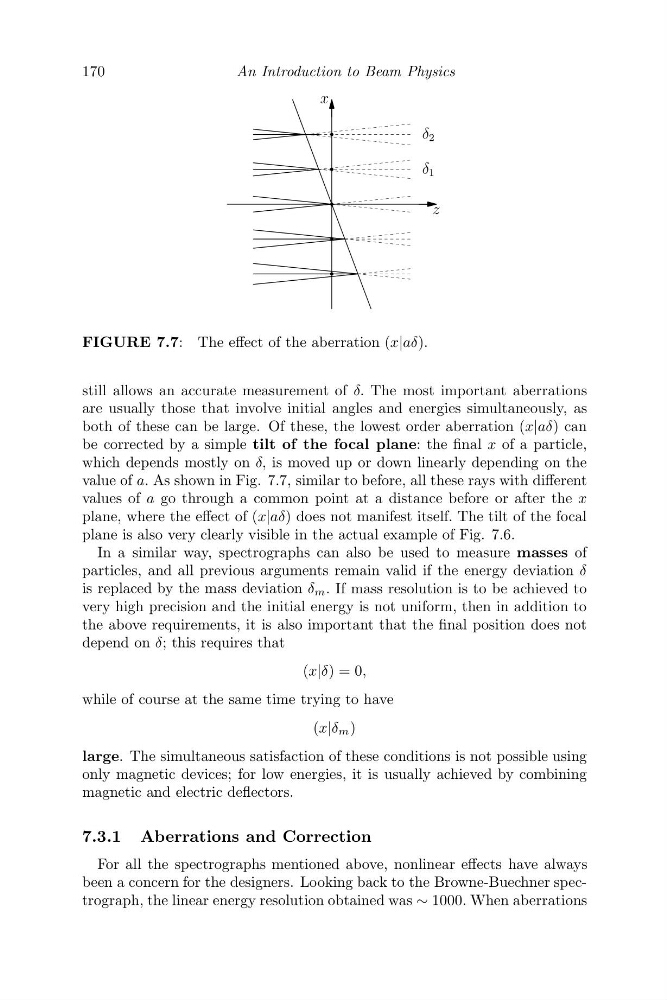
FIGURE 7.7: The effect of the aberration (x|aδ).
still allows an accurate measurement of δ. The most important aberrations
are usually those that involve initial angles and energies simultaneously, as
both of these can be large. Of these, the lowest order aberration (x|aδ) can
be corrected by a simple tilt of the focal plane: the final x of a particle,
which depends mostly on δ, is moved up or down linearly depending on the
value of a. As shown in Fig. 7.7, similar to before, all these rays with different
values of a go through a common point at a distance before or after the x
plane, where the effect of (x|aδ) does not manifest itself. The tilt of the focal
plane is also very clearly visible in the actual example of Fig. 7.6.
In a similar way, spectrographs can also be used to measure masses of
particles, and all previous arguments remain valid if the energy deviation δ
is replaced by the mass deviation δ m . If mass resolution is to be achieved to
very high precision and the initial energy is not uniform, then in addition to
the above requirements, it is also important that the final position does not
depend on δ; this requires that
(x|δ) = 0,
while of course at the same time trying to have
(x|δ m )
large. The simultaneous satisfaction of these conditions is not possible using
only magnetic devices; for low energies, it is usually achieved by combining
magnetic and electric deflectors.
7.3.1 Aberrations and Correction
For all the spectrographs mentioned above, nonlinear effects have always
been a concern for the designers. Looking back to the Browne-Buechner spectrograph, the linear energy resolution obtained was ∼ 1000. When aberrations
An Introduction to Beam Physics
z
x
δ 1
δ 2
FIGURE 7.7: The effect of the aberration (x|aδ).
still allows an accurate measurement of δ. The most important aberrations
are usually those that involve initial angles and energies simultaneously, as
both of these can be large. Of these, the lowest order aberration (x|aδ) can
be corrected by a simple tilt of the focal plane: the final x of a particle,
which depends mostly on δ, is moved up or down linearly depending on the
value of a. As shown in Fig. 7.7, similar to before, all these rays with different
values of a go through a common point at a distance before or after the x
plane, where the effect of (x|aδ) does not manifest itself. The tilt of the focal
plane is also very clearly visible in the actual example of Fig. 7.6.
In a similar way, spectrographs can also be used to measure masses of
particles, and all previous arguments remain valid if the energy deviation δ
is replaced by the mass deviation δ m . If mass resolution is to be achieved to
very high precision and the initial energy is not uniform, then in addition to
the above requirements, it is also important that the final position does not
depend on δ; this requires that
(x|δ) = 0,
while of course at the same time trying to have
(x|δ m )
large. The simultaneous satisfaction of these conditions is not possible using
only magnetic devices; for low energies, it is usually achieved by combining
magnetic and electric deflectors.
7.3.1 Aberrations and Correction
For all the spectrographs mentioned above, nonlinear effects have always
been a concern for the designers. Looking back to the Browne-Buechner spectrograph, the linear energy resolution obtained was ∼ 1000. When aberrations