

Computation and Properties of Maps
137
5.4 Manipulation of Maps
In most cases, a beam optical system consists of more than one element
and it is necessary to connect the maps of individual pieces. Often the inverse
of a map is needed. Sometimes one part of our system is the reversion of
another part; therefore, it is time saving if the map of the reversed part can
be obtained directly from that of the other part. All these map manipulations
can be done elegantly using DA techniques.
5.4.1 Composition of Maps
Whenever a system contains more than one element, which is virtually
always true, we have to deal with the composition of maps. This is the
foundation of almost all other map manipulations, as we will see later.
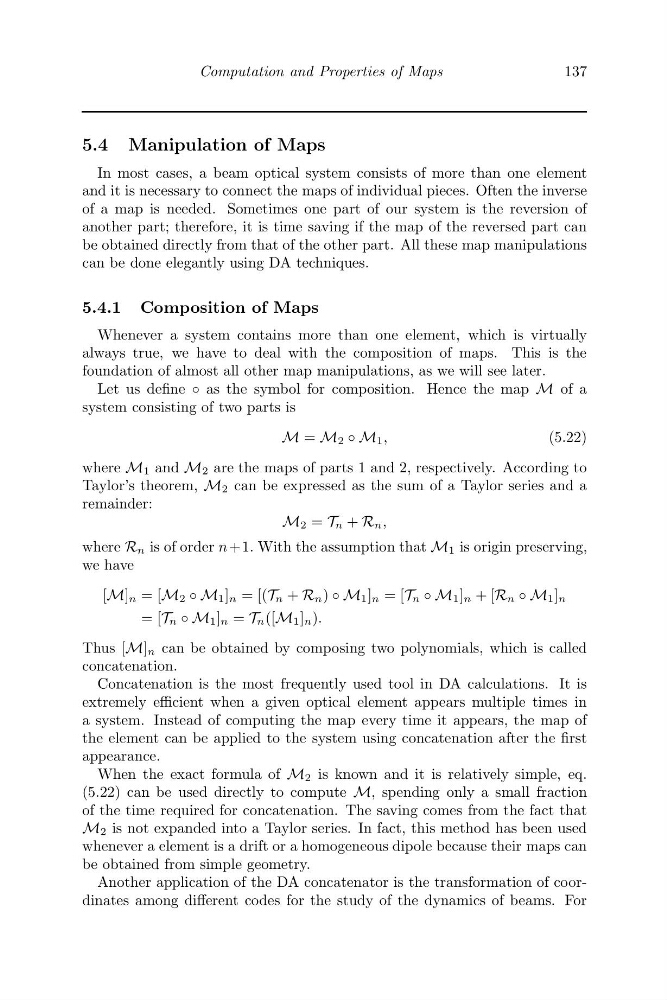
Let us define ◦ as the symbol for composition. Hence the map M of a
system consisting of two parts is
M = M 2 ◦ M 1 ,
(5.22)
where M 1 and M 2 are the maps of parts 1 and 2, respectively. According to
Taylor’s theorem, M 2 can be expressed as the sum of a Taylor series and a
remainder:
M 2 = T n + R n ,
where R n is of order n+1. With the assumption that M 1 is origin preserving,
we have
[M] n = [M 2 ◦ M 1 ] n = [(T n + R n ) ◦ M 1 ] n = [T n ◦ M 1 ] n + [R n ◦ M 1 ] n
= [T n ◦ M 1 ] n = T n ([M 1 ] n ).
Thus [M] n can be obtained by composing two polynomials, which is called
concatenation.
Concatenation is the most frequently used tool in DA calculations. It is
extremely efficient when a given optical element appears multiple times in
a system. Instead of computing the map every time it appears, the map of
the element can be applied to the system using concatenation after the first
appearance.
When the exact formula of M 2 is known and it is relatively simple, eq.
(5.22) can be used directly to compute M, spending only a small fraction
of the time required for concatenation. The saving comes from the fact that
M 2 is not expanded into a Taylor series. In fact, this method has been used
whenever a element is a drift or a homogeneous dipole because their maps can
be obtained from simple geometry.
Another application of the DA concatenator is the transformation of coordinates among different codes for the study of the dynamics of beams. For
137
5.4 Manipulation of Maps
In most cases, a beam optical system consists of more than one element
and it is necessary to connect the maps of individual pieces. Often the inverse
of a map is needed. Sometimes one part of our system is the reversion of
another part; therefore, it is time saving if the map of the reversed part can
be obtained directly from that of the other part. All these map manipulations
can be done elegantly using DA techniques.
5.4.1 Composition of Maps
Whenever a system contains more than one element, which is virtually
always true, we have to deal with the composition of maps. This is the
foundation of almost all other map manipulations, as we will see later.
Let us define ◦ as the symbol for composition. Hence the map M of a
system consisting of two parts is
M = M 2 ◦ M 1 ,
(5.22)
where M 1 and M 2 are the maps of parts 1 and 2, respectively. According to
Taylor’s theorem, M 2 can be expressed as the sum of a Taylor series and a
remainder:
M 2 = T n + R n ,
where R n is of order n+1. With the assumption that M 1 is origin preserving,
we have
[M] n = [M 2 ◦ M 1 ] n = [(T n + R n ) ◦ M 1 ] n = [T n ◦ M 1 ] n + [R n ◦ M 1 ] n
= [T n ◦ M 1 ] n = T n ([M 1 ] n ).
Thus [M] n can be obtained by composing two polynomials, which is called
concatenation.
Concatenation is the most frequently used tool in DA calculations. It is
extremely efficient when a given optical element appears multiple times in
a system. Instead of computing the map every time it appears, the map of
the element can be applied to the system using concatenation after the first
appearance.
When the exact formula of M 2 is known and it is relatively simple, eq.
(5.22) can be used directly to compute M, spending only a small fraction
of the time required for concatenation. The saving comes from the fact that
M 2 is not expanded into a Taylor series. In fact, this method has been used
whenever a element is a drift or a homogeneous dipole because their maps can
be obtained from simple geometry.
Another application of the DA concatenator is the transformation of coordinates among different codes for the study of the dynamics of beams. For