

138
An Introduction to Beam Physics
instance, while many codes work in the above discussed curvilinear canonical
coordinates, other codes use the slope instead of the normalized momentum.
In certain cases, Cartesian coordinates are used, which may be a better choice
for certain elements, for example, wigglers, but are usually not very well suited
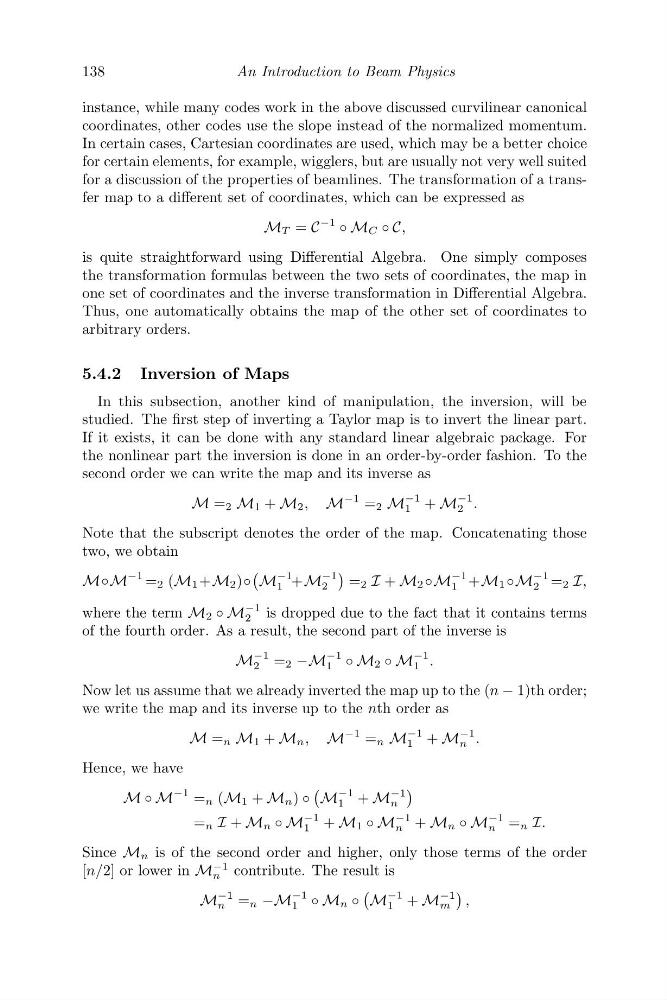
for a discussion of the properties of beamlines. The transformation of a transfer map to a different set of coordinates, which can be expressed as
M T = C
−1
◦ M C ◦ C,
is quite straightforward using Differential Algebra. One simply composes
the transformation formulas between the two sets of coordinates, the map in
one set of coordinates and the inverse transformation in Differential Algebra.
Thus, one automatically obtains the map of the other set of coordinates to
arbitrary orders.
5.4.2 Inversion of Maps
In this subsection, another kind of manipulation, the inversion, will be
studied. The first step of inverting a Taylor map is to invert the linear part.
If it exists, it can be done with any standard linear algebraic package. For
the nonlinear part the inversion is done in an order-by-order fashion. To the
second order we can write the map and its inverse as
M = 2 M 1 + M 2 , M
−1 = 2 M
−1
1 + M
−1
2 .
Note that the subscript denotes the order of the map. Concatenating those
two, we obtain
M◦M
−1 = 2 (M 1 +M 2 )◦
M
−1
1 +M
−1
2
= 2 I + M 2 ◦M
−1
1 +M 1 ◦M
−1
2 = 2 I,
where the term M 2 ◦ M
−1
2 is dropped due to the fact that it contains terms
of the fourth order. As a result, the second part of the inverse is
M
−1
2 = 2 −M
−1
1 ◦ M 2 ◦ M
−1
1 .
Now let us assume that we already inverted the map up to the (n − 1)th order;
we write the map and its inverse up to the nth order as
M = n M 1 + M n , M
−1 = n M
−1
1 + M
−1
n .
Hence, we have
M ◦ M
−1 = n (M 1 + M n ) ◦
M
−1
1 + M
−1
n
= n I + M n ◦ M
−1
1 + M 1 ◦ M
−1
n + M n ◦ M
−1
n = n I.
Since M n is of the second order and higher, only those terms of the order
[n/2] or lower in M
−1
n contribute. The result is
M
−1
n = n −M
−1
1 ◦ M n ◦
M
−1
1 + M
−1
m
,
An Introduction to Beam Physics
instance, while many codes work in the above discussed curvilinear canonical
coordinates, other codes use the slope instead of the normalized momentum.
In certain cases, Cartesian coordinates are used, which may be a better choice
for certain elements, for example, wigglers, but are usually not very well suited
for a discussion of the properties of beamlines. The transformation of a transfer map to a different set of coordinates, which can be expressed as
M T = C
−1
◦ M C ◦ C,
is quite straightforward using Differential Algebra. One simply composes
the transformation formulas between the two sets of coordinates, the map in
one set of coordinates and the inverse transformation in Differential Algebra.
Thus, one automatically obtains the map of the other set of coordinates to
arbitrary orders.
5.4.2 Inversion of Maps
In this subsection, another kind of manipulation, the inversion, will be
studied. The first step of inverting a Taylor map is to invert the linear part.
If it exists, it can be done with any standard linear algebraic package. For
the nonlinear part the inversion is done in an order-by-order fashion. To the
second order we can write the map and its inverse as
M = 2 M 1 + M 2 , M
−1 = 2 M
−1
1 + M
−1
2 .
Note that the subscript denotes the order of the map. Concatenating those
two, we obtain
M◦M
−1 = 2 (M 1 +M 2 )◦
M
−1
1 +M
−1
2
= 2 I + M 2 ◦M
−1
1 +M 1 ◦M
−1
2 = 2 I,
where the term M 2 ◦ M
−1
2 is dropped due to the fact that it contains terms
of the fourth order. As a result, the second part of the inverse is
M
−1
2 = 2 −M
−1
1 ◦ M 2 ◦ M
−1
1 .
Now let us assume that we already inverted the map up to the (n − 1)th order;
we write the map and its inverse up to the nth order as
M = n M 1 + M n , M
−1 = n M
−1
1 + M
−1
n .
Hence, we have
M ◦ M
−1 = n (M 1 + M n ) ◦
M
−1
1 + M
−1
n
= n I + M n ◦ M
−1
1 + M 1 ◦ M
−1
n + M n ◦ M
−1
n = n I.
Since M n is of the second order and higher, only those terms of the order
[n/2] or lower in M
−1
n contribute. The result is
M
−1
n = n −M
−1
1 ◦ M n ◦
M
−1
1 + M
−1
m
,