

120
An Introduction to Beam Physics
and its effect in eq. (5.2) is easy to study. It turns out that in the map only
those terms that have the form
z f = z i · f z (z ¯
z, w ¯
w), w f = w i · f w (z ¯
z, w ¯
w)
are allowed to remain. In passing we note that this situation is remarkably
similar to what happens in the theory of normal forms of repetitive motion
[5].
There are two types of rotational symmetry: One is characterized by the
system being invariant under a rotation of any angle, which we call continuous rotational symmetry; the other is characterized by the system being
invariant under a fixed angle, which we refer to as discrete rotational symmetry. The former is widely seen in light optics where almost all glass lenses
are rotational invariant and in electron microscopes where solenoids are the
primary focusing elements. The latter is preserved in quadrupoles and all
higher multipoles.
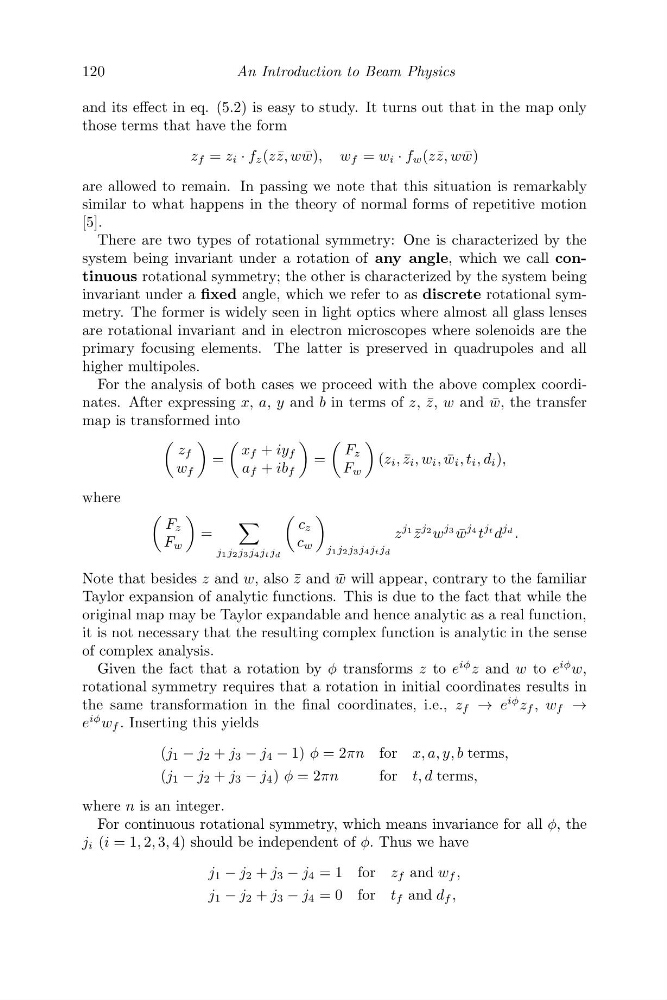
For the analysis of both cases we proceed with the above complex coordinates. After expressing x, a, y and b in terms of z, ¯
z, w and ¯
w, the transfer
map is transformed into
z f
w f
=
x f + iy f
a f + ib f
=
F z
F w
(z i , ¯
z i , w i , ¯
w i , t i , d i ),
where
F z
F w
=
j1j2j3j4jtj d
c z
c w
j1j2j3j4jtj d
z
j1 ¯
z
j2 w
j3 ¯
w
j4 t
jt d
j d .
Note that besides z and w, also ¯
z and ¯
w will appear, contrary to the familiar
Taylor expansion of analytic functions. This is due to the fact that while the
original map may be Taylor expandable and hence analytic as a real function,
it is not necessary that the resulting complex function is analytic in the sense
of complex analysis.
Given the fact that a rotation by φ transforms z to e
iφ z and w to e
iφ w,
rotational symmetry requires that a rotation in initial coordinates results in
the same transformation in the final coordinates, i.e., z f → e
iφ z f , w f →
e
iφ w f . Inserting this yields
(j 1 − j 2 + j 3 − j 4 − 1) φ = 2πn for x, a, y, b terms,
(j 1 − j 2 + j 3 − j 4 ) φ = 2πn
for t, d terms,
where n is an integer.
For continuous rotational symmetry, which means invariance for all φ, the
j i (i = 1, 2, 3, 4) should be independent of φ. Thus we have
j 1 − j 2 + j 3 − j 4 = 1 for z f and w f ,
j 1 − j 2 + j 3 − j 4 = 0 for t f and d f ,
An Introduction to Beam Physics
and its effect in eq. (5.2) is easy to study. It turns out that in the map only
those terms that have the form
z f = z i · f z (z ¯
z, w ¯
w), w f = w i · f w (z ¯
z, w ¯
w)
are allowed to remain. In passing we note that this situation is remarkably
similar to what happens in the theory of normal forms of repetitive motion
[5].
There are two types of rotational symmetry: One is characterized by the
system being invariant under a rotation of any angle, which we call continuous rotational symmetry; the other is characterized by the system being
invariant under a fixed angle, which we refer to as discrete rotational symmetry. The former is widely seen in light optics where almost all glass lenses
are rotational invariant and in electron microscopes where solenoids are the
primary focusing elements. The latter is preserved in quadrupoles and all
higher multipoles.
For the analysis of both cases we proceed with the above complex coordinates. After expressing x, a, y and b in terms of z, ¯
z, w and ¯
w, the transfer
map is transformed into
z f
w f
=
x f + iy f
a f + ib f
=
F z
F w
(z i , ¯
z i , w i , ¯
w i , t i , d i ),
where
F z
F w
=
j1j2j3j4jtj d
c z
c w
j1j2j3j4jtj d
z
j1 ¯
z
j2 w
j3 ¯
w
j4 t
jt d
j d .
Note that besides z and w, also ¯
z and ¯
w will appear, contrary to the familiar
Taylor expansion of analytic functions. This is due to the fact that while the
original map may be Taylor expandable and hence analytic as a real function,
it is not necessary that the resulting complex function is analytic in the sense
of complex analysis.
Given the fact that a rotation by φ transforms z to e
iφ z and w to e
iφ w,
rotational symmetry requires that a rotation in initial coordinates results in
the same transformation in the final coordinates, i.e., z f → e
iφ z f , w f →
e
iφ w f . Inserting this yields
(j 1 − j 2 + j 3 − j 4 − 1) φ = 2πn for x, a, y, b terms,
(j 1 − j 2 + j 3 − j 4 ) φ = 2πn
for t, d terms,
where n is an integer.
For continuous rotational symmetry, which means invariance for all φ, the
j i (i = 1, 2, 3, 4) should be independent of φ. Thus we have
j 1 − j 2 + j 3 − j 4 = 1 for z f and w f ,
j 1 − j 2 + j 3 − j 4 = 0 for t f and d f ,