

Computation and Properties of Maps
119
and altogether, about three-fourths of all matrix elements vanish. To first
order, the matrix must have the special form
ˆ
M =
⎛
⎜
⎜
⎜
⎜
⎜
⎜
⎝
(x|x) (x|a)
0
0
0
0
(a|x) (a|a)
0
0
0
0
0
0
(y|y) (y|b) 0
0
0
0
(b|y) (b|b) 0
0
0
0
0
0
(l|l) (l|δ)
0
0
0
0 (δ|l) (δ|δ)
⎞
⎟
⎟
⎟
⎟
⎟
⎟
⎠
,
which is what we observed in the case of the drift and the electric and magnetic
quadrupoles.
5.1.3 Rotational Symmetry
One special case of the double midplane symmetry that we just discussed
is the full rotational symmetry that round lenses satisfy. In this case there is
a symmetry going beyond what double midplane symmetry requires; the map
has to be invariant under a rotation in the x-y plane. Let the rotation angle
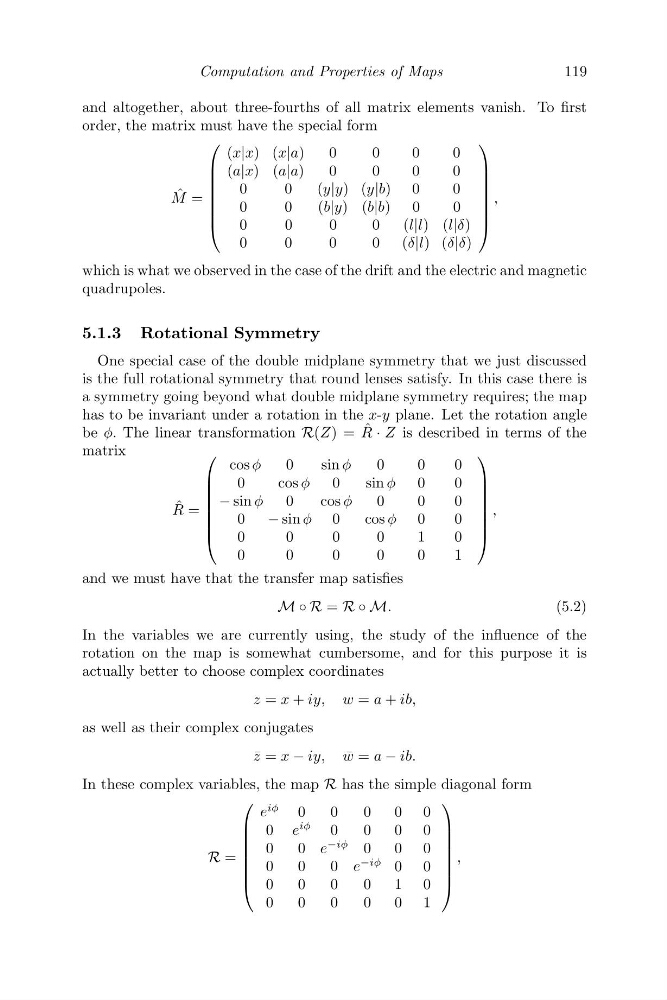
be φ. The linear transformation R(Z) = ˆ
R · Z is described in terms of the
matrix
ˆ
R =
⎛
⎜
⎜
⎜
⎜
⎜
⎜
⎝
cos φ
0
sinφ
0
0
0
0
cosφ
0
sinφ 0
0
− sin φ
0
cosφ
0
0
0
0
− sin φ 0
cosφ 0
0
0
0
0
0
1
0
0
0
0
0
0
1
⎞
⎟
⎟
⎟
⎟
⎟
⎟
⎠
,
and we must have that the transfer map satisfies
M ◦ R = R ◦ M.
(5.2)
In the variables we are currently using, the study of the influence of the
rotation on the map is somewhat cumbersome, and for this purpose it is
actually better to choose complex coordinates
z = x + iy, w = a + ib,
as well as their complex conjugates
¯
z = x − iy, ¯
w = a − ib.
In these complex variables, the map R has the simple diagonal form
R =
⎛
⎜
⎜
⎜
⎜
⎜
⎜
⎝
e
iφ
0
0
0
0 0
0 e
iφ
0
0
0 0
0
0 e
−iφ 0
0 0
0
0
0 e
−iφ 0 0
0
0
0
0
1 0
0
0
0
0
0 1
⎞
⎟
⎟
⎟
⎟
⎟
⎟
⎠
,
119
and altogether, about three-fourths of all matrix elements vanish. To first
order, the matrix must have the special form
ˆ
M =
⎛
⎜
⎜
⎜
⎜
⎜
⎜
⎝
(x|x) (x|a)
0
0
0
0
(a|x) (a|a)
0
0
0
0
0
0
(y|y) (y|b) 0
0
0
0
(b|y) (b|b) 0
0
0
0
0
0
(l|l) (l|δ)
0
0
0
0 (δ|l) (δ|δ)
⎞
⎟
⎟
⎟
⎟
⎟
⎟
⎠
,
which is what we observed in the case of the drift and the electric and magnetic
quadrupoles.
5.1.3 Rotational Symmetry
One special case of the double midplane symmetry that we just discussed
is the full rotational symmetry that round lenses satisfy. In this case there is
a symmetry going beyond what double midplane symmetry requires; the map
has to be invariant under a rotation in the x-y plane. Let the rotation angle
be φ. The linear transformation R(Z) = ˆ
R · Z is described in terms of the
matrix
ˆ
R =
⎛
⎜
⎜
⎜
⎜
⎜
⎜
⎝
cos φ
0
sinφ
0
0
0
0
cosφ
0
sinφ 0
0
− sin φ
0
cosφ
0
0
0
0
− sin φ 0
cosφ 0
0
0
0
0
0
1
0
0
0
0
0
0
1
⎞
⎟
⎟
⎟
⎟
⎟
⎟
⎠
,
and we must have that the transfer map satisfies
M ◦ R = R ◦ M.
(5.2)
In the variables we are currently using, the study of the influence of the
rotation on the map is somewhat cumbersome, and for this purpose it is
actually better to choose complex coordinates
z = x + iy, w = a + ib,
as well as their complex conjugates
¯
z = x − iy, ¯
w = a − ib.
In these complex variables, the map R has the simple diagonal form
R =
⎛
⎜
⎜
⎜
⎜
⎜
⎜
⎝
e
iφ
0
0
0
0 0
0 e
iφ
0
0
0 0
0
0 e
−iφ 0
0 0
0
0
0 e
−iφ 0 0
0
0
0
0
1 0
0
0
0
0
0 1
⎞
⎟
⎟
⎟
⎟
⎟
⎟
⎠
,