

Computation and Properties of Maps
121
TABLE 5.1:
Number of aberrations
Order j 1 j 2 j 3 j 4
1
1 0 0 0
0 0 1 0
3
2 1 0 0
2 0 0 1
0 1 2 0
0 0 2 1
1 1 1 0
1 0 1 1
which eliminate many terms. First, all terms with j 1 +j 2 +j 3 +j 4 even vanish,
because j 1 + j 3 and j 2 + j 4 always have the same parity, which means that
j 1 − j 2 + j 3 − j 4 is also even. This implies that in rotationally symmetric
systems, all even order geometric aberrations disappear. As a summary, all
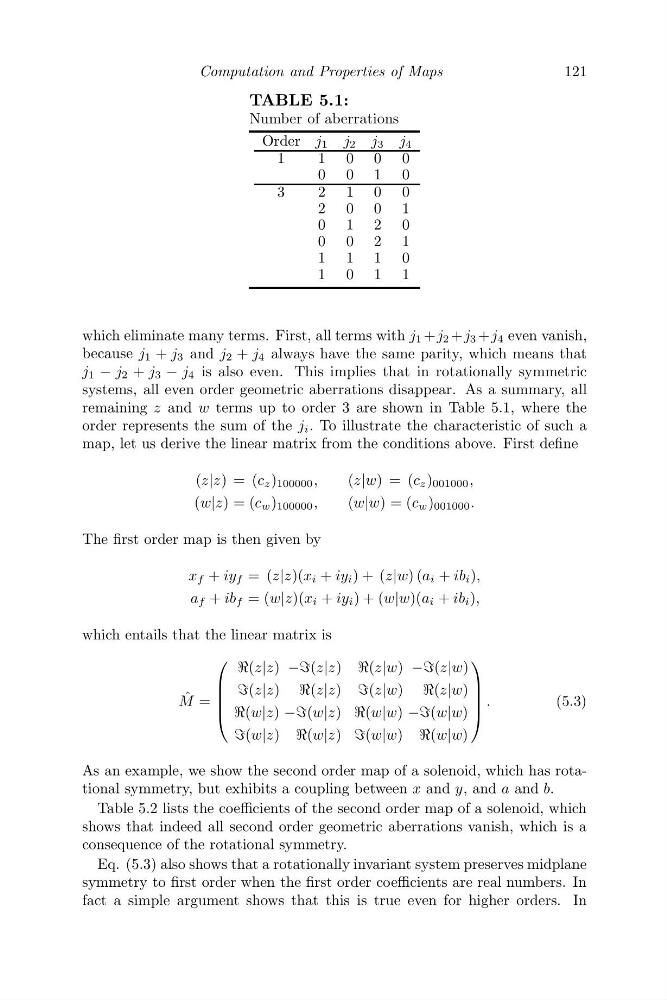
remaining z and w terms up to order 3 are shown in Table 5.1, where the
order represents the sum of the j i . To illustrate the characteristic of such a
map, let us derive the linear matrix from the conditions above. First define
(z|z) = (c z ) 100000 ,
(z|w) = (c z ) 001000 ,
(w|z) = (c w ) 100000 ,
(w|w) = (c w ) 001000 .
The first order map is then given by
x f + iy f = (z|z)(x i + iy i ) + (z|w) (a i + ib i ),
a f + ib f = (w|z)(x i + iy i ) + (w|w)(a i + ib i ),
which entails that the linear matrix is
ˆ
M =
⎛
⎜
⎜
⎜
⎝
(z|z) −−(z|z) (z|w) −−(z|w)
(z|z) (z|z) (z|w) (z|w)
(w|z) −−(w|z) (w|w) −−(w|w)
(w|z) (w|z) (w|w) (w|w)
⎞
⎟
⎟
⎟
⎠
.
(5.3)
As an example, we show the second order map of a solenoid, which has rotational symmetry, but exhibits a coupling between x and y, and a and b.
Table 5.2 lists the coefficients of the second order map of a solenoid, which
shows that indeed all second order geometric aberrations vanish, which is a
consequence of the rotational symmetry.
Eq. (5.3) also shows that a rotationally invariant system preserves midplane
symmetry to first order when the first order coefficients are real numbers. In
fact a simple argument shows that this is true even for higher orders. In
121
TABLE 5.1:
Number of aberrations
Order j 1 j 2 j 3 j 4
1
1 0 0 0
0 0 1 0
3
2 1 0 0
2 0 0 1
0 1 2 0
0 0 2 1
1 1 1 0
1 0 1 1
which eliminate many terms. First, all terms with j 1 +j 2 +j 3 +j 4 even vanish,
because j 1 + j 3 and j 2 + j 4 always have the same parity, which means that
j 1 − j 2 + j 3 − j 4 is also even. This implies that in rotationally symmetric
systems, all even order geometric aberrations disappear. As a summary, all
remaining z and w terms up to order 3 are shown in Table 5.1, where the
order represents the sum of the j i . To illustrate the characteristic of such a
map, let us derive the linear matrix from the conditions above. First define
(z|z) = (c z ) 100000 ,
(z|w) = (c z ) 001000 ,
(w|z) = (c w ) 100000 ,
(w|w) = (c w ) 001000 .
The first order map is then given by
x f + iy f = (z|z)(x i + iy i ) + (z|w) (a i + ib i ),
a f + ib f = (w|z)(x i + iy i ) + (w|w)(a i + ib i ),
which entails that the linear matrix is
ˆ
M =
⎛
⎜
⎜
⎜
⎝
(z|z) −−(z|z) (z|w) −−(z|w)
(z|z) (z|z) (z|w) (z|w)
(w|z) −−(w|z) (w|w) −−(w|w)
(w|z) (w|z) (w|w) (w|w)
⎞
⎟
⎟
⎟
⎠
.
(5.3)
As an example, we show the second order map of a solenoid, which has rotational symmetry, but exhibits a coupling between x and y, and a and b.
Table 5.2 lists the coefficients of the second order map of a solenoid, which
shows that indeed all second order geometric aberrations vanish, which is a
consequence of the rotational symmetry.
Eq. (5.3) also shows that a rotationally invariant system preserves midplane
symmetry to first order when the first order coefficients are real numbers. In
fact a simple argument shows that this is true even for higher orders. In