

The Linearization of the Equations of Motion
95
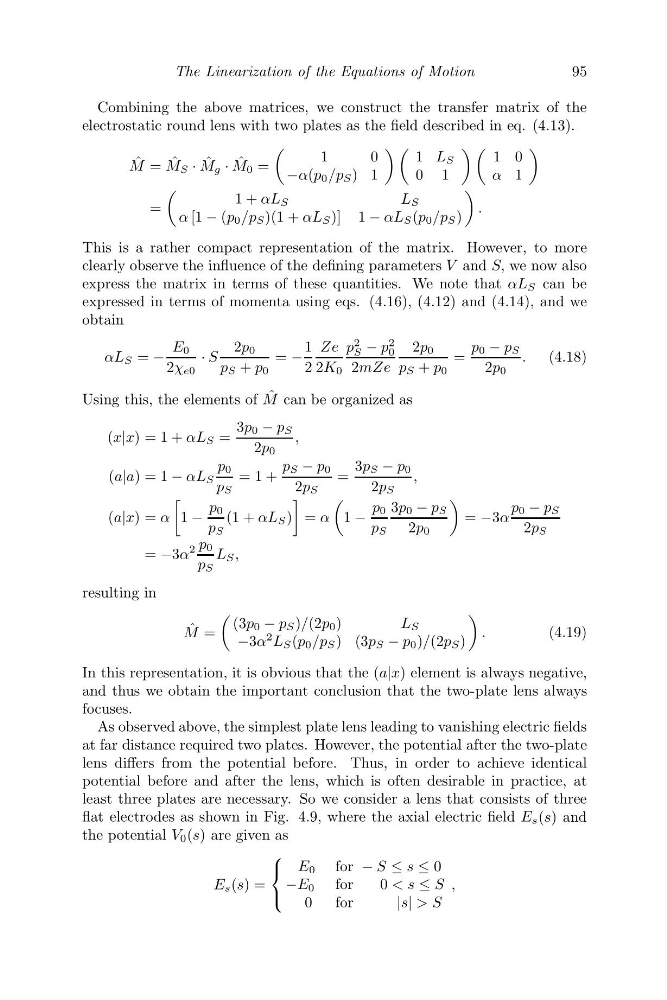
Combining the above matrices, we construct the transfer matrix of the
electrostatic round lens with two plates as the field described in eq. (4.13).
ˆ
M = ˆ
M S · ˆ
M g · ˆ
M 0 =
1
0
−α(p 0 /p S ) 1
1 L S
0 1
1 0
α 1
=
1 + αL S
L S
α [1 − (p 0 /p S )(1 + αL S )] 1 − αL S (p 0 /p S )
.
This is a rather compact representation of the matrix. However, to more
clearly observe the influence of the defining parameters V and S, we now also
express the matrix in terms of these quantities. We note that αL S can be
expressed in terms of momenta using eqs. (4.16), (4.12) and (4.14), and we
obtain
αL S = −
E 0
2χ e0
· S
2p 0
p S + p 0
= −
1
2
Ze
2K 0
p
2
S − p
2
0
2mZe
2p 0
p S + p 0
=
p 0 − p S
2p 0
. (4.18)
Using this, the elements of ˆ
M can be organized as
(x|x) = 1 + αL S =
3p 0 − p S
2p 0
,
(a|a) = 1 − αL S
p 0
p S
= 1 +
p S − p 0
2p S
=
3p S − p 0
2p S
,
(a|x) = α
1 −
p 0
p S
(1 + αL S )
= α
1 −
p 0
p S
3p 0 − p S
2p 0
= −3α
p 0 − p S
2p S
= −3α
2 p 0
p S
L S ,
resulting in
ˆ
M =
(3p 0 − p S )/(2p 0 )
L S
−3α
2 L S (p 0 /p S ) (3p S − p 0 )/(2p S )
.
(4.19)
In this representation, it is obvious that the (a|x) element is always negative,
and thus we obtain the important conclusion that the two-plate lens always
focuses.
As observed above, the simplest plate lens leading to vanishing electric fields
at far distance required two plates. However, the potential after the two-plate
lens differs from the potential before. Thus, in order to achieve identical
potential before and after the lens, which is often desirable in practice, at
least three plates are necessary. So we consider a lens that consists of three
flat electrodes as shown in Fig. 4.9, where the axial electric field E s (s) and
the potential V 0 (s) are given as
E s (s) =
⎧
⎨
⎩
E 0 for − S ≤ s ≤ 0
−E 0 for
0 < s ≤ S
0
for
|s| > S
,
95
Combining the above matrices, we construct the transfer matrix of the
electrostatic round lens with two plates as the field described in eq. (4.13).
ˆ
M = ˆ
M S · ˆ
M g · ˆ
M 0 =
1
0
−α(p 0 /p S ) 1
1 L S
0 1
1 0
α 1
=
1 + αL S
L S
α [1 − (p 0 /p S )(1 + αL S )] 1 − αL S (p 0 /p S )
.
This is a rather compact representation of the matrix. However, to more
clearly observe the influence of the defining parameters V and S, we now also
express the matrix in terms of these quantities. We note that αL S can be
expressed in terms of momenta using eqs. (4.16), (4.12) and (4.14), and we
obtain
αL S = −
E 0
2χ e0
· S
2p 0
p S + p 0
= −
1
2
Ze
2K 0
p
2
S − p
2
0
2mZe
2p 0
p S + p 0
=
p 0 − p S
2p 0
. (4.18)
Using this, the elements of ˆ
M can be organized as
(x|x) = 1 + αL S =
3p 0 − p S
2p 0
,
(a|a) = 1 − αL S
p 0
p S
= 1 +
p S − p 0
2p S
=
3p S − p 0
2p S
,
(a|x) = α
1 −
p 0
p S
(1 + αL S )
= α
1 −
p 0
p S
3p 0 − p S
2p 0
= −3α
p 0 − p S
2p S
= −3α
2 p 0
p S
L S ,
resulting in
ˆ
M =
(3p 0 − p S )/(2p 0 )
L S
−3α
2 L S (p 0 /p S ) (3p S − p 0 )/(2p S )
.
(4.19)
In this representation, it is obvious that the (a|x) element is always negative,
and thus we obtain the important conclusion that the two-plate lens always
focuses.
As observed above, the simplest plate lens leading to vanishing electric fields
at far distance required two plates. However, the potential after the two-plate
lens differs from the potential before. Thus, in order to achieve identical
potential before and after the lens, which is often desirable in practice, at
least three plates are necessary. So we consider a lens that consists of three
flat electrodes as shown in Fig. 4.9, where the axial electric field E s (s) and
the potential V 0 (s) are given as
E s (s) =
⎧
⎨
⎩
E 0 for − S ≤ s ≤ 0
−E 0 for
0 < s ≤ S
0
for
|s| > S
,