

The Linearization of the Equations of Motion
91
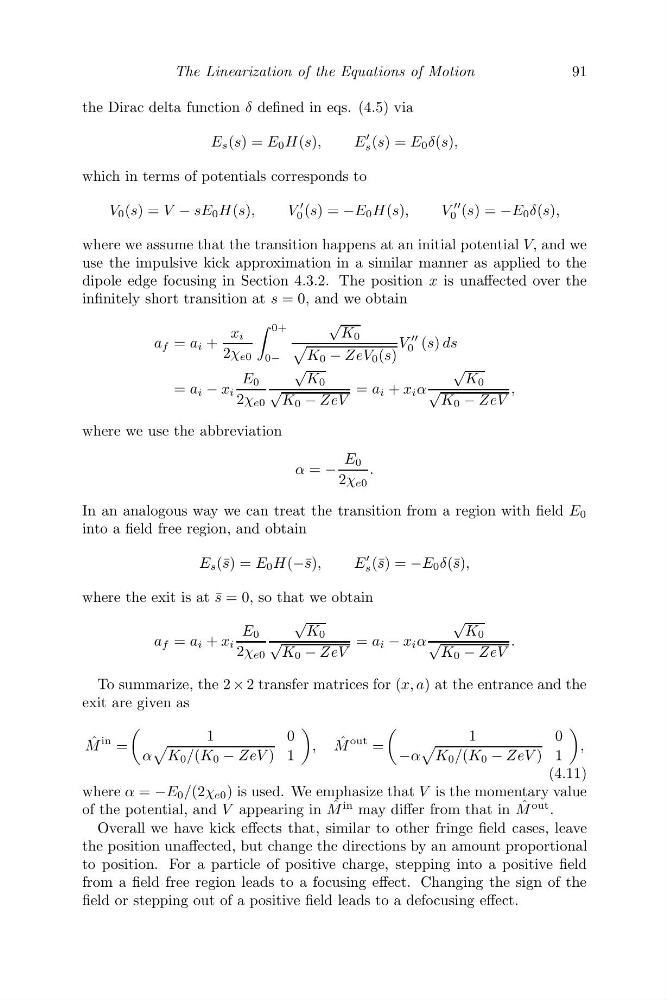
the Dirac delta function δ defined in eqs. (4.5) via
E s (s) = E 0 H(s),
E
s (s) = E 0 δ(s),
which in terms of potentials corresponds to
V 0 (s) = V − sE 0 H(s),
V
0 (s) = −E 0 H(s),
V
0 (s) = −E 0 δ(s),
where we assume that the transition happens at an initial potential V, and we
use the impulsive kick approximation in a similar manner as applied to the
dipole edge focusing in Section 4.3.2. The position x is unaffected over the
infinitely short transition at s = 0, and we obtain
a f = a i +
x i
2χ e0
0+
0−
√
K 0
K 0 − ZeV 0 (s)
V
0 (s) ds
= a i − x i
E 0
2χ e0
√
K 0
√
K 0 − ZeV
= a i + x i α
√
K 0
√
K 0 − ZeV
,
where we use the abbreviation
α = −
E 0
2χ e0
.
In an analogous way we can treat the transition from a region with field E 0
into a field free region, and obtain
E s (¯ s) = E 0 H(−¯ s),
E
s (¯ s) = −E 0 δ(¯ s),
where the exit is at ¯
s = 0, so that we obtain
a f = a i + x i
E 0
2χ e0
√
K 0
√
K 0 − ZeV
= a i − x i α
√
K 0
√
K 0 − ZeV
.
To summarize, the 2 × 2 transfer matrices for (x, a) at the entrance and the
exit are given as
ˆ
M
in =
1
0
α
K 0 /(K 0 − ZeV ) 1
,
ˆ
M
out =
1
0
−α
K 0 /(K 0 − ZeV ) 1
,
(4.11)
where α = −E 0 /(2χ e0 ) is used. We emphasize that V is the momentary value
of the potential, and V appearing in ˆ
M
in may differ from that in ˆ
M
out .
Overall we have kick effects that, similar to other fringe field cases, leave
the position unaffected, but change the directions by an amount proportional
to position. For a particle of positive charge, stepping into a positive field
from a field free region leads to a focusing effect. Changing the sign of the
field or stepping out of a positive field leads to a defocusing effect.
91
the Dirac delta function δ defined in eqs. (4.5) via
E s (s) = E 0 H(s),
E
s (s) = E 0 δ(s),
which in terms of potentials corresponds to
V 0 (s) = V − sE 0 H(s),
V
0 (s) = −E 0 H(s),
V
0 (s) = −E 0 δ(s),
where we assume that the transition happens at an initial potential V, and we
use the impulsive kick approximation in a similar manner as applied to the
dipole edge focusing in Section 4.3.2. The position x is unaffected over the
infinitely short transition at s = 0, and we obtain
a f = a i +
x i
2χ e0
0+
0−
√
K 0
K 0 − ZeV 0 (s)
V
0 (s) ds
= a i − x i
E 0
2χ e0
√
K 0
√
K 0 − ZeV
= a i + x i α
√
K 0
√
K 0 − ZeV
,
where we use the abbreviation
α = −
E 0
2χ e0
.
In an analogous way we can treat the transition from a region with field E 0
into a field free region, and obtain
E s (¯ s) = E 0 H(−¯ s),
E
s (¯ s) = −E 0 δ(¯ s),
where the exit is at ¯
s = 0, so that we obtain
a f = a i + x i
E 0
2χ e0
√
K 0
√
K 0 − ZeV
= a i − x i α
√
K 0
√
K 0 − ZeV
.
To summarize, the 2 × 2 transfer matrices for (x, a) at the entrance and the
exit are given as
ˆ
M
in =
1
0
α
K 0 /(K 0 − ZeV ) 1
,
ˆ
M
out =
1
0
−α
K 0 /(K 0 − ZeV ) 1
,
(4.11)
where α = −E 0 /(2χ e0 ) is used. We emphasize that V is the momentary value
of the potential, and V appearing in ˆ
M
in may differ from that in ˆ
M
out .
Overall we have kick effects that, similar to other fringe field cases, leave
the position unaffected, but change the directions by an amount proportional
to position. For a particle of positive charge, stepping into a positive field
from a field free region leads to a focusing effect. Changing the sign of the
field or stepping out of a positive field leads to a defocusing effect.