

90
An Introduction to Beam Physics
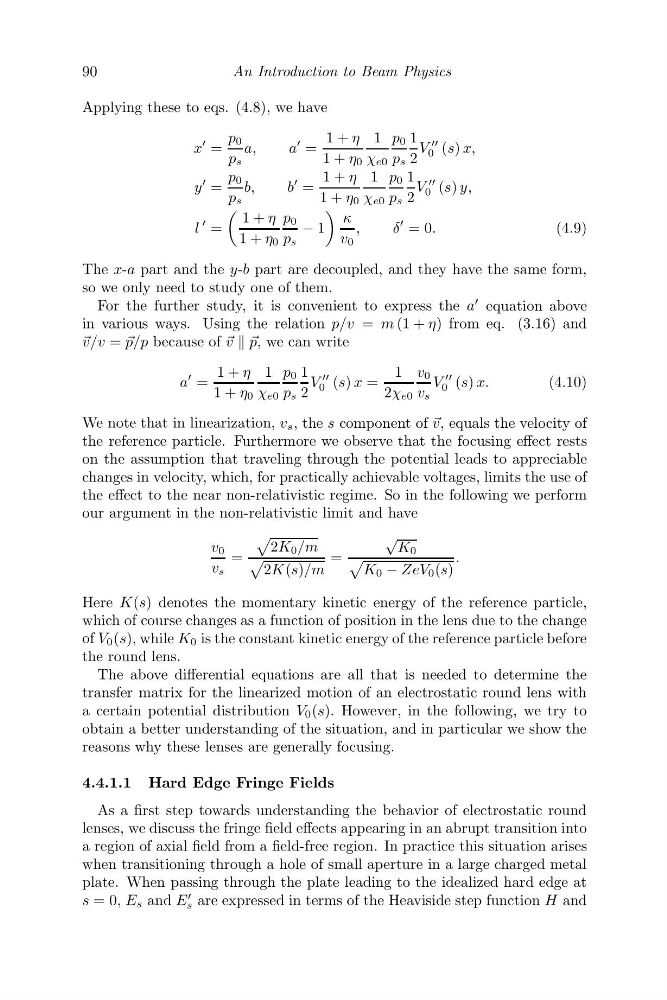
Applying these to eqs. (4.8), we have
x
=
p 0
p s
a,
a
=
1 + η
1 + η 0
1
χ e0
p 0
p s
1
2
V
0 (s) x,
y
=
p 0
p s
b,
b
=
1 + η
1 + η 0
1
χ e0
p 0
p s
1
2
V
0 (s) y,
l
=
1 + η
1 + η 0
p 0
p s
− 1
κ
v 0
,
δ
= 0.
(4.9)
The x-a part and the y-b part are decoupled, and they have the same form,
so we only need to study one of them.
For the further study, it is convenient to express the a
equation above
in various ways. Using the relation p/v = m (1 + η) from eq. (3.16) and
v/v =
p/p because of v
p, we can write
a
=
1 + η
1 + η 0
1
χ e0
p 0
p s
1
2
V
0 (s) x =
1
2χ e0
v 0
v s
V
0 (s) x.
(4.10)
We note that in linearization, v s , the s component of v, equals the velocity of
the reference particle. Furthermore we observe that the focusing effect rests
on the assumption that traveling through the potential leads to appreciable
changes in velocity, which, for practically achievable voltages, limits the use of
the effect to the near non-relativistic regime. So in the following we perform
our argument in the non-relativistic limit and have
v 0
v s
=
2K 0 /m
2K(s)/m
=
√
K 0
K 0 − ZeV 0 (s)
.
Here K(s) denotes the momentary kinetic energy of the reference particle,
which of course changes as a function of position in the lens due to the change
of V 0 (s), while K 0 is the constant kinetic energy of the reference particle before
the round lens.
The above differential equations are all that is needed to determine the
transfer matrix for the linearized motion of an electrostatic round lens with
a certain potential distribution V 0 (s). However, in the following, we try to
obtain a better understanding of the situation, and in particular we show the
reasons why these lenses are generally focusing.
4.4.1.1 Hard Edge Fringe Fields
As a first step towards understanding the behavior of electrostatic round
lenses, we discuss the fringe field effects appearing in an abrupt transition into
a region of axial field from a field-free region. In practice this situation arises
when transitioning through a hole of small aperture in a large charged metal
plate. When passing through the plate leading to the idealized hard edge at
s = 0, E s and E
s are expressed in terms of the Heaviside step function H and
An Introduction to Beam Physics
Applying these to eqs. (4.8), we have
x
=
p 0
p s
a,
a
=
1 + η
1 + η 0
1
χ e0
p 0
p s
1
2
V
0 (s) x,
y
=
p 0
p s
b,
b
=
1 + η
1 + η 0
1
χ e0
p 0
p s
1
2
V
0 (s) y,
l
=
1 + η
1 + η 0
p 0
p s
− 1
κ
v 0
,
δ
= 0.
(4.9)
The x-a part and the y-b part are decoupled, and they have the same form,
so we only need to study one of them.
For the further study, it is convenient to express the a
equation above
in various ways. Using the relation p/v = m (1 + η) from eq. (3.16) and
v/v =
p/p because of v
p, we can write
a
=
1 + η
1 + η 0
1
χ e0
p 0
p s
1
2
V
0 (s) x =
1
2χ e0
v 0
v s
V
0 (s) x.
(4.10)
We note that in linearization, v s , the s component of v, equals the velocity of
the reference particle. Furthermore we observe that the focusing effect rests
on the assumption that traveling through the potential leads to appreciable
changes in velocity, which, for practically achievable voltages, limits the use of
the effect to the near non-relativistic regime. So in the following we perform
our argument in the non-relativistic limit and have
v 0
v s
=
2K 0 /m
2K(s)/m
=
√
K 0
K 0 − ZeV 0 (s)
.
Here K(s) denotes the momentary kinetic energy of the reference particle,
which of course changes as a function of position in the lens due to the change
of V 0 (s), while K 0 is the constant kinetic energy of the reference particle before
the round lens.
The above differential equations are all that is needed to determine the
transfer matrix for the linearized motion of an electrostatic round lens with
a certain potential distribution V 0 (s). However, in the following, we try to
obtain a better understanding of the situation, and in particular we show the
reasons why these lenses are generally focusing.
4.4.1.1 Hard Edge Fringe Fields
As a first step towards understanding the behavior of electrostatic round
lenses, we discuss the fringe field effects appearing in an abrupt transition into
a region of axial field from a field-free region. In practice this situation arises
when transitioning through a hole of small aperture in a large charged metal
plate. When passing through the plate leading to the idealized hard edge at
s = 0, E s and E
s are expressed in terms of the Heaviside step function H and