

92
An Introduction to Beam Physics
4.4.1.2 The Mechanism of Focusing
We now consider in a very general manner the situation of a weak or short
electrostatic lens. We observe that in eq. (4.7), one important effect has been
neglected, namely the fact that the particle necessarily gains and loses energy
as it travels through the lens. As a matter of fact, any transverse field bends a
particle more readily when it is applied where the particle has lower velocity.
Consider a weak lens that consists of a potential that in the region from
−S to +S is first constant, then rises, then plateaus, and then falls off to its
original constant value, similar to the case shown on the right in Fig. 3.3.
Necessarily the regions of positive second derivative appear near the minima
of the potential function, while the regions of negative second derivative correspond to maxima of the potential function. So while traveling through the
lens, the particle is more sensitive to the focusing fields than to the defocusing
fields; and even though the focusing and defocusing portions cancel, the net
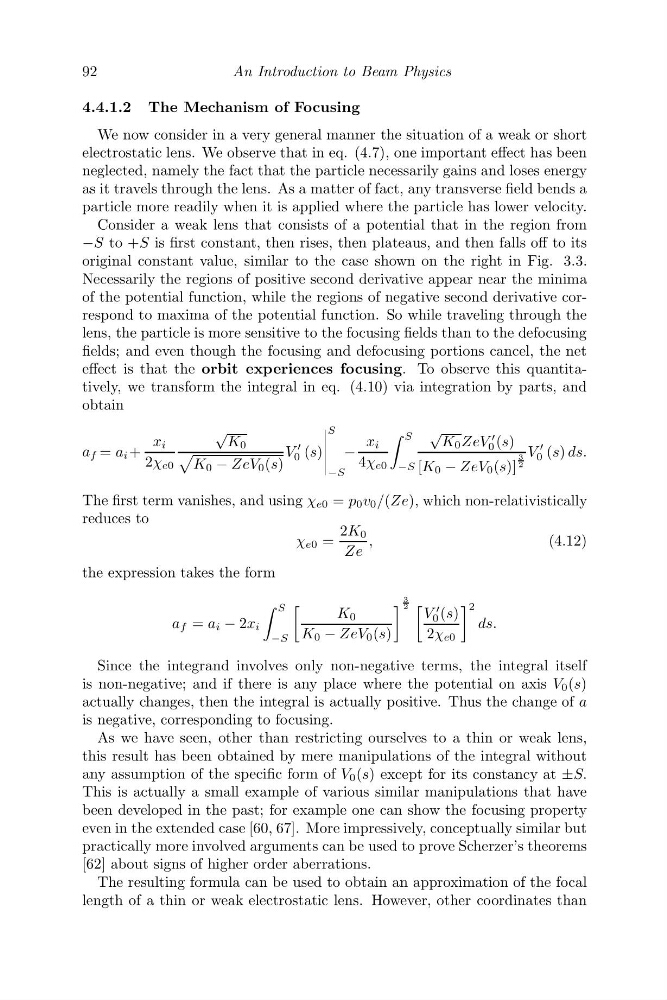
effect is that the orbit experiences focusing. To observe this quantitatively, we transform the integral in eq. (4.10) via integration by parts, and
obtain
a f = a i +
x i
2χ e0
√
K 0
K 0 − ZeV 0 (s)
V
0 (s)
S
−S
−
x i
4χ e0
S
−S
√
K 0 ZeV
0 (s)
[K 0 − ZeV 0 (s)]
3
2
V
0 (s) ds.
The first term vanishes, and using χ e0 = p 0 v 0 /(Ze), which non-relativistically
reduces to
χ e0 =
2K 0
Ze
,
(4.12)
the expression takes the form
a f = a i − 2x i
S
−S
K 0
K 0 − ZeV 0 (s)
3
2
V
0 (s)
2χ e0
2
ds.
Since the integrand involves only non-negative terms, the integral itself
is non-negative; and if there is any place where the potential on axis V 0 (s)
actually changes, then the integral is actually positive. Thus the change of a
is negative, corresponding to focusing.
As we have seen, other than restricting ourselves to a thin or weak lens,
this result has been obtained by mere manipulations of the integral without
any assumption of the specific form of V 0 (s) except for its constancy at ±S.
This is actually a small example of various similar manipulations that have
been developed in the past; for example one can show the focusing property
even in the extended case [60, 67]. More impressively, conceptually similar but
practically more involved arguments can be used to prove Scherzer’s theorems
[62] about signs of higher order aberrations.
The resulting formula can be used to obtain an approximation of the focal
length of a thin or weak electrostatic lens. However, other coordinates than
An Introduction to Beam Physics
4.4.1.2 The Mechanism of Focusing
We now consider in a very general manner the situation of a weak or short
electrostatic lens. We observe that in eq. (4.7), one important effect has been
neglected, namely the fact that the particle necessarily gains and loses energy
as it travels through the lens. As a matter of fact, any transverse field bends a
particle more readily when it is applied where the particle has lower velocity.
Consider a weak lens that consists of a potential that in the region from
−S to +S is first constant, then rises, then plateaus, and then falls off to its
original constant value, similar to the case shown on the right in Fig. 3.3.
Necessarily the regions of positive second derivative appear near the minima
of the potential function, while the regions of negative second derivative correspond to maxima of the potential function. So while traveling through the
lens, the particle is more sensitive to the focusing fields than to the defocusing
fields; and even though the focusing and defocusing portions cancel, the net
effect is that the orbit experiences focusing. To observe this quantitatively, we transform the integral in eq. (4.10) via integration by parts, and
obtain
a f = a i +
x i
2χ e0
√
K 0
K 0 − ZeV 0 (s)
V
0 (s)
S
−S
−
x i
4χ e0
S
−S
√
K 0 ZeV
0 (s)
[K 0 − ZeV 0 (s)]
3
2
V
0 (s) ds.
The first term vanishes, and using χ e0 = p 0 v 0 /(Ze), which non-relativistically
reduces to
χ e0 =
2K 0
Ze
,
(4.12)
the expression takes the form
a f = a i − 2x i
S
−S
K 0
K 0 − ZeV 0 (s)
3
2
V
0 (s)
2χ e0
2
ds.
Since the integrand involves only non-negative terms, the integral itself
is non-negative; and if there is any place where the potential on axis V 0 (s)
actually changes, then the integral is actually positive. Thus the change of a
is negative, corresponding to focusing.
As we have seen, other than restricting ourselves to a thin or weak lens,
this result has been obtained by mere manipulations of the integral without
any assumption of the specific form of V 0 (s) except for its constancy at ±S.
This is actually a small example of various similar manipulations that have
been developed in the past; for example one can show the focusing property
even in the extended case [60, 67]. More impressively, conceptually similar but
practically more involved arguments can be used to prove Scherzer’s theorems
[62] about signs of higher order aberrations.
The resulting formula can be used to obtain an approximation of the focal
length of a thin or weak electrostatic lens. However, other coordinates than