

174 Damage to concrete structures
Penetration of chloride ions by capillary suction proceeds much faster
than by diffusion. Capillary suction typically occurs in an outer layer of
about 20 mm. This means that due to capillary suction, water containing
chloride ions can very quickly reach a penetration depth of about 20 mm.
From this capillary boundary on, chloride ions will typically further penetrate the concrete by diffusion. From a practical point of view, the diffusion process of chloride ions is governed by the same equations as for
carbon dioxide. Fick’s second law can be applied, showing that the chloride
diffusion process, in the case of a constant diffusion coefficient, also follows a square root time relation.
Similar to the diffusion of carbon dioxide, in the case of chloride ions
additional processes will also influence the diffusion process. Chlorides will
be bound in hydration products, e.g. forming Friedel’s salts 3CaO · Al 2 O 3 ·
CaCl 2 · 10H 2 O in concrete based on C 3 A-rich cement. While the aluminate
phases play the most important role in chloride binding in concrete, other
phases can also contribute. Binding of chloride in cementitious materials is
a very complex process which is affected by many factors, including chloride concentration, cement composition, hydroxyl concentration, cation of
chloride salt, temperature, and electrical field (Yuan et al. 2009). Previous
carbonation of the concrete is also important in this respect, reducing the
chloride-binding capacity.
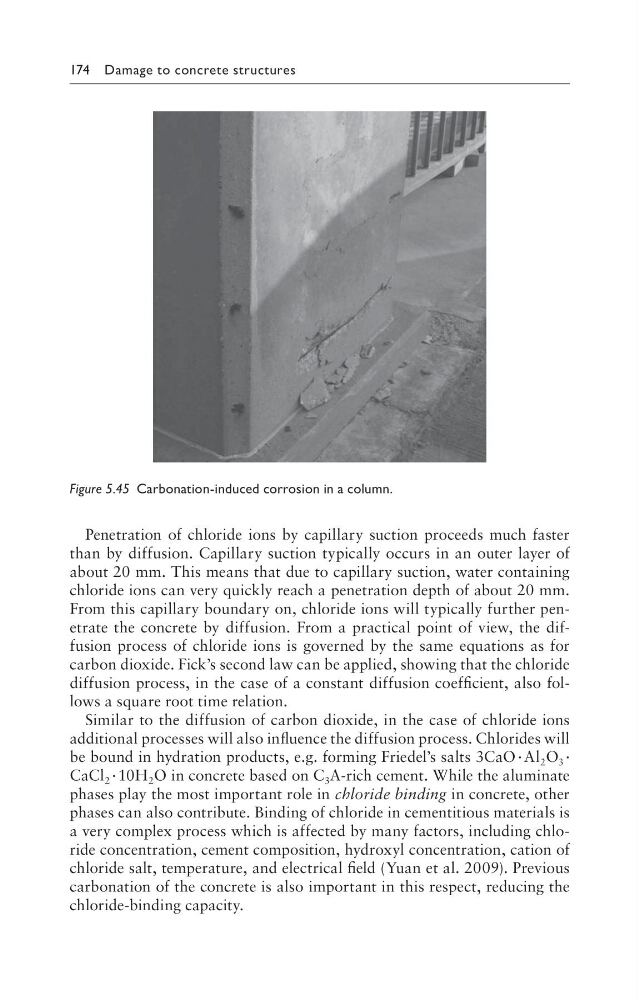
Figure 5.45 Carbonation-induced corrosion in a column.
Penetration of chloride ions by capillary suction proceeds much faster
than by diffusion. Capillary suction typically occurs in an outer layer of
about 20 mm. This means that due to capillary suction, water containing
chloride ions can very quickly reach a penetration depth of about 20 mm.
From this capillary boundary on, chloride ions will typically further penetrate the concrete by diffusion. From a practical point of view, the diffusion process of chloride ions is governed by the same equations as for
carbon dioxide. Fick’s second law can be applied, showing that the chloride
diffusion process, in the case of a constant diffusion coefficient, also follows a square root time relation.
Similar to the diffusion of carbon dioxide, in the case of chloride ions
additional processes will also influence the diffusion process. Chlorides will
be bound in hydration products, e.g. forming Friedel’s salts 3CaO · Al 2 O 3 ·
CaCl 2 · 10H 2 O in concrete based on C 3 A-rich cement. While the aluminate
phases play the most important role in chloride binding in concrete, other
phases can also contribute. Binding of chloride in cementitious materials is
a very complex process which is affected by many factors, including chloride concentration, cement composition, hydroxyl concentration, cation of
chloride salt, temperature, and electrical field (Yuan et al. 2009). Previous
carbonation of the concrete is also important in this respect, reducing the
chloride-binding capacity.
Figure 5.45 Carbonation-induced corrosion in a column.