

Actions during service 175
It is also important to notice that following Fick’s second law, diffusing chloride ions are treated as electrically neutral particles travelling in
pore solution without the influence of other species. Nevertheless, chloride ions have a negative charge and, thus, a movement of chloride ions
will be accompanied by a movement of some positive ions in the opposite
direction. As a consequence, the cation type of chloride salt influences the
chloride diffusion coefficient. Furthermore, the many types of ions present in the pore solution (Na + , K + , SO 4
2− , OH − , …) will also influence the
diffusion process of chloride ions. In a more accurate chloride-transport
model, the chloride ions should be treated as negative particles and the
interaction with other ions has to be taken into account. For this kind of
more advanced chloride-transport models, reference is made to literature
(Yuan 2009).
Although the practically applied square root time relation is based on
a constant diffusion coefficient, in reality, a time dependency exists and
is often expressed in the following way with D(t) the diffusion coefficient
at time t, and D ref the diffusion coefficient at reference time t ref (Audenaert
et al. 2010):
D t
D
t
t
ref
ref
m
( ) =
(5.25)
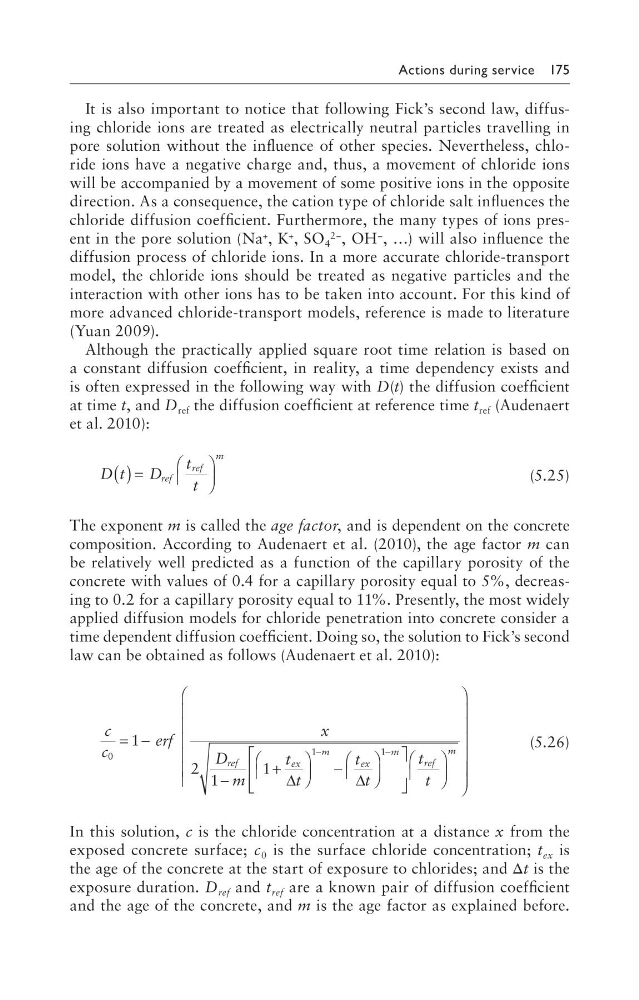
The exponent m is called the age factor, and is dependent on the concrete
composition. According to Audenaert et al. (2010), the age factor m can
be relatively well predicted as a function of the capillary porosity of the
concrete with values of 0.4 for a capillary porosity equal to 5%, decreasing to 0.2 for a capillary porosity equal to 11%. Presently, the most widely
applied diffusion models for chloride penetration into concrete consider a
time dependent diffusion coefficient. Doing so, the solution to Fick’s second
law can be obtained as follows (Audenaert et al. 2010):
c
c
erf
x
D
m
t
t
t
t
ref
ex
m
ex
0
1
1
2 1
1
= −
−
+
−
−
∆
∆
−
1 m
ref
m
t
t
(5.26)
In this solution, c is the chloride concentration at a distance x from the
exposed concrete surface; c 0 is the surface chloride concentration; t ex is
the age of the concrete at the start of exposure to chlorides; and Δt is the
exposure duration. D ref and t ref are a known pair of diffusion coefficient
and the age of the concrete, and m is the age factor as explained before.
It is also important to notice that following Fick’s second law, diffusing chloride ions are treated as electrically neutral particles travelling in
pore solution without the influence of other species. Nevertheless, chloride ions have a negative charge and, thus, a movement of chloride ions
will be accompanied by a movement of some positive ions in the opposite
direction. As a consequence, the cation type of chloride salt influences the
chloride diffusion coefficient. Furthermore, the many types of ions present in the pore solution (Na + , K + , SO 4
2− , OH − , …) will also influence the
diffusion process of chloride ions. In a more accurate chloride-transport
model, the chloride ions should be treated as negative particles and the
interaction with other ions has to be taken into account. For this kind of
more advanced chloride-transport models, reference is made to literature
(Yuan 2009).
Although the practically applied square root time relation is based on
a constant diffusion coefficient, in reality, a time dependency exists and
is often expressed in the following way with D(t) the diffusion coefficient
at time t, and D ref the diffusion coefficient at reference time t ref (Audenaert
et al. 2010):
D t
D
t
t
ref
ref
m
( ) =
(5.25)
The exponent m is called the age factor, and is dependent on the concrete
composition. According to Audenaert et al. (2010), the age factor m can
be relatively well predicted as a function of the capillary porosity of the
concrete with values of 0.4 for a capillary porosity equal to 5%, decreasing to 0.2 for a capillary porosity equal to 11%. Presently, the most widely
applied diffusion models for chloride penetration into concrete consider a
time dependent diffusion coefficient. Doing so, the solution to Fick’s second
law can be obtained as follows (Audenaert et al. 2010):
c
c
erf
x
D
m
t
t
t
t
ref
ex
m
ex
0
1
1
2 1
1
= −
−
+
−
−
∆
∆
−
1 m
ref
m
t
t
(5.26)
In this solution, c is the chloride concentration at a distance x from the
exposed concrete surface; c 0 is the surface chloride concentration; t ex is
the age of the concrete at the start of exposure to chlorides; and Δt is the
exposure duration. D ref and t ref are a known pair of diffusion coefficient
and the age of the concrete, and m is the age factor as explained before.