

Actions during service 171
In real concrete, steady-state conditions are not reached, as the carbon
dioxide concentration is a function of time. This has to be considered by
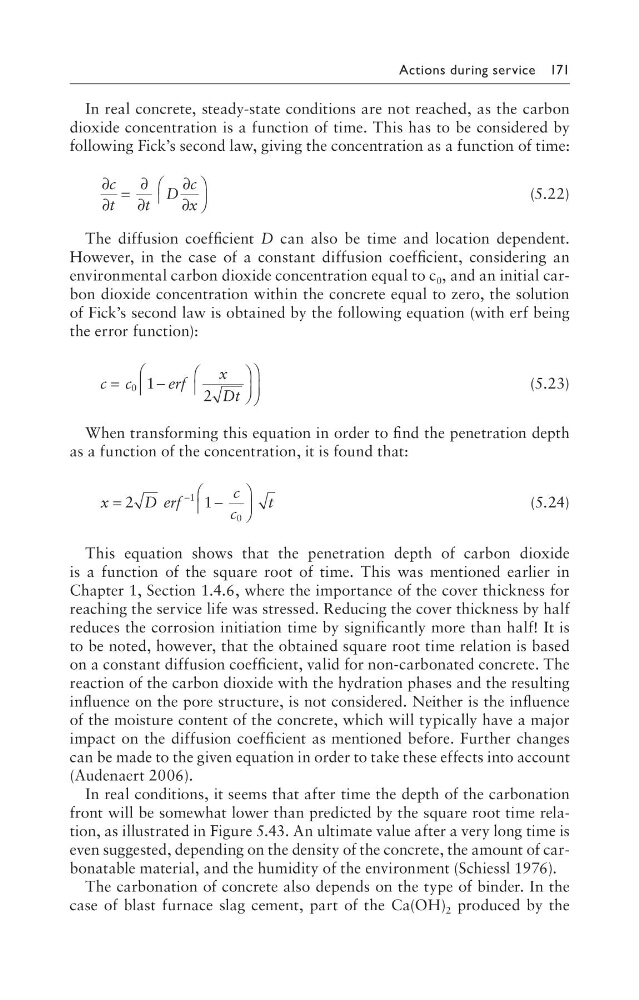
following Fick’s second law, giving the concentration as a function of time:
∂
∂
=
∂
∂
∂
∂
c
t
t
c
x
D
(5.22)
The diffusion coefficient D can also be time and location dependent.
However, in the case of a constant diffusion coefficient, considering an
environmental carbon dioxide concentration equal to c 0 , and an initial carbon dioxide concentration within the concrete equal to zero, the solution
of Fick’s second law is obtained by the following equation (with erf being
the error function):
c c
erf
x
Dt
=
−
0 1
2
(5.23)
When transforming this equation in order to find the penetration depth
as a function of the concentration, it is found that:
x
D erf
c
c
t
=
−
−
2
1
1
0
(5.24)
This equation shows that the penetration depth of carbon dioxide
is a function of the square root of time. This was mentioned earlier in
Chapter 1, Section 1.4.6, where the importance of the cover thickness for
reaching the service life was stressed. Reducing the cover thickness by half
reduces the corrosion initiation time by significantly more than half! It is
to be noted, however, that the obtained square root time relation is based
on a constant diffusion coefficient, valid for non-carbonated concrete. The
reaction of the carbon dioxide with the hydration phases and the resulting
influence on the pore structure, is not considered. Neither is the influence
of the moisture content of the concrete, which will typically have a major
impact on the diffusion coefficient as mentioned before. Further changes
can be made to the given equation in order to take these effects into account
(Audenaert 2006).
In real conditions, it seems that after time the depth of the carbonation
front will be somewhat lower than predicted by the square root time relation, as illustrated in Figure 5.43. An ultimate value after a very long time is
even suggested, depending on the density of the concrete, the amount of carbonatable material, and the humidity of the environment (Schiessl 1976).
The carbonation of concrete also depends on the type of binder. In the
case of blast furnace slag cement, part of the Ca(OH) 2 produced by the
In real concrete, steady-state conditions are not reached, as the carbon
dioxide concentration is a function of time. This has to be considered by
following Fick’s second law, giving the concentration as a function of time:
∂
∂
=
∂
∂
∂
∂
c
t
t
c
x
D
(5.22)
The diffusion coefficient D can also be time and location dependent.
However, in the case of a constant diffusion coefficient, considering an
environmental carbon dioxide concentration equal to c 0 , and an initial carbon dioxide concentration within the concrete equal to zero, the solution
of Fick’s second law is obtained by the following equation (with erf being
the error function):
c c
erf
x
Dt
=
−
0 1
2
(5.23)
When transforming this equation in order to find the penetration depth
as a function of the concentration, it is found that:
x
D erf
c
c
t
=
−
−
2
1
1
0
(5.24)
This equation shows that the penetration depth of carbon dioxide
is a function of the square root of time. This was mentioned earlier in
Chapter 1, Section 1.4.6, where the importance of the cover thickness for
reaching the service life was stressed. Reducing the cover thickness by half
reduces the corrosion initiation time by significantly more than half! It is
to be noted, however, that the obtained square root time relation is based
on a constant diffusion coefficient, valid for non-carbonated concrete. The
reaction of the carbon dioxide with the hydration phases and the resulting
influence on the pore structure, is not considered. Neither is the influence
of the moisture content of the concrete, which will typically have a major
impact on the diffusion coefficient as mentioned before. Further changes
can be made to the given equation in order to take these effects into account
(Audenaert 2006).
In real conditions, it seems that after time the depth of the carbonation
front will be somewhat lower than predicted by the square root time relation, as illustrated in Figure 5.43. An ultimate value after a very long time is
even suggested, depending on the density of the concrete, the amount of carbonatable material, and the humidity of the environment (Schiessl 1976).
The carbonation of concrete also depends on the type of binder. In the
case of blast furnace slag cement, part of the Ca(OH) 2 produced by the