

170 Damage to concrete structures
it remains passivated. The thickness of the concrete cover thus needs to be
appropriately determined, based on the penetration rate of CO 2 , in order to
protect the steel rebars from corrosion.
One of the main influencing factors in determining the penetration rate
of carbon dioxide is the moisture condition of the concrete. Diffusion of
CO 2 proceeds at a much higher rate (by a factor of about 10,000) in air
than in water. Saturated concrete (e.g. part of quay walls permanently
under water) will hardly carbonate because diffusion of carbon dioxide
in saturated concrete is extremely slow. On the other hand, fully dry concrete will also not carbonate because water is needed for the carbonation
reaction as explained before. Thus, carbonation of concrete depends on
the possibility of penetration by carbon dioxide (which goes faster in dry
conditions) and the ability of carbon dioxide to go into solution as a first
step in the chemical carbonation process (which, of course, is not possible
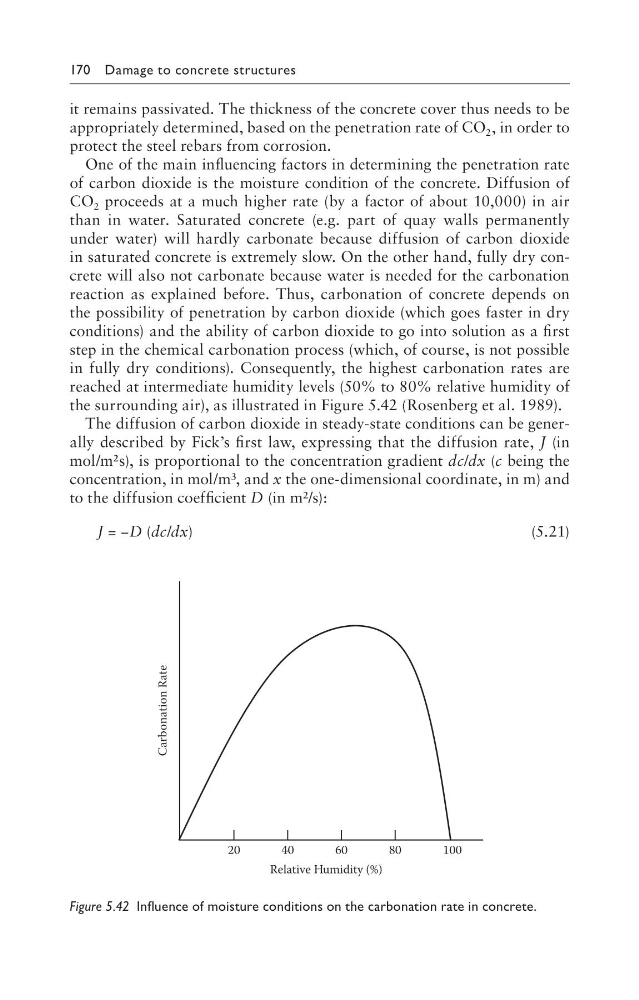
in fully dry conditions). Consequently, the highest carbonation rates are
reached at intermediate humidity levels (50% to 80% relative humidity of
the surrounding air), as illustrated in Figure 5.42 (Rosenberg et al. 1989).
The diffusion of carbon dioxide in steady-state conditions can be generally described by Fick’s first law, expressing that the diffusion rate, J (in
mol/m²s), is proportional to the concentration gradient dc/dx (c being the
concentration, in mol/m³, and x the one-dimensional coordinate, in m) and
to the diffusion coefficient D (in m²/s):
J = −D (dc/dx)
(5.21)
Relative Humidity (%)
100
80
60
40
20
Carbonation Rate
Figure 5.42 Influence of moisture conditions on the carbonation rate in concrete.
it remains passivated. The thickness of the concrete cover thus needs to be
appropriately determined, based on the penetration rate of CO 2 , in order to
protect the steel rebars from corrosion.
One of the main influencing factors in determining the penetration rate
of carbon dioxide is the moisture condition of the concrete. Diffusion of
CO 2 proceeds at a much higher rate (by a factor of about 10,000) in air
than in water. Saturated concrete (e.g. part of quay walls permanently
under water) will hardly carbonate because diffusion of carbon dioxide
in saturated concrete is extremely slow. On the other hand, fully dry concrete will also not carbonate because water is needed for the carbonation
reaction as explained before. Thus, carbonation of concrete depends on
the possibility of penetration by carbon dioxide (which goes faster in dry
conditions) and the ability of carbon dioxide to go into solution as a first
step in the chemical carbonation process (which, of course, is not possible
in fully dry conditions). Consequently, the highest carbonation rates are
reached at intermediate humidity levels (50% to 80% relative humidity of
the surrounding air), as illustrated in Figure 5.42 (Rosenberg et al. 1989).
The diffusion of carbon dioxide in steady-state conditions can be generally described by Fick’s first law, expressing that the diffusion rate, J (in
mol/m²s), is proportional to the concentration gradient dc/dx (c being the
concentration, in mol/m³, and x the one-dimensional coordinate, in m) and
to the diffusion coefficient D (in m²/s):
J = −D (dc/dx)
(5.21)
Relative Humidity (%)
100
80
60
40
20
Carbonation Rate
Figure 5.42 Influence of moisture conditions on the carbonation rate in concrete.