

Actions during service 169
H 2 O + CO 2 (g) → HCO 3
− (aq) + H + (aq)
(5.18)
HCO 3
− (aq) → CO 3
2− (aq) + H + (aq)
(5.19)
Afterwards, a neutralisation reaction will proceed, according to the following reaction, in the case of the carbonation of Ca(OH) 2 :
Ca 2+ (aq) + 2OH − (aq) + 2H + (aq) + CO 3
2− (aq) → CaCO 3 + 2H 2 O
(5.20)
By this chemical reaction, hydroxyl ions will be removed from the pore
solution, reducing the pH value. Furthermore, the formed calcium carbonate, CaCO 3 , which has very low solubility, will precipitate in the pores.
In Portland cement-based systems, the carbonation process will lead to a
reduced porosity of the concrete and further reduce penetration of carbon
dioxide. However, in blended systems, e.g. containing blast furnace slag, an
increased porosity can be noticed due to carbonation.
While at first instance, the penetrating CO 2 reacts with the calcium
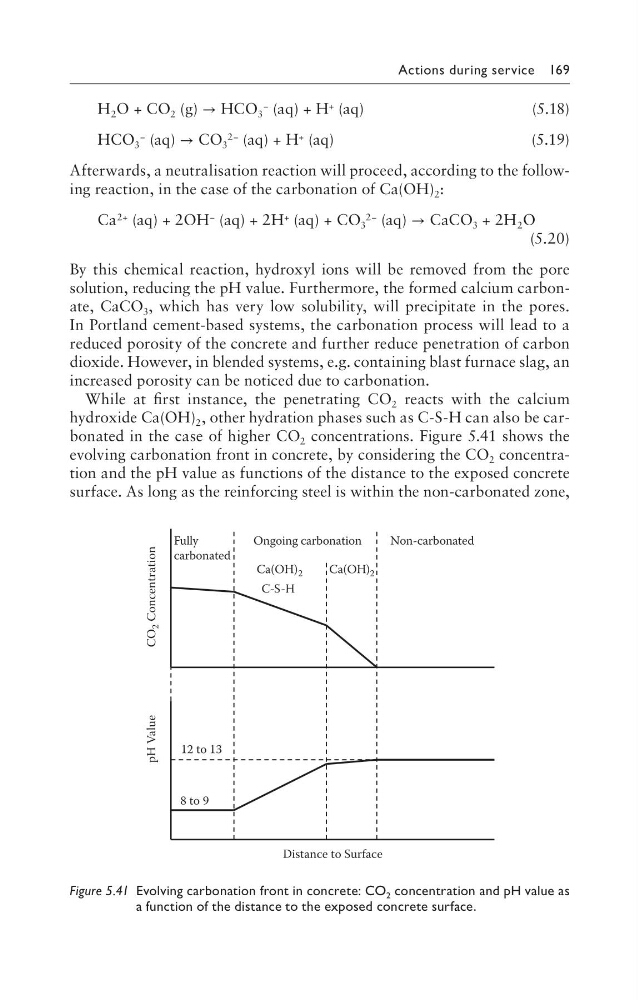
hydroxide Ca(OH) 2 , other hydration phases such as C-S-H can also be carbonated in the case of higher CO 2 concentrations. Figure 5.41 shows the
evolving carbonation front in concrete, by considering the CO 2 concentration and the pH value as functions of the distance to the exposed concrete
surface. As long as the reinforcing steel is within the non-carbonated zone,
Distance to Surface
12 to 13
Fully
carbonated
Non-carbonated
Ongoing carbonation
Ca(OH) 2
C-S-H
Ca(OH) 2
8 to 9
pH Value
CO
2 Concentration
Figure 5.41 Evolving carbonation front in concrete: CO 2 concentration and pH value as
a function of the distance to the exposed concrete surface.
H 2 O + CO 2 (g) → HCO 3
− (aq) + H + (aq)
(5.18)
HCO 3
− (aq) → CO 3
2− (aq) + H + (aq)
(5.19)
Afterwards, a neutralisation reaction will proceed, according to the following reaction, in the case of the carbonation of Ca(OH) 2 :
Ca 2+ (aq) + 2OH − (aq) + 2H + (aq) + CO 3
2− (aq) → CaCO 3 + 2H 2 O
(5.20)
By this chemical reaction, hydroxyl ions will be removed from the pore
solution, reducing the pH value. Furthermore, the formed calcium carbonate, CaCO 3 , which has very low solubility, will precipitate in the pores.
In Portland cement-based systems, the carbonation process will lead to a
reduced porosity of the concrete and further reduce penetration of carbon
dioxide. However, in blended systems, e.g. containing blast furnace slag, an
increased porosity can be noticed due to carbonation.
While at first instance, the penetrating CO 2 reacts with the calcium
hydroxide Ca(OH) 2 , other hydration phases such as C-S-H can also be carbonated in the case of higher CO 2 concentrations. Figure 5.41 shows the
evolving carbonation front in concrete, by considering the CO 2 concentration and the pH value as functions of the distance to the exposed concrete
surface. As long as the reinforcing steel is within the non-carbonated zone,
Distance to Surface
12 to 13
Fully
carbonated
Non-carbonated
Ongoing carbonation
Ca(OH) 2
C-S-H
Ca(OH) 2
8 to 9
pH Value
CO
2 Concentration
Figure 5.41 Evolving carbonation front in concrete: CO 2 concentration and pH value as
a function of the distance to the exposed concrete surface.