

124 Damage to concrete structures
chemical or mineralogical transformations will also occur in the aggregate
particles. At 575°C, quartzite aggregate particles will show a crystal transformation from α-quartz to β-quartz, leading to a volume increase of about
5.7%. Calcareous aggregates, on the other hand, remain stable until 700°C.
Above 700°C, limestone (CaCO 3 ) gets decarbonated, forming calcium
oxide (CaO) and carbon dioxide (CO 2 ). After cooling down, the calcium
oxide (resulting from the decarbonation of limestone and from the decomposition of Ca(OH) 2 in the cement stone) reacts with moisture from the
environment, forming calcium hydroxide (Ca(OH) 2 ). This hydration process leads to a significant volume increase (44%), causing disintegration
of the concrete. This explains why further concrete damage can typically
occur shortly after the fire.
5.2.5.3.2 Interaction between cement matrix and aggregates
While the previous paragraphs explain some transformations and effects
in the cement stone and the aggregate particles separately, the physical
interaction between both phases also has to be duly considered. As mentioned before, the cement paste shrinks due to the loss of free and chemically bound water. On the other hand, the aggregate particles expand due
to thermal dilation and possible mineralogical transformation at higher
TC
SCC01 PPF0
SCC02 PPF0
HPC PPF0
1
2
3
3
2
4
1
4
1200
1000
800
600
400
Temperature (°C)
Weight Loss (%)
200
0
–40
–30
–20
–10
0
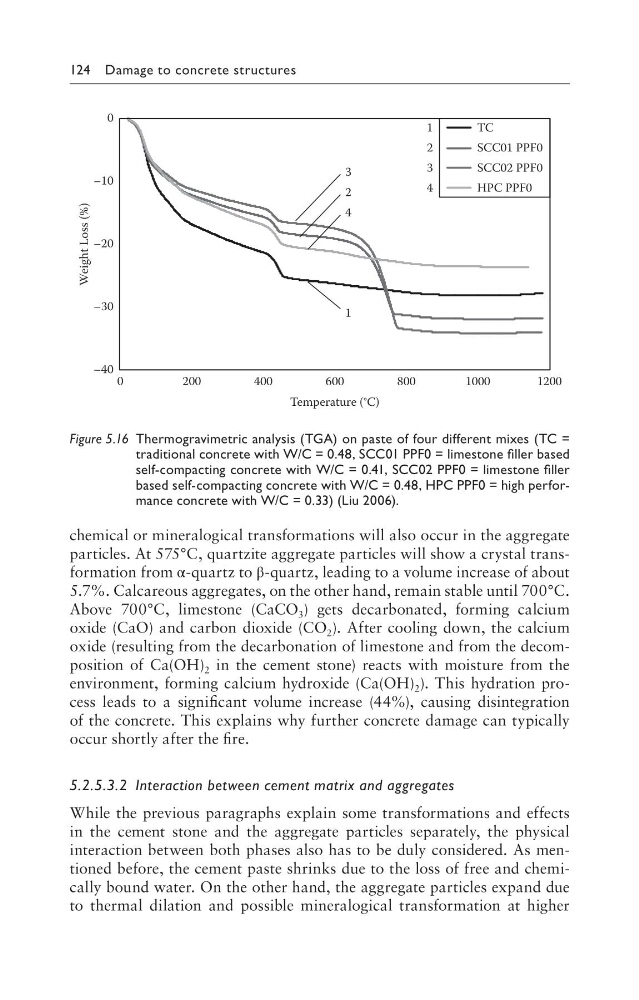
Figure 5.16 Thermogravimetric analysis (TGA) on paste of four different mixes (TC =
traditional concrete with W/C = 0.48, SCC01 PPF0 = limestone filler based
self-compacting concrete with W/C = 0.41, SCC02 PPF0 = limestone filler
based self-compacting concrete with W/C = 0.48, HPC PPF0 = high performance concrete with W/C = 0.33) (Liu 2006).
chemical or mineralogical transformations will also occur in the aggregate
particles. At 575°C, quartzite aggregate particles will show a crystal transformation from α-quartz to β-quartz, leading to a volume increase of about
5.7%. Calcareous aggregates, on the other hand, remain stable until 700°C.
Above 700°C, limestone (CaCO 3 ) gets decarbonated, forming calcium
oxide (CaO) and carbon dioxide (CO 2 ). After cooling down, the calcium
oxide (resulting from the decarbonation of limestone and from the decomposition of Ca(OH) 2 in the cement stone) reacts with moisture from the
environment, forming calcium hydroxide (Ca(OH) 2 ). This hydration process leads to a significant volume increase (44%), causing disintegration
of the concrete. This explains why further concrete damage can typically
occur shortly after the fire.
5.2.5.3.2 Interaction between cement matrix and aggregates
While the previous paragraphs explain some transformations and effects
in the cement stone and the aggregate particles separately, the physical
interaction between both phases also has to be duly considered. As mentioned before, the cement paste shrinks due to the loss of free and chemically bound water. On the other hand, the aggregate particles expand due
to thermal dilation and possible mineralogical transformation at higher
TC
SCC01 PPF0
SCC02 PPF0
HPC PPF0
1
2
3
3
2
4
1
4
1200
1000
800
600
400
Temperature (°C)
Weight Loss (%)
200
0
–40
–30
–20
–10
0
Figure 5.16 Thermogravimetric analysis (TGA) on paste of four different mixes (TC =
traditional concrete with W/C = 0.48, SCC01 PPF0 = limestone filler based
self-compacting concrete with W/C = 0.41, SCC02 PPF0 = limestone filler
based self-compacting concrete with W/C = 0.48, HPC PPF0 = high performance concrete with W/C = 0.33) (Liu 2006).