

Actions during service 123
reduction in strength and stiffness. A summary of the different phenomena
on the material’s level is given in the following paragraphs. Afterward, the
structural behaviour during a fire is also briefly discussed.
5.2.5.3.1 Chemical and mineralogical transformations
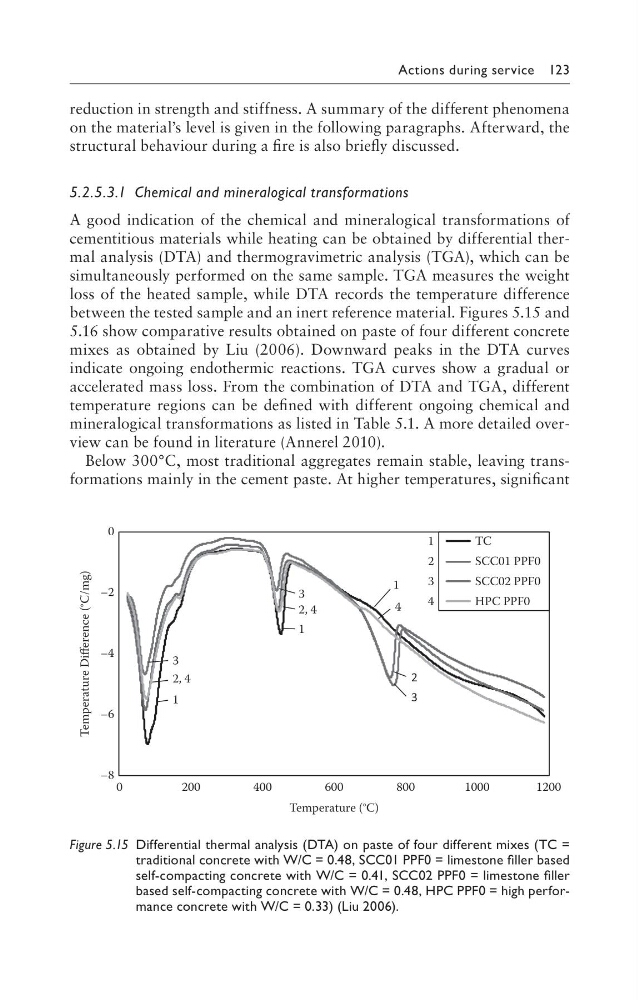
A good indication of the chemical and mineralogical transformations of
cementitious materials while heating can be obtained by differential thermal analysis (DTA) and thermogravimetric analysis (TGA), which can be
simultaneously performed on the same sample. TGA measures the weight
loss of the heated sample, while DTA records the temperature difference
between the tested sample and an inert reference material. Figures 5.15 and
5.16 show comparative results obtained on paste of four different concrete
mixes as obtained by Liu (2006). Downward peaks in the DTA curves
indicate ongoing endothermic reactions. TGA curves show a gradual or
accelerated mass loss. From the combination of DTA and TGA, different
temperature regions can be defined with different ongoing chemical and
mineralogical transformations as listed in Table 5.1. A more detailed overview can be found in literature (Annerel 2010).
Below 300°C, most traditional aggregates remain stable, leaving transformations mainly in the cement paste. At higher temperatures, significant
TC
SCC01 PPF0
SCC02 PPF0
HPC PPF0
1
2
3
4
4
1
3
2, 4
1
3
2, 4
1
1200
1000
800
600
400
Temperature (°C)
Temperature Difference (°C/mg)
200
0
–8
–6
–4
–2
0
Figure 5.15 Differential thermal analysis (DTA) on paste of four different mixes (TC =
traditional concrete with W/C = 0.48, SCC01 PPF0 = limestone filler based
self-compacting concrete with W/C = 0.41, SCC02 PPF0 = limestone filler
based self-compacting concrete with W/C = 0.48, HPC PPF0 = high performance concrete with W/C = 0.33) (Liu 2006).
reduction in strength and stiffness. A summary of the different phenomena
on the material’s level is given in the following paragraphs. Afterward, the
structural behaviour during a fire is also briefly discussed.
5.2.5.3.1 Chemical and mineralogical transformations
A good indication of the chemical and mineralogical transformations of
cementitious materials while heating can be obtained by differential thermal analysis (DTA) and thermogravimetric analysis (TGA), which can be
simultaneously performed on the same sample. TGA measures the weight
loss of the heated sample, while DTA records the temperature difference
between the tested sample and an inert reference material. Figures 5.15 and
5.16 show comparative results obtained on paste of four different concrete
mixes as obtained by Liu (2006). Downward peaks in the DTA curves
indicate ongoing endothermic reactions. TGA curves show a gradual or
accelerated mass loss. From the combination of DTA and TGA, different
temperature regions can be defined with different ongoing chemical and
mineralogical transformations as listed in Table 5.1. A more detailed overview can be found in literature (Annerel 2010).
Below 300°C, most traditional aggregates remain stable, leaving transformations mainly in the cement paste. At higher temperatures, significant
TC
SCC01 PPF0
SCC02 PPF0
HPC PPF0
1
2
3
4
4
1
3
2, 4
1
3
2, 4
1
1200
1000
800
600
400
Temperature (°C)
Temperature Difference (°C/mg)
200
0
–8
–6
–4
–2
0
Figure 5.15 Differential thermal analysis (DTA) on paste of four different mixes (TC =
traditional concrete with W/C = 0.48, SCC01 PPF0 = limestone filler based
self-compacting concrete with W/C = 0.41, SCC02 PPF0 = limestone filler
based self-compacting concrete with W/C = 0.48, HPC PPF0 = high performance concrete with W/C = 0.33) (Liu 2006).