

Social Responsibility in a University Hospital: An Application …
637
overload and other related items are linked to the high turnover, absenteeism, and
rework, which are the main causes of the low productivity and demotivation of
employees (Iida 2005).
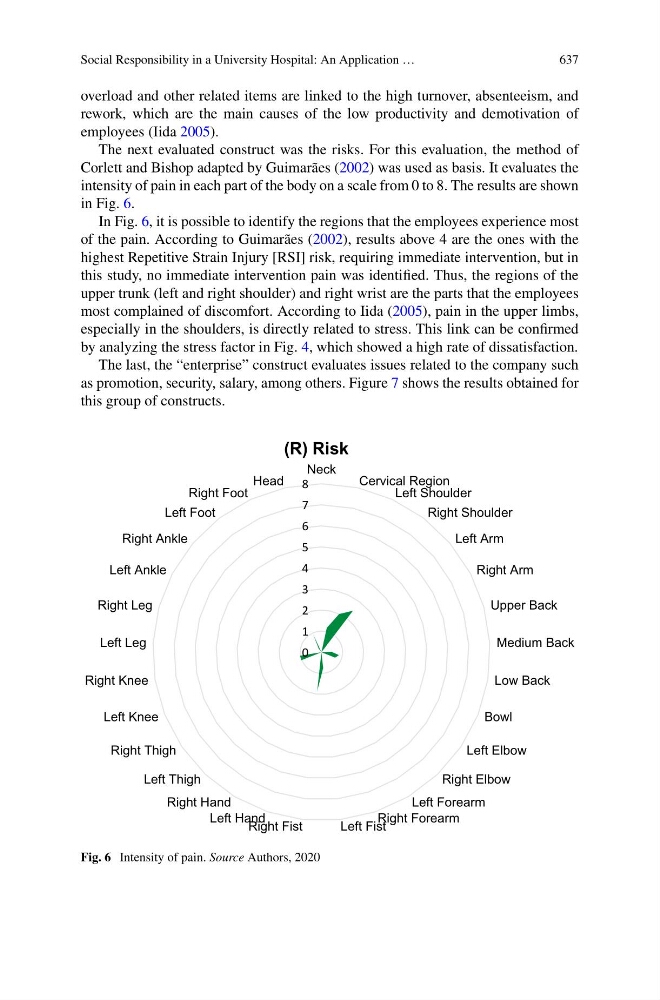
The next evaluated construct was the risks. For this evaluation, the method of
Corlett and Bishop adapted by Guimarães (2002) was used as basis. It evaluates the
intensity of pain in each part of the body on a scale from 0 to 8. The results are shown
in Fig. 6.
In Fig. 6, it is possible to identify the regions that the employees experience most
of the pain. According to Guimarães (2002), results above 4 are the ones with the
highest Repetitive Strain Injury [RSI] risk, requiring immediate intervention, but in
this study, no immediate intervention pain was identified. Thus, the regions of the
upper trunk (left and right shoulder) and right wrist are the parts that the employees
most complained of discomfort. According to Iida (2005), pain in the upper limbs,
especially in the shoulders, is directly related to stress. This link can be confirmed
by analyzing the stress factor in Fig. 4, which showed a high rate of dissatisfaction.
The last, the “enterprise” construct evaluates issues related to the company such
as promotion, security, salary, among others. Figure 7 shows the results obtained for
this group of constructs.
0
1
2
3
4
5
6
7
8
Neck
Cervical Region
Left Shoulder
Right Shoulder
Left Arm
Right Arm
Upper Back
Medium Back
Low Back
Bowl
Left Elbow
Right Elbow
Left Forearm
Right Forearm
Left Fist
Right Fist
Left Hand
Right Hand
Left Thigh
Right Thigh
Left Knee
Right Knee
Left Leg
Right Leg
Left Ankle
Right Ankle
Left Foot
Right Foot
Head
(R) Risk
Fig. 6 Intensity of pain. Source Authors, 2020