

Macroergonomics as a Way for Social Responsibility…
617
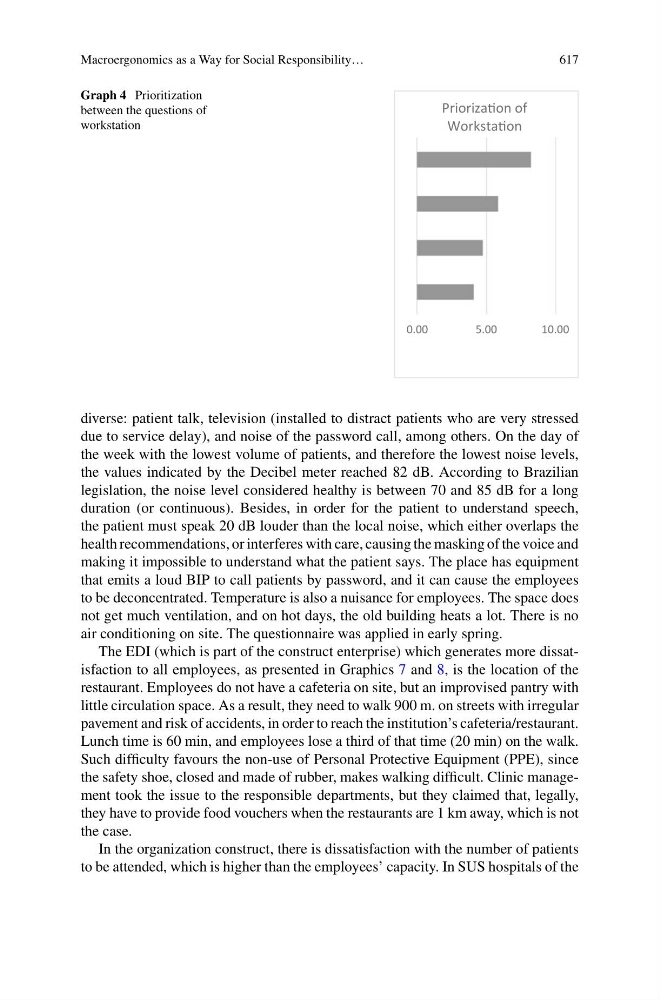
Graph 4 Prioritization
between the questions of
workstation
0.00
5.00
10.00
PriorizaƟon of
WorkstaƟon
diverse: patient talk, television (installed to distract patients who are very stressed
due to service delay), and noise of the password call, among others. On the day of
the week with the lowest volume of patients, and therefore the lowest noise levels,
the values indicated by the Decibel meter reached 82 dB. According to Brazilian
legislation, the noise level considered healthy is between 70 and 85 dB for a long
duration (or continuous). Besides, in order for the patient to understand speech,
the patient must speak 20 dB louder than the local noise, which either overlaps the
health recommendations, or interferes with care, causing the masking of the voice and
making it impossible to understand what the patient says. The place has equipment
that emits a loud BIP to call patients by password, and it can cause the employees
to be deconcentrated. Temperature is also a nuisance for employees. The space does
not get much ventilation, and on hot days, the old building heats a lot. There is no
air conditioning on site. The questionnaire was applied in early spring.
The EDI (which is part of the construct enterprise) which generates more dissatisfaction to all employees, as presented in Graphics 7 and 8, is the location of the
restaurant. Employees do not have a cafeteria on site, but an improvised pantry with
little circulation space. As a result, they need to walk 900 m. on streets with irregular
pavement and risk of accidents, in order to reach the institution’s cafeteria/restaurant.
Lunch time is 60 min, and employees lose a third of that time (20 min) on the walk.
Such difficulty favours the non-use of Personal Protective Equipment (PPE), since
the safety shoe, closed and made of rubber, makes walking difficult. Clinic management took the issue to the responsible departments, but they claimed that, legally,
they have to provide food vouchers when the restaurants are 1 km away, which is not
the case.
In the organization construct, there is dissatisfaction with the number of patients
to be attended, which is higher than the employees’ capacity. In SUS hospitals of the
617
Graph 4 Prioritization
between the questions of
workstation
0.00
5.00
10.00
PriorizaƟon of
WorkstaƟon
diverse: patient talk, television (installed to distract patients who are very stressed
due to service delay), and noise of the password call, among others. On the day of
the week with the lowest volume of patients, and therefore the lowest noise levels,
the values indicated by the Decibel meter reached 82 dB. According to Brazilian
legislation, the noise level considered healthy is between 70 and 85 dB for a long
duration (or continuous). Besides, in order for the patient to understand speech,
the patient must speak 20 dB louder than the local noise, which either overlaps the
health recommendations, or interferes with care, causing the masking of the voice and
making it impossible to understand what the patient says. The place has equipment
that emits a loud BIP to call patients by password, and it can cause the employees
to be deconcentrated. Temperature is also a nuisance for employees. The space does
not get much ventilation, and on hot days, the old building heats a lot. There is no
air conditioning on site. The questionnaire was applied in early spring.
The EDI (which is part of the construct enterprise) which generates more dissatisfaction to all employees, as presented in Graphics 7 and 8, is the location of the
restaurant. Employees do not have a cafeteria on site, but an improvised pantry with
little circulation space. As a result, they need to walk 900 m. on streets with irregular
pavement and risk of accidents, in order to reach the institution’s cafeteria/restaurant.
Lunch time is 60 min, and employees lose a third of that time (20 min) on the walk.
Such difficulty favours the non-use of Personal Protective Equipment (PPE), since
the safety shoe, closed and made of rubber, makes walking difficult. Clinic management took the issue to the responsible departments, but they claimed that, legally,
they have to provide food vouchers when the restaurants are 1 km away, which is not
the case.
In the organization construct, there is dissatisfaction with the number of patients
to be attended, which is higher than the employees’ capacity. In SUS hospitals of the