

48
P. B. Carvalho et al.
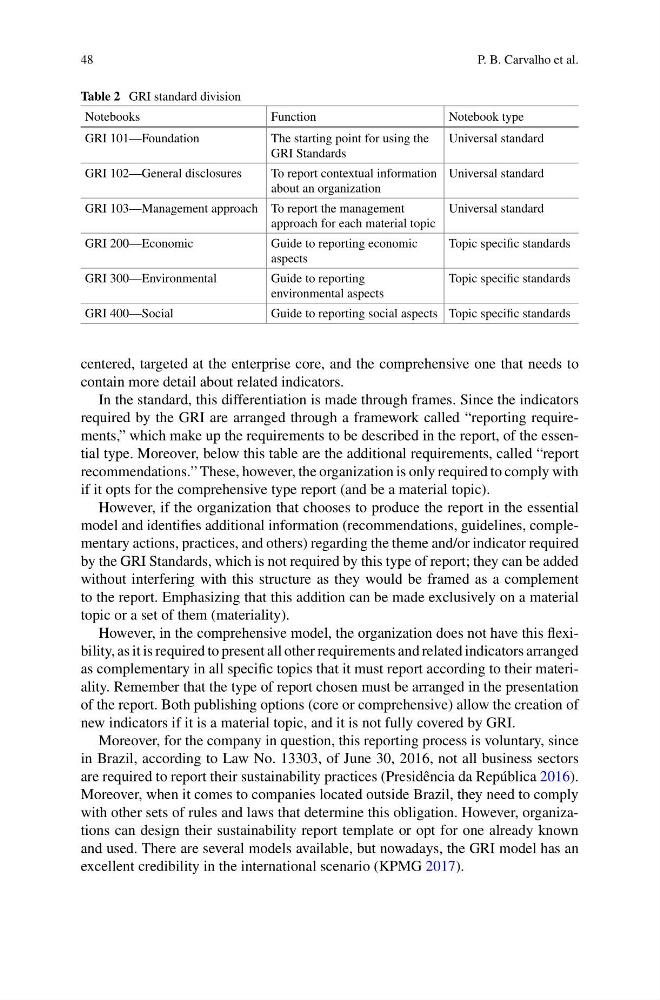
Table 2 GRI standard division
Notebooks
Function
Notebook type
GRI 101—Foundation
The starting point for using the
GRI Standards
Universal standard
GRI 102—General disclosures
To report contextual information
about an organization
Universal standard
GRI 103—Management approach To report the management
approach for each material topic
Universal standard
GRI 200—Economic
Guide to reporting economic
aspects
Topic specific standards
GRI 300—Environmental
Guide to reporting
environmental aspects
Topic specific standards
GRI 400—Social
Guide to reporting social aspects Topic specific standards
centered, targeted at the enterprise core, and the comprehensive one that needs to
contain more detail about related indicators.
In the standard, this differentiation is made through frames. Since the indicators
required by the GRI are arranged through a framework called “reporting requirements,” which make up the requirements to be described in the report, of the essential type. Moreover, below this table are the additional requirements, called “report
recommendations.” These, however, the organization is only required to comply with
if it opts for the comprehensive type report (and be a material topic).
However, if the organization that chooses to produce the report in the essential
model and identifies additional information (recommendations, guidelines, complementary actions, practices, and others) regarding the theme and/or indicator required
by the GRI Standards, which is not required by this type of report; they can be added
without interfering with this structure as they would be framed as a complement
to the report. Emphasizing that this addition can be made exclusively on a material
topic or a set of them (materiality).
However, in the comprehensive model, the organization does not have this flexibility, as it is required to present all other requirements and related indicators arranged
as complementary in all specific topics that it must report according to their materiality. Remember that the type of report chosen must be arranged in the presentation
of the report. Both publishing options (core or comprehensive) allow the creation of
new indicators if it is a material topic, and it is not fully covered by GRI.
Moreover, for the company in question, this reporting process is voluntary, since
in Brazil, according to Law No. 13303, of June 30, 2016, not all business sectors
are required to report their sustainability practices (Presidência da República 2016).
Moreover, when it comes to companies located outside Brazil, they need to comply
with other sets of rules and laws that determine this obligation. However, organizations can design their sustainability report template or opt for one already known
and used. There are several models available, but nowadays, the GRI model has an
excellent credibility in the international scenario (KPMG 2017).
P. B. Carvalho et al.
Table 2 GRI standard division
Notebooks
Function
Notebook type
GRI 101—Foundation
The starting point for using the
GRI Standards
Universal standard
GRI 102—General disclosures
To report contextual information
about an organization
Universal standard
GRI 103—Management approach To report the management
approach for each material topic
Universal standard
GRI 200—Economic
Guide to reporting economic
aspects
Topic specific standards
GRI 300—Environmental
Guide to reporting
environmental aspects
Topic specific standards
GRI 400—Social
Guide to reporting social aspects Topic specific standards
centered, targeted at the enterprise core, and the comprehensive one that needs to
contain more detail about related indicators.
In the standard, this differentiation is made through frames. Since the indicators
required by the GRI are arranged through a framework called “reporting requirements,” which make up the requirements to be described in the report, of the essential type. Moreover, below this table are the additional requirements, called “report
recommendations.” These, however, the organization is only required to comply with
if it opts for the comprehensive type report (and be a material topic).
However, if the organization that chooses to produce the report in the essential
model and identifies additional information (recommendations, guidelines, complementary actions, practices, and others) regarding the theme and/or indicator required
by the GRI Standards, which is not required by this type of report; they can be added
without interfering with this structure as they would be framed as a complement
to the report. Emphasizing that this addition can be made exclusively on a material
topic or a set of them (materiality).
However, in the comprehensive model, the organization does not have this flexibility, as it is required to present all other requirements and related indicators arranged
as complementary in all specific topics that it must report according to their materiality. Remember that the type of report chosen must be arranged in the presentation
of the report. Both publishing options (core or comprehensive) allow the creation of
new indicators if it is a material topic, and it is not fully covered by GRI.
Moreover, for the company in question, this reporting process is voluntary, since
in Brazil, according to Law No. 13303, of June 30, 2016, not all business sectors
are required to report their sustainability practices (Presidência da República 2016).
Moreover, when it comes to companies located outside Brazil, they need to comply
with other sets of rules and laws that determine this obligation. However, organizations can design their sustainability report template or opt for one already known
and used. There are several models available, but nowadays, the GRI model has an
excellent credibility in the international scenario (KPMG 2017).